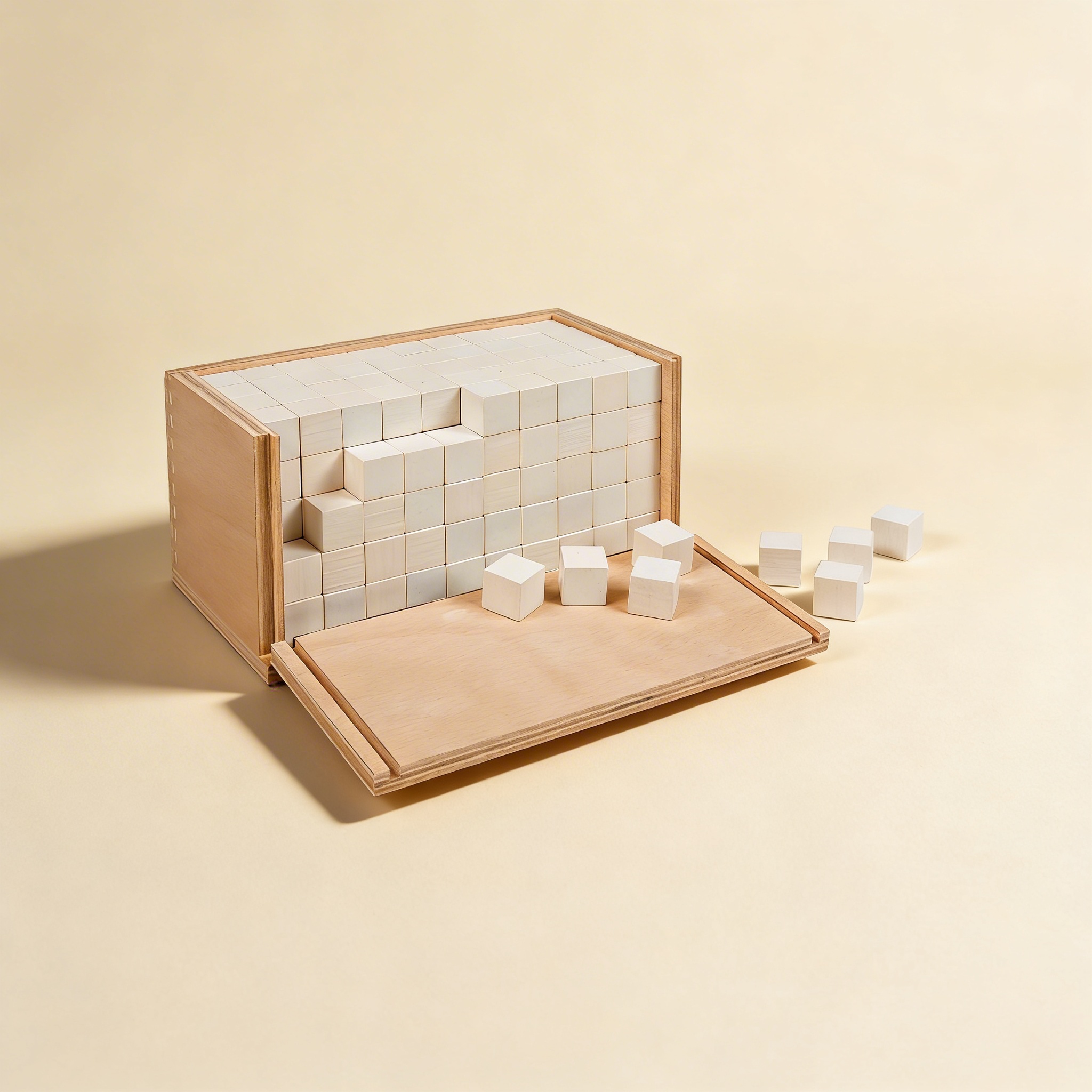
The Volume Box — 250 Unit Cubes for Cubic Volume Exploration is a Sensorial Montessori material designed for children aged 6-12, crafted by Nienhuis Montessori to AMI standards.
This Volume Box with 250 Cubes is an essential Montessori material for exploring cubic volume and mathematical relationships. The hinged wooden storage box contains precisely 250 uniform cubes arranged in organized layers, allowing children to build and measure three-dimensional shapes while developing spatial reasoning and understanding of volume concepts through hands-on manipulation.
“Free the child's potential, and you will transform him into the world.”— Maria MontessoriTo Educate the Human Potential
“Education is a natural process spontaneously carried out by the human individual, and is acquired not by listening to words but by experiences upon the environment.”
— Maria Montessori, Education for a New World
The Volume Box with 250 Cubes embodies Montessori's principle of concrete to abstract learning, where mathematical concepts emerge through sensorial exploration. This material bridges the Sensorial and Mathematics areas, allowing children to physically construct and deconstruct cubic forms to understand volume relationships. Through repeated manipulation of these precision cubes, children develop what Montessori called the 'mathematical mind' - an inherent human tendency to seek order, precision, and patterns. The material's self-correcting nature enables independent discovery of mathematical laws governing three-dimensional space. By building cubes of increasing size (2³, 3³, 4³, 5³), children internalize the concept of cubing numbers through their hands before encountering abstract formulas, creating a deep, embodied understanding of volumetric relationships.
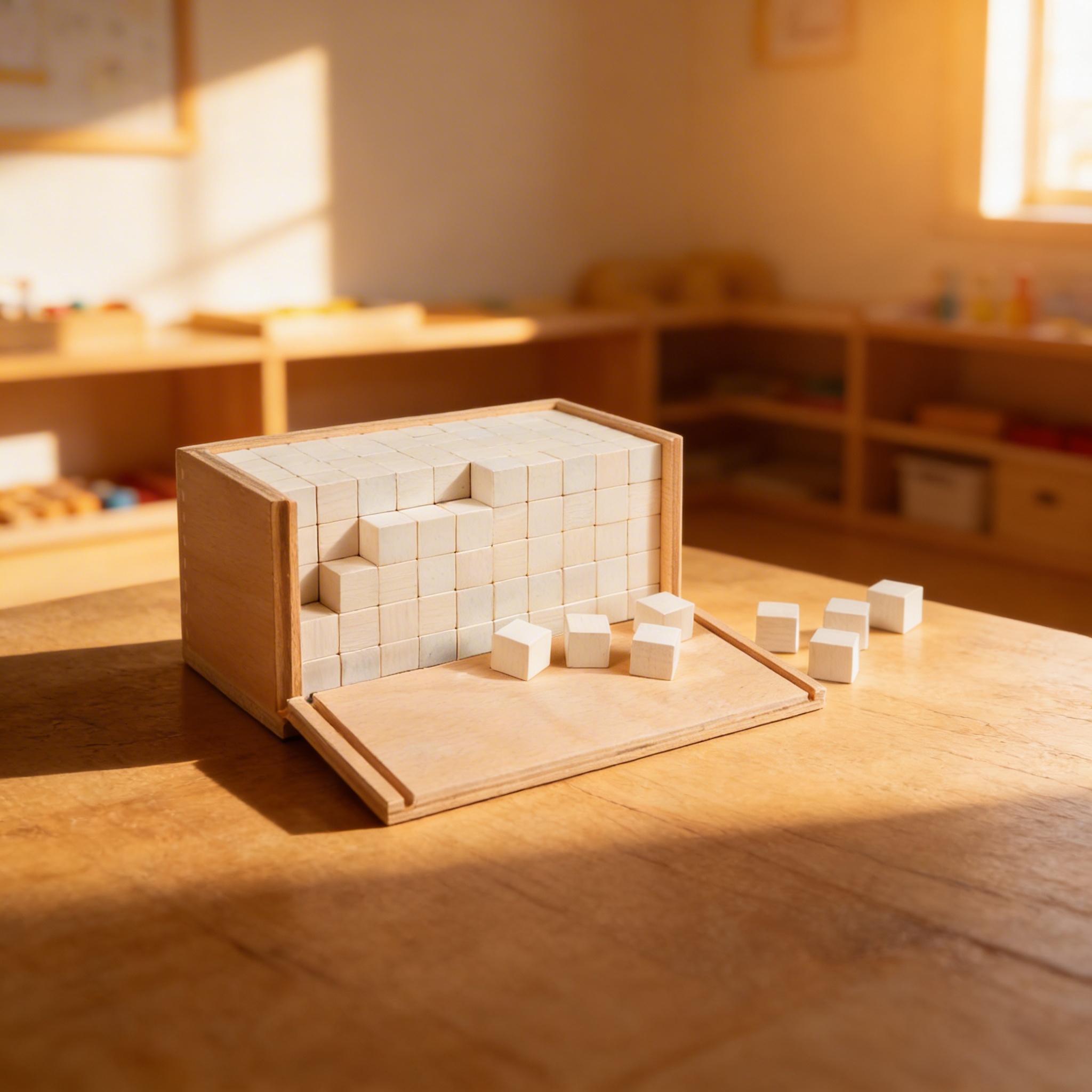
Each order includes everything needed for proper presentation and long-term use.
Follow the Montessori method of presentation for optimal child development.
Begin by inviting the child to count out 8 cubes and construct a 2×2×2 cube
Once complete, have the child count the cubes used and record: 2³ = 8
Progress to building a 3×3×3 cube using 27 cubes
Continue with 4×4×4 (64 cubes) and 5×5×5 (125 cubes)
Explore the pattern: 1³=1, 2³=8, 3³=27, 4³=64, 5³=125
Every material is carefully selected for durability, safety, and authentic Montessori experience.
The smooth wooden cubes provide essential tactile feedback while building, supporting the child's understanding of volume through sensory experience.
Each material supports multiple areas of child development simultaneously.
Building with unit cubes develops concrete understanding of volume, area, and linear measurements while preparing for abstract mathematical concepts.
Manipulating cubes in three dimensions enhances spatial reasoning and visualization skills essential for geometry and engineering thinking.
Planning structures and maintaining organization of materials strengthens concentration, order, and systematic thinking patterns.
Designed for child-sized hands
Professional tips from AMI-trained guides to maximize the educational value of this material.
“Present this material after the child has worked extensively with the Pink Tower and has a solid understanding of the decimal system”
Allow ample time for free exploration before introducing formal cubic number work - children often discover patterns independently
Connect this work to the Trinomial Cube by showing how (a+b+c)³ can be built with unit cubes
Use this material to bridge concrete and abstract when introducing volume formulas in upper elementary
Everything you need to know about this material.
Each cube measures 2cm x 2cm x 2cm. The hinged wooden storage box is designed to hold all 250 cubes in organized layers, typically measuring approximately 20cm x 20cm x 12.5cm when closed.
Children build various three-dimensional shapes, measure their dimensions, and calculate volume by counting cubes. They can create cubes, rectangular prisms, and other geometric solids, discovering that volume equals length × width × height through concrete manipulation.
This material teaches cubic volume, spatial relationships, multiplication facts, square and cubic numbers, geometric progression, and the relationship between linear, square, and cubic measurements. It provides concrete understanding of abstract mathematical formulas.
While both explore volume, the 250 Cubes offer more flexibility for creating various shapes and sizes. The Thousand Cube is specifically designed to represent 10³, while this set allows children to build and measure multiple geometric forms independently.
Children should have experience with the Pink Tower and Brown Stair, understand basic multiplication, and be familiar with measuring length, width, and height. Prior work with the bead materials and geometric solids also provides helpful foundation.
Can't find what you're looking for?
Contact Our Experts
Share your experience with this material and help other educators and parents.
Bundle related materials and save. Free curriculum guide included with every set.


