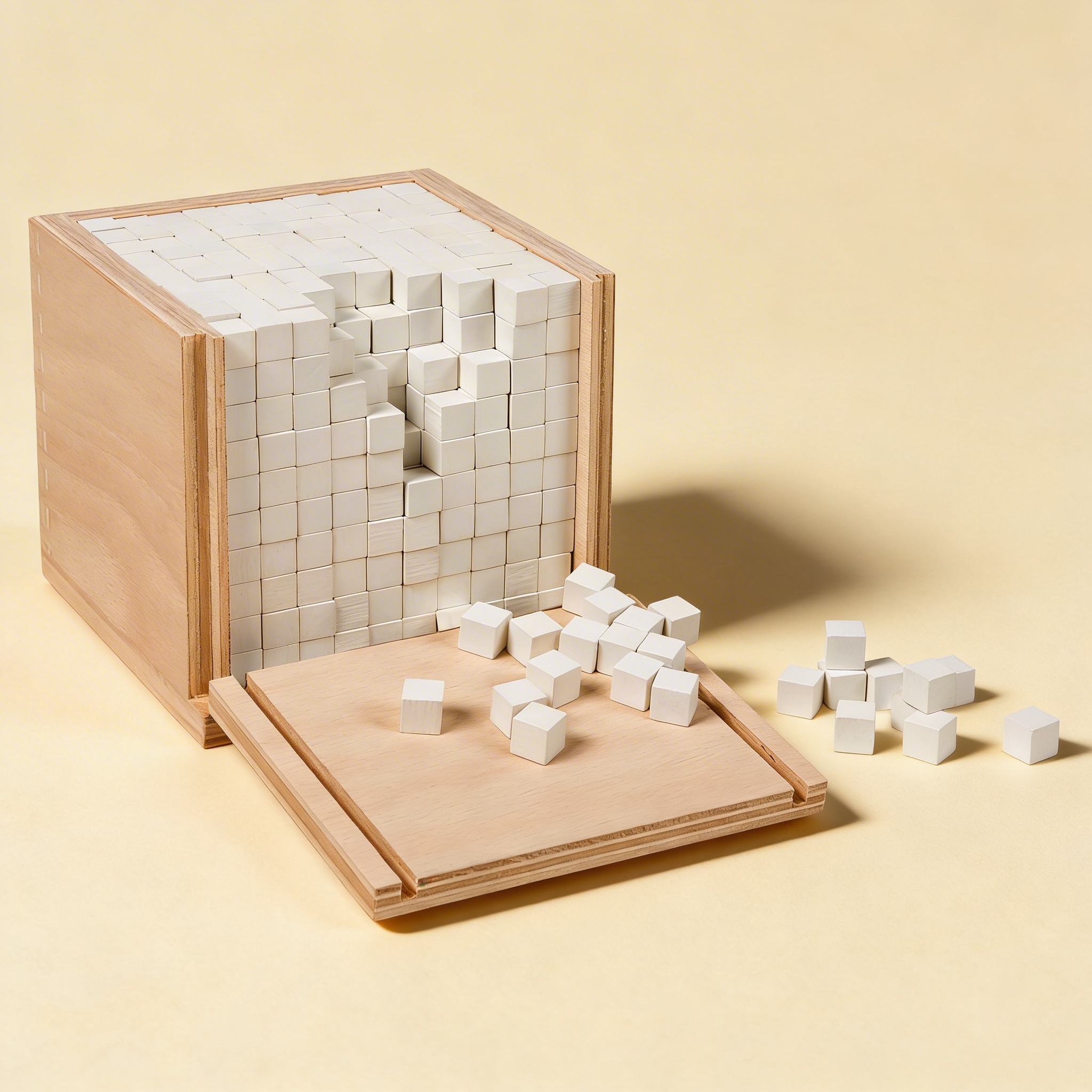
The Volume Box — 1000 Unit Cubes with Sliding Demonstration Drawer is a Sensorial Montessori material designed for children aged 6-12, crafted by Nienhuis Montessori to AMI standards.
This precision-crafted Volume Box demonstrates the concrete representation of 1000 through a perfect 10×10×10 cube formation. The innovative sliding drawer design allows children to explore cubic relationships and volume concepts by physically manipulating and counting individual unit cubes, making abstract mathematical concepts tangible and comprehensible.
“Children display a universal love of mathematics, which is par excellence the science of precision, order, and intelligence.”— Maria MontessoriThe Discovery of the Child
“The greatest sign of success for a teacher is to be able to say, 'The children are now working as if I did not exist.'”
— Maria Montessori, The Absorbent Mind
The Volume Box embodies Dr. Montessori's principle of making abstract concepts concrete through sensorial exploration. This material bridges the gap between the sensorial and mathematical areas, allowing children to literally hold 1000 in their hands. Through the physical manipulation of unit cubes, children construct their understanding of volume, cubic relationships, and large numbers from the concrete to the abstract. The material's self-correcting nature - exactly 1000 cubes fitting perfectly in the 10×10×10 formation - provides immediate feedback and supports the child's natural mathematical mind. This hands-on approach respects the child's need to learn through movement and touch, building a solid foundation for advanced mathematical concepts through repeated sensorial experiences.
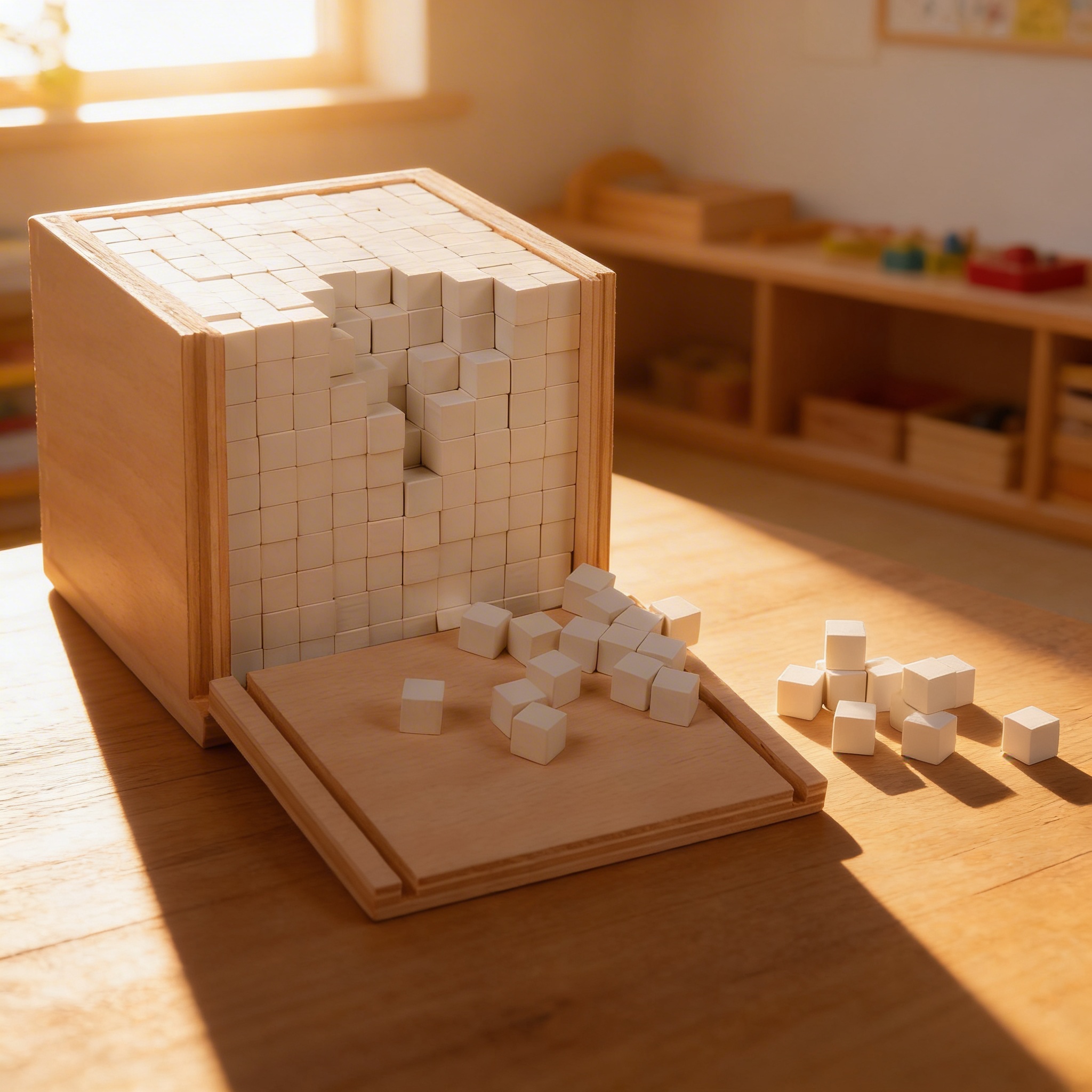
Each order includes everything needed for proper presentation and long-term use.
Follow the Montessori method of presentation for optimal child development.
Open the sliding drawer and invite the child to remove one unit cube, examining its dimensions
Build a 10×10 base layer, counting each cube as placed
Continue building upward, creating 10 complete layers of 100 cubes each
Once complete, explore the relationship: 10×10×10 = 1000
Carefully return all cubes to the drawer, observing how they fit perfectly
Every material is carefully selected for durability, safety, and authentic Montessori experience.
Each cube is carefully crafted to exact specifications, ensuring perfect stacking and accurate mathematical relationships when exploring volume and cubic numbers.
Each material supports multiple areas of child development simultaneously.
Bridges concrete manipulation to abstract understanding of volume, cubic relationships, and powers of 10 through hands-on exploration.
Develops three-dimensional thinking and spatial intelligence through building and deconstructing the cubic formation.
Provides concrete experience of 10³ = 1000, supporting understanding of multiplication and exponential relationships.
Designed for child-sized hands
Professional tips from AMI-trained guides to maximize the educational value of this material.
“Present this material after solid work with linear and square number concepts - the child should understand 10² before approaching 10³”
Initial presentations should focus on the sensorial aspect before introducing mathematical notation and vocabulary
Allow multiple sessions for building the complete cube - stamina and concentration develop through practice
Create opportunities for collaborative work where children can check each other's counting and construction
Everything you need to know about this material.
The Volume Box measures 10cm x 10cm x 10cm when fully assembled with all 1000 cubes. It's typically made from high-quality beechwood with a natural finish. The sliding drawer mechanism is crafted for smooth operation and durability, allowing repeated use without wear.
This material introduces concepts of volume, cubic numbers, and place value through concrete manipulation. Children discover that 10³ = 1000 by physically building and deconstructing the cube, understanding powers and exponential growth. It also supports work with decimals, fractions, and algebraic concepts in later elementary years.
Children should have experience with the Golden Bead Material, particularly the thousand cube, and be comfortable with linear and square number concepts. Prior work with the bead chains, squares, and cubes helps establish the foundation for understanding cubic relationships and volume.
Initially, children explore the physical construction of 1000, counting and arranging cubes. They progress to comparing volumes, discovering relationships between linear, square, and cubic measurements. Advanced work includes calculating partial volumes, exploring decimal cubes (0.1³ = 0.001), and connecting to abstract mathematical notation.
Extensions include creating smaller cubes (2³, 3³, 4³) for comparison, using graph paper to record discoveries, measuring and calculating volumes of classroom objects, and connecting to the decimal system through fractional cubes. Children can also explore surface area calculations and net diagrams of cubes.
Can't find what you're looking for?
Contact Our Experts
Share your experience with this material and help other educators and parents.
Bundle related materials and save. Free curriculum guide included with every set.


