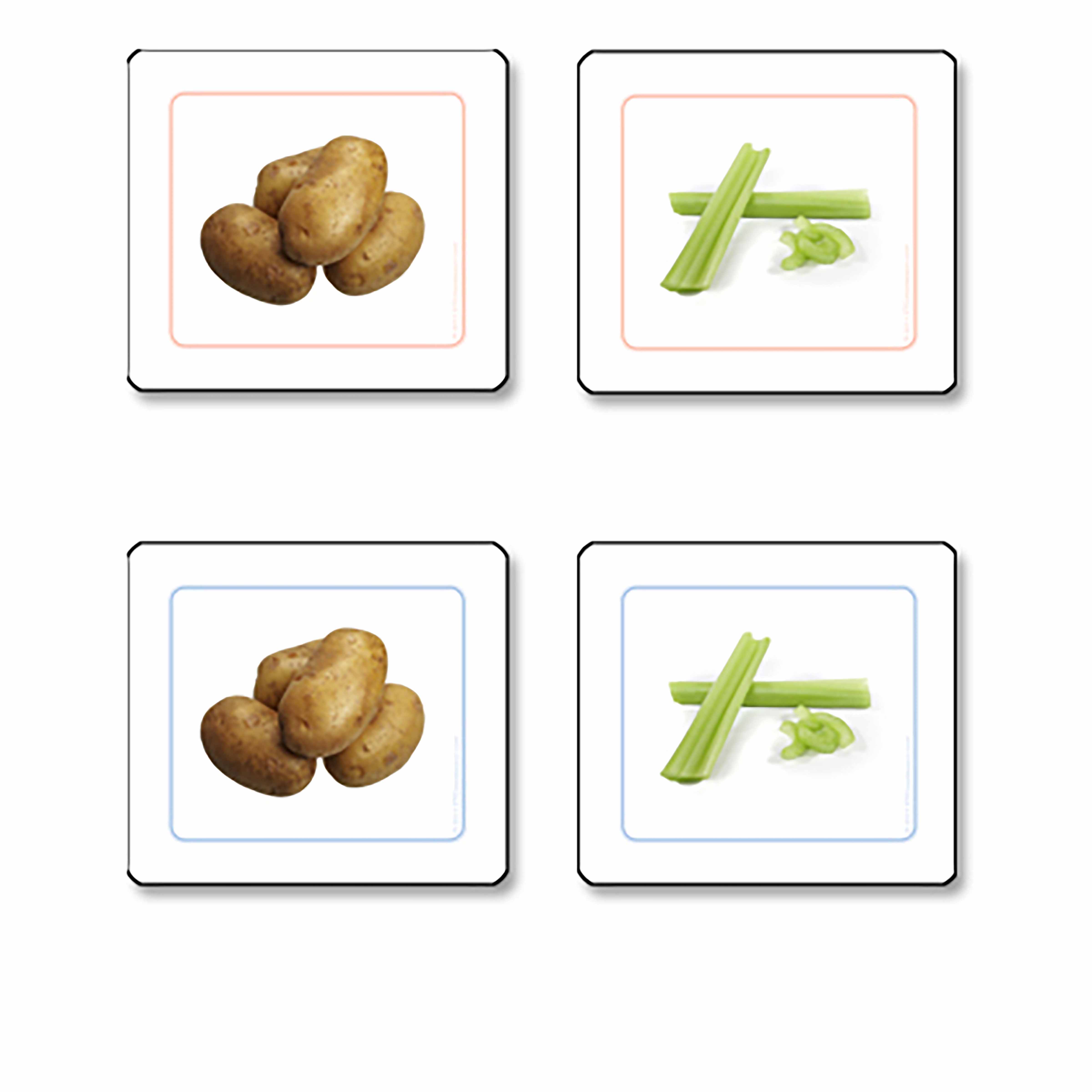
The Vegetables Matching Cards is a Furniture & Storage Montessori material designed for children aged 3-6, crafted by Nienhuis Montessori to AMI standards.
These Vegetables Matching Cards offer a visual discrimination activity featuring realistic photographs of common vegetables. Each vegetable appears on two cards with different colored borders (pink and blue), allowing children to match identical vegetables while developing observation skills and vocabulary. The laminated cardstock construction ensures durability for repeated classroom use.
“The child is both a hope and a promise for mankind.”— Maria MontessoriEducation and Peace
“The hands are the instruments of man's intelligence.”
— Maria Montessori, The Absorbent Mind
The Vegetables Matching Cards fulfill the young child's need for order and classification through precise visual discrimination work. These laminated cardstock cards with their pink and blue borders create a concrete system for organizing identical vegetable photographs, addressing the child's sensitive period for small details between ages three and six. The realistic vegetable photographs connect the child's abstract matching work to real-world knowledge, building vocabulary through repeated handling of each card. The dual-color border system transforms simple matching into a structured activity where children can self-check their work by verifying border colors align. This matching work with vegetable images prepares the visual discrimination skills needed for later reading, where children must distinguish between similar letter forms. The durable laminated surface allows countless repetitions, essential for the child who seeks mastery through practice.
Each order includes everything needed for proper presentation and long-term use.
Follow the Montessori method of presentation for optimal child development.
Turn over the top blue-bordered card and name the vegetable shown
Scan the pink-bordered column from top to bottom to find the matching vegetable
Place the blue-bordered card directly to the right of its pink match
Continue until all vegetables are matched in horizontal pairs
Each material supports multiple areas of child development simultaneously.
Children develop keen observation skills by identifying identical vegetables despite different colored borders.
Expands vocabulary through naming vegetables and discussing their characteristics.
Supports early scientific thinking through categorizing and matching natural objects.
The focused matching activity builds attention span and careful observation habits.
Designed for child-sized hands
Professional tips from AMI-trained guides to maximize the educational value of this material.
“Start with 6-8 vegetable pairs for initial presentations, adding more as competence grows”
Store cards in separate envelopes by border color to maintain the activity's structure
Create a control chart showing all vegetables with names for independent reference
Rotate vegetable selections seasonally to maintain interest and relevance
Everything you need to know about this material.
The set includes pairs of cards featuring common vegetables. Each vegetable appears on two cards - one with a pink border and one with a blue border - allowing children to practice matching identical vegetables while developing visual discrimination skills.
These cards are designed for children ages 3-6 years. They're perfect for preschool and kindergarten students who are developing visual discrimination skills, building vocabulary, and learning about healthy foods and nutrition.
The cards are made from laminated cardstock construction, making them extremely durable for repeated classroom use. The lamination protects the realistic photographs from spills, fingerprints, and general wear, ensuring they'll last through many learning sessions.
Children develop multiple skills including visual discrimination, concentration, vocabulary expansion, memory skills, and knowledge about vegetables. The activity also supports language development as children name and discuss the vegetables while matching.
These cards work perfectly for matching work on a mat, sorting activities by color borders, vocabulary lessons during circle time, or as part of nutrition and healthy eating discussions. They can also be used for memory games or combined with real vegetables for concrete learning experiences.
Can't find what you're looking for?
Contact Our Experts
Share your experience with this material and help other educators and parents.

