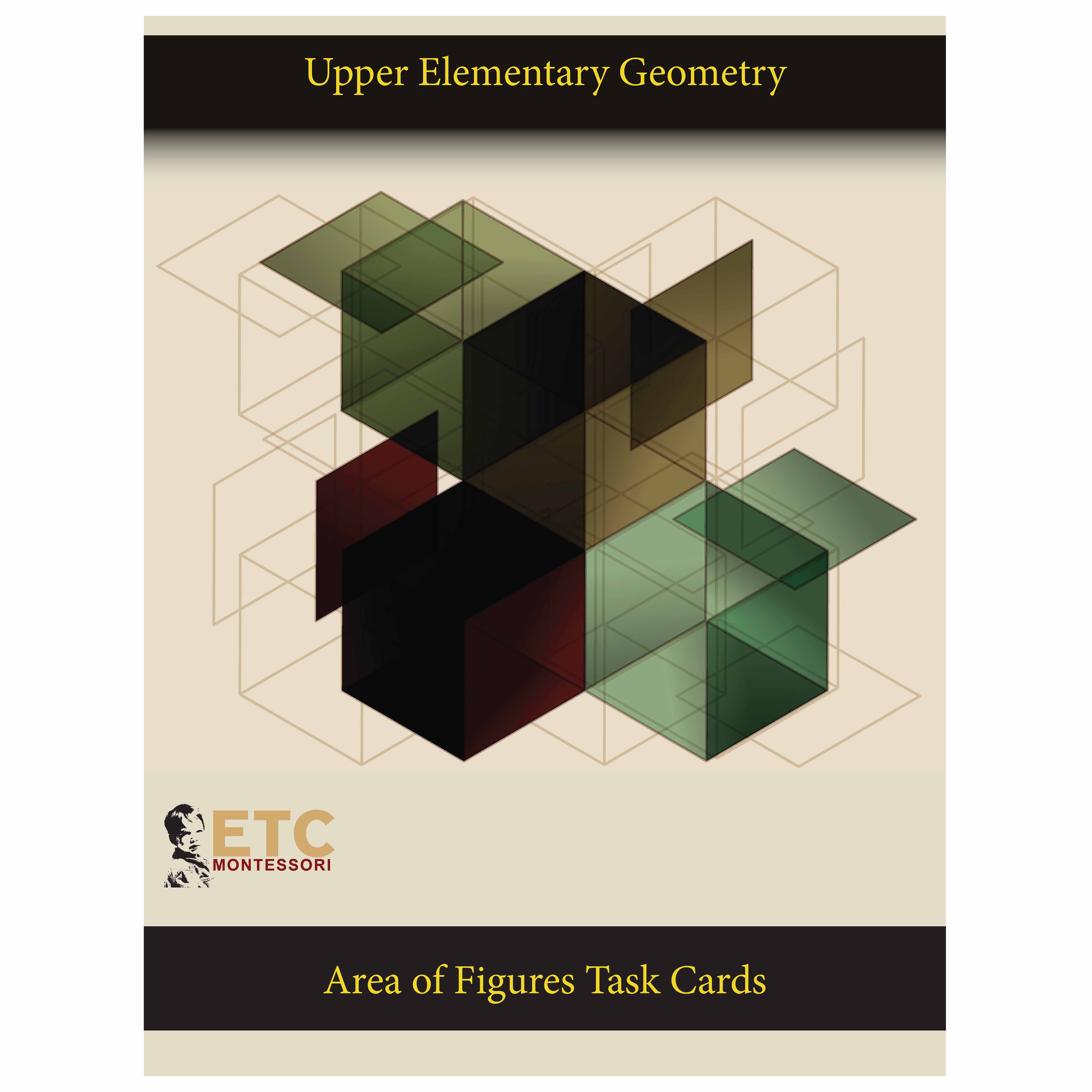
The Upper Elementary Geometry - Area is a Educational Materials Montessori material designed for children aged 3-6, crafted by Nienhuis Montessori to AMI standards.
This Upper Elementary Geometry Area task card set introduces students to calculating areas of complex geometric shapes through Montessori's visual approach. The laminated cards feature transparent overlapping geometric forms, helping children understand how composite shapes can be analyzed by breaking them into familiar components. Designed for upper elementary work, these materials support the transition from concrete geometric manipulatives to abstract mathematical thinking.
“The child is both a hope and a promise for mankind.”— Maria MontessoriEducation and Peace
“The hands are the instruments of man's intelligence.”
— Maria Montessori, The Absorbent Mind
The Upper Elementary Geometry Area task cards bridge concrete geometric exploration and abstract mathematical reasoning through carefully designed visual challenges. Each laminated card presents overlapping transparent shapes that children must mentally decompose, requiring them to identify familiar forms within complex configurations. This geometry material addresses the elementary child's growing capacity for abstract thought while honoring their continued need for visual clarity. The transparent overlapping forms on these cards allow students to trace relationships between composite and component shapes, developing spatial reasoning essential for advanced mathematics. By presenting area calculation through visual decomposition rather than formulaic memorization, these geometry cards respect the child's natural mathematical development. The progression from simple to complex overlapping shapes within this set mirrors the child's journey from concrete manipulation to abstract analysis, preparing them for algebraic thinking while maintaining geometric understanding.
Each order includes everything needed for proper presentation and long-term use.
Follow the Montessori method of presentation for optimal child development.
Select a card showing two overlapping shapes and trace the outline onto graph paper
Identify and mark the component shapes within the composite form
Calculate the area of each component shape separately
Determine whether overlapping sections should be added or subtracted
Record the total area and check using an alternative decomposition method
Every material is carefully selected for durability, safety, and authentic Montessori experience.
Sourced from sustainably managed European forests. Beechwood is chosen for its exceptional durability, smooth grain, and natural warmth that invites touch.
Natural, unbleached cotton in child-friendly colors. The fabric provides the right amount of friction for developing fingers while being gentle on sensitive skin.
Water-based, child-safe finish that meets the strictest European safety standards. Designed to withstand years of daily use without chipping or peeling.
Each material supports multiple areas of child development simultaneously.
Bridges the gap between concrete geometric materials and abstract area formulas through visual representations.
Develops ability to decompose complex shapes into simpler components for calculation.
Progressive card series builds mathematical concepts systematically, following Montessori principles.
Self-correcting format allows students to work autonomously and build confidence in geometry.
Designed for child-sized hands
Professional tips from AMI-trained guides to maximize the educational value of this material.
“Introduce decomposition strategies systematically - start with shapes that break cleanly into non-overlapping parts before presenting overlapping forms”
Connect this work to earlier concrete experiences with geometric metal insets and constructive triangles
Encourage multiple solution methods for the same shape to develop flexible mathematical thinking
Use the transparency feature to demonstrate how shapes can be mentally 'lifted' and rearranged
Everything you need to know about this material.
This appears to be a labeling error. Upper Elementary Geometry - Area materials are designed for ages 9-12 (fourth through sixth grade). The content focuses on calculating areas of complex shapes, which requires mathematical skills typically developed in upper elementary years, not ages 3-6.
Children should have completed work with the Geometric Cabinet, Metal Insets, and basic area materials like the Yellow Area Material. They should understand concepts of perimeter, simple area calculations for triangles and rectangles, and be familiar with decomposing shapes before working with these advanced area cards.
The transparent overlays allow children to physically see how complex shapes can be broken down into familiar geometric forms. By overlapping triangles, rectangles, and other shapes, students can visualize how to calculate the total area by adding or subtracting component areas, making abstract concepts concrete and visible.
This set covers area calculations for composite shapes, irregular polygons, and overlapping figures. Students learn to identify component shapes, calculate individual areas, understand concepts of addition and subtraction of areas, and apply formulas for triangles, rectangles, parallelograms, and trapezoids in complex configurations.
The cards bridge concrete and abstract learning by providing visual representations that can be manipulated and analyzed. Students move from physically tracing and measuring to mental decomposition of shapes, gradually developing the ability to visualize area calculations without physical materials, preparing them for traditional geometry coursework.
Can't find what you're looking for?
Contact Our Experts
Share your experience with this material and help other educators and parents.


