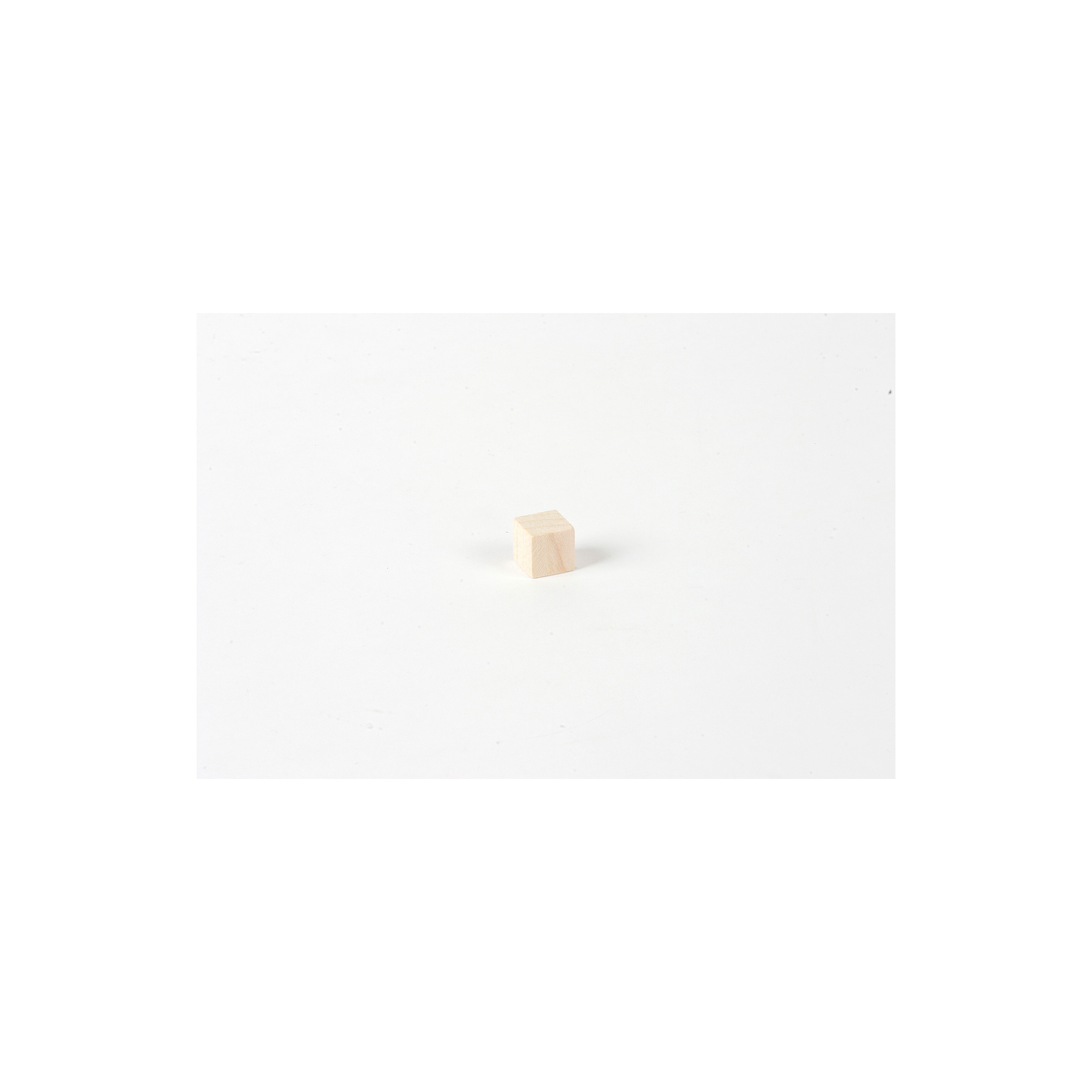
The Unpainted Cube: 1x1x1 cm is a Sensorial Montessori material designed for children aged 3-6, crafted by Nienhuis Montessori to AMI standards.
This precisely crafted 1cm wooden cube serves as a fundamental unit in Montessori sensorial exploration and mathematical concepts. The unpainted natural wood finish allows children to focus on dimension and form while providing a tactile experience that connects abstract concepts to concrete manipulation.
“The senses, being explorers of the world, open the way to knowledge.”— Maria MontessoriThe Discovery of the Child
“Children display a universal love of mathematics, which is par excellence the science of precision, order, and intelligence.”
— Maria Montessori, The Discovery of the Child
The Unpainted Cube: 1x1x1 cm represents the foundation of dimensional understanding in Montessori mathematics. This single cubic centimeter introduces children to the concept of volume through direct manipulation of a precise geometric form. The natural wood surface of the 1cm cube engages the child's tactile sense while its exact dimensions establish a concrete reference point for mathematical abstractions. In Montessori classrooms, this small wooden cube becomes the building block for understanding larger mathematical concepts - ten cubes form a ten-bar, one hundred create a hundred-square, and one thousand construct the thousand-cube. The unpainted finish eliminates visual distractions, allowing children to focus purely on the cube's dimensional properties and its relationship to other mathematical materials. Through handling this fundamental unit, children develop an embodied understanding of measurement, quantity, and spatial relationships that will serve as the sensorial foundation for advanced mathematical thinking.
Each order includes everything needed for proper presentation and long-term use.
Follow the Montessori method of presentation for optimal child development.
Invite the child to hold the cube between thumb and forefinger, exploring all six faces
Place the cube on the mat and trace around each face with the index finger
Compare the cube to other classroom materials by placing it alongside them
Count edges (12), vertices (8), and faces (6) by touching each element
Every material is carefully selected for durability, safety, and authentic Montessori experience.
The unpainted wood surface provides authentic tactile feedback essential for sensorial learning, allowing children to experience the material's natural warmth and texture.
Each material supports multiple areas of child development simultaneously.
Introduces the concept of cubic measurement and serves as a concrete representation of volume units.
Develops discrimination of dimension through tactile and visual exploration of precise measurements.
Bridges abstract mathematical concepts with manipulative materials for deeper understanding.
Designed for child-sized hands
Professional tips from AMI-trained guides to maximize the educational value of this material.
“Store multiple 1cm cubes in a small container for grouping activities and decimal system work”
Use the cube as a non-standard unit of measurement for classroom objects
'edge,' 'face,' 'vertex' only after sensorial exploration
Connect the cube to the pink tower's smallest cube to reinforce size relationships
Everything you need to know about this material.
The cube measures precisely 1cm x 1cm x 1cm, making it a perfect unit cube for Montessori sensorial and mathematical activities.
The natural unpainted wood finish allows children to focus purely on dimension, form, and texture without color distraction, while also ensuring the material is safe and non-toxic for young learners.
Children can use it for size comparison, building patterns, exploring volume concepts, counting, creating geometric shapes, and as a concrete representation of mathematical units.
This cube is designed for ages 3-6. Due to its small size (1cm), it may pose a choking hazard for children under 3 years and should only be used with appropriate supervision.
It provides hands-on, concrete manipulation of abstract mathematical concepts, allowing children to physically explore dimension, volume, and quantity through self-directed sensorial experiences.
Can't find what you're looking for?
Contact Our Experts
Share your experience with this material and help other educators and parents.


