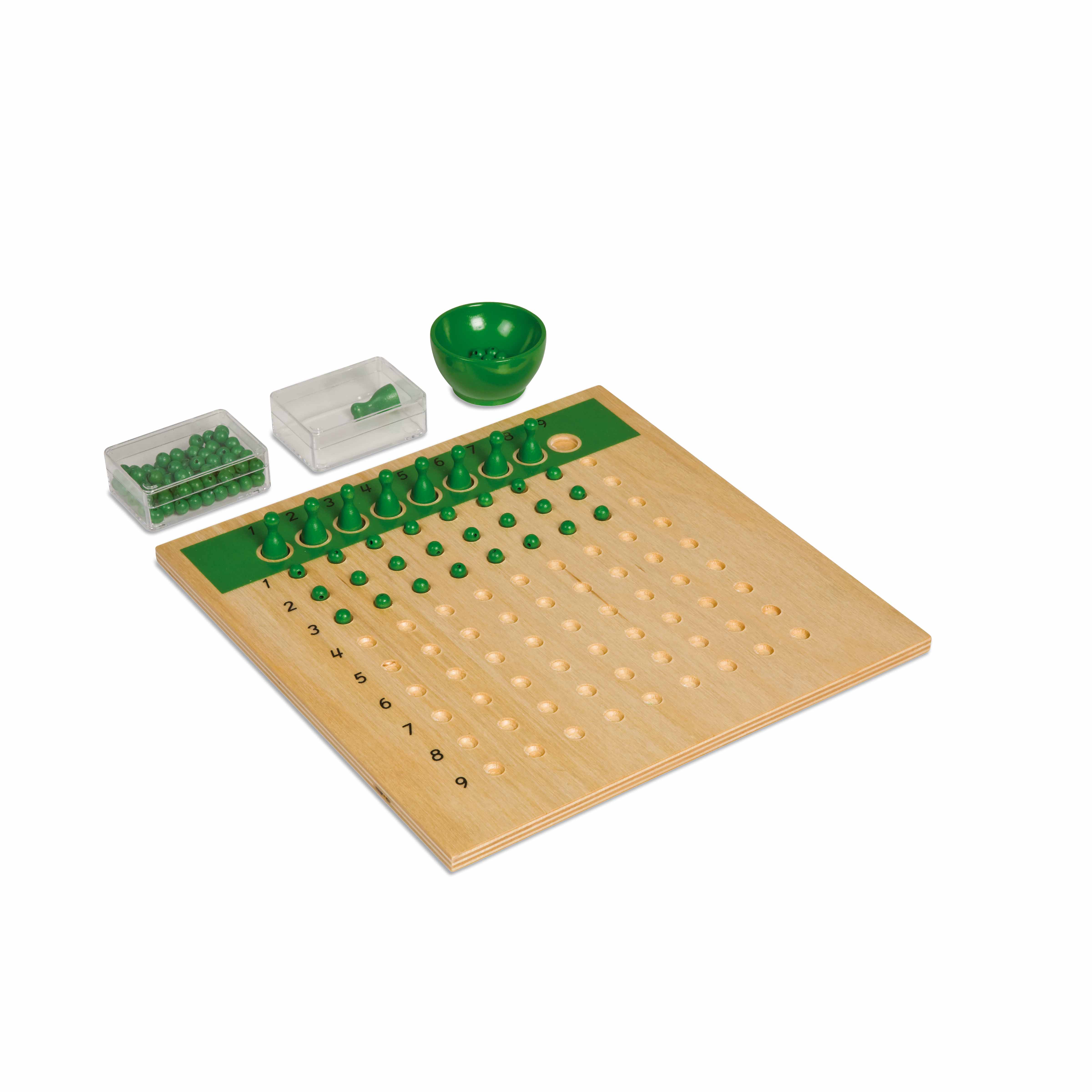
The Unit Division Board is a Mathematics Montessori material designed for children aged 3-6, crafted by Nienhuis Montessori to AMI standards.
The Unit Division Board introduces children to the concept of division through hands-on manipulation of green pegs representing divisors and beads representing dividends. This classic Montessori mathematics material features a 9×9 grid board with numbered axes, allowing children to physically work through division problems by distributing beads evenly among pegs to discover quotients and remainders.
“Children display a universal love of mathematics, which is par excellence the science of precision, order, and intelligence.”— Maria MontessoriThe Discovery of the Child
“The greatest sign of success for a teacher is to be able to say, 'The children are now working as if I did not exist.'”
— Maria Montessori, The Absorbent Mind
The Unit Division Board transforms abstract division into a concrete experience through the physical distribution of beads among green pegs. Each green peg on this 9×9 grid represents a divisor, while beads serve as the dividend to be shared equally. The Unit Division Board's numbered axes create a visual framework where children discover quotients by counting how many beads each peg receives. This hands-on manipulation reveals division as the inverse of multiplication, as children physically see remainders when beads cannot be distributed evenly. The board's systematic grid layout allows exploration of division facts from 1÷1 through 81÷9, building a sensorial understanding before abstract algorithms. Through repeated work with the Unit Division Board, children internalize that division means equal sharing, preparing them for more complex mathematical concepts. The tactile experience of placing beads creates muscle memory that reinforces numerical relationships.
Each order includes everything needed for proper presentation and long-term use.
Follow the Montessori method of presentation for optimal child development.
Choose a division problem, such as 12÷3. Place 3 green pegs in the top row
Count out 12 beads as your dividend
Distribute beads one at a time to each peg in sequence until all beads are placed
Count the beads under each peg to discover the quotient (4)
Record the equation: 12÷3=4
Each material supports multiple areas of child development simultaneously.
Children physically distribute beads among pegs, building concrete understanding of division as equal sharing.
Discovering quotients and remainders through hands-on manipulation develops logical thinking and problem-solving skills.
Working systematically through division tables reveals mathematical patterns and relationships between numbers.
Placing small pegs and beads in specific holes refines pincer grip and hand-eye coordination.
Designed for child-sized hands
Professional tips from AMI-trained guides to maximize the educational value of this material.
“Introduce division vocabulary (dividend, divisor, quotient) as children work with the materials”
Create a systematic progression from simple divisions (even results) to complex (with remainders)
Connect division work to previous multiplication experiences using the same numbers
Observe which division facts children find challenging and provide extra practice with those combinations
Everything you need to know about this material.
The Unit Division Board is designed for children ages 3-6 years old. However, it's typically introduced around age 4-5 after children have mastered addition, subtraction, and multiplication concepts. The material grows with the child as they progress from simple division to more complex problems.
The Unit Division Board includes a wooden 9×9 grid board with numbered axes (1-9), a set of green skittles or pegs representing divisors, and 81 green beads representing dividends. Some sets may also include a small bowl or container for the beads and division problem cards.
Children place green pegs across the top of the board to represent the divisor (how many groups), then distribute beads evenly among the pegs to find the quotient. Any beads that cannot be distributed evenly become the remainder. This concrete manipulation helps children understand division as equal sharing or grouping.
Before introducing the Unit Division Board, children should be comfortable with counting to at least 81, have experience with the golden bead material, understand basic multiplication concepts, and be familiar with the concept of sharing equally. Prior work with the multiplication boards is also helpful.
Unlike abstract paper-and-pencil methods, the Unit Division Board provides a concrete, visual, and tactile way to understand division. Children physically manipulate materials to see division as the inverse of multiplication, making abstract concepts tangible and building a deep conceptual understanding before moving to abstraction.
Can't find what you're looking for?
Contact Our Experts
Share your experience with this material and help other educators and parents.

