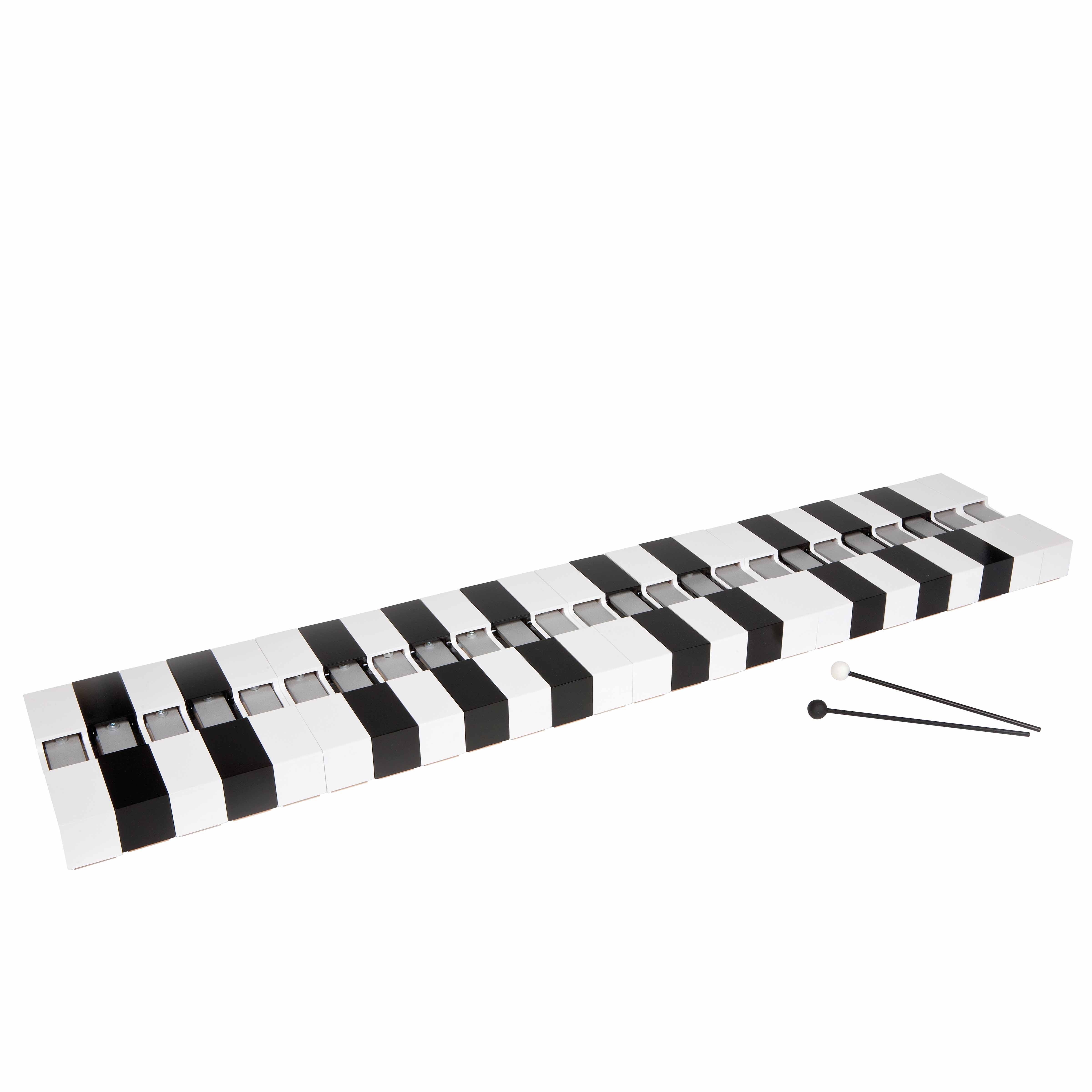
The Tone Bars Set With Two Mallets is a Educational Materials Montessori material designed for children aged 6-12, crafted by Nienhuis Montessori to AMI standards.
This professional-grade Tone Bars Set introduces children to the chromatic scale through hands-on musical exploration. The precision-tuned metal bars are arranged like piano keys with resonating chambers beneath each tone, allowing children to discover pitch relationships, compose melodies, and develop their auditory discrimination skills through structured musical activities.
“The child is both a hope and a promise for mankind.”— Maria MontessoriEducation and Peace
“The hands are the instruments of man's intelligence.”
— Maria Montessori, The Absorbent Mind
The Tone Bars Set fulfills the elementary child's need to explore abstract concepts through concrete manipulation. Each precision-tuned metal bar represents a specific pitch in the chromatic scale, making the mathematical relationships between frequencies tangible. The resonating chambers beneath the bars amplify each tone, allowing children to perceive subtle differences in pitch that develop their auditory discrimination. This material bridges sensorial experiences from primary years to the abstract study of music theory in elementary. The arrangement mimicking piano keys connects the child's exploration to the wider musical world. Through striking the metal bars with mallets, children discover harmonies, dissonance, and the physical properties of sound production. The Tone Bars Set answers the elementary child's question 'how does music work?' by providing a scientific instrument for musical investigation.
Each order includes everything needed for proper presentation and long-term use.
Follow the Montessori method of presentation for optimal child development.
Begin with the C major scale bars only, playing each in sequence
Introduce matching pairs activity - play a bar and find its octave
Create simple three-note patterns for the child to repeat
Each material supports multiple areas of child development simultaneously.
Refines the ability to distinguish between different pitches and tonal qualities, essential for musical development and language skills.
Explores the mathematical relationships between musical intervals and frequencies through hands-on experimentation.
Encourages composition and improvisation while building confidence in musical performance and self-expression.
Develops precise hand movements and coordination through proper mallet technique and controlled striking.
Designed for child-sized hands
Professional tips from AMI-trained guides to maximize the educational value of this material.
“Present the material in a quiet area where children can focus on subtle pitch differences”
Demonstrate proper mallet grip - held loosely between thumb and first two fingers
Connect tone bar work to pitched bell activities from primary years
Create notation cards matching the bar arrangement for transitioning to music reading
Everything you need to know about this material.
Children explore the chromatic scale, pitch relationships, musical intervals, and basic composition. The set helps develop auditory discrimination, pattern recognition, and an understanding of musical structure through hands-on experimentation with individual tones.
The tone bars are arranged like piano keys with both natural notes (white keys) and sharps/flats (black keys) covering a full chromatic scale. Each precision-tuned metal bar sits above its own resonating chamber, which amplifies and enriches the sound quality when struck.
Children can play simple melodies, create their own compositions, match pitches, identify intervals, and participate in group musical activities. The material supports both individual exploration and collaborative music-making, from basic note recognition to advanced harmonic studies.
This professional-grade instrument features precision-tuned metal bars with individual resonating chambers, ensuring perfect pitch and rich tonal quality. The durable construction, accurate tuning, and educational design make it a long-lasting classroom investment suitable for years of musical education.
For younger children (6-8), it develops basic pitch recognition and fine motor skills. Middle elementary students (8-10) explore melody creation and music reading. Older children (10-12) can study intervals, chords, and musical theory while developing advanced composition skills and musical expression.
Can't find what you're looking for?
Contact Our Experts
Share your experience with this material and help other educators and parents.

