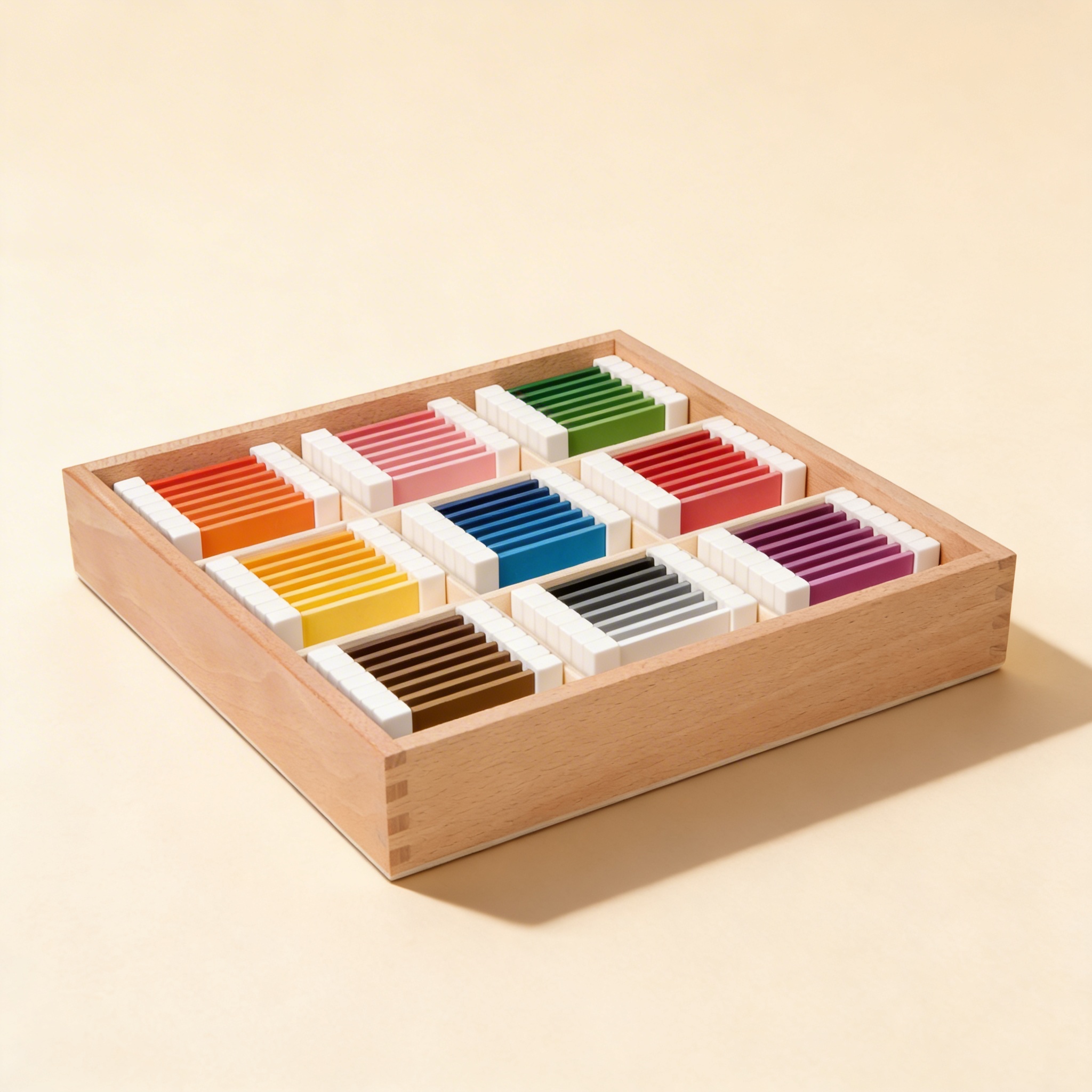
The Third Colour Box — 63 Tablets in 9 Colour Families with Gradations is a Sensorial Montessori material designed for children aged 3-6, crafted by Nienhuis Montessori to AMI standards.
The Third Box of Color Tablets is an advanced Montessori sensorial material featuring 63 tablets arranged in 9 color families, each with 7 graduated shades from lightest to darkest. This precise material refines visual discrimination and prepares children for understanding gradation, sequences, and systematic organization while building vocabulary for subtle color variations.
“Free the child's potential, and you will transform him into the world.”— Maria MontessoriTo Educate the Human Potential
“Education is a natural process spontaneously carried out by the human individual, and is acquired not by listening to words but by experiences upon the environment.”
— Maria Montessori, Education for a New World
The Third Box of Color Tablets embodies Montessori's principle of isolation of difficulty by presenting the abstract concept of gradation through a single sensory quality—color. This material supports the child's sensitive period for order and classification, allowing them to construct mental categories through hands-on manipulation. The systematic arrangement of seven shades within each color family provides concrete experience with seriation, a foundational mathematical concept. Through this work, children develop what Montessori called the 'mathematical mind'—the human tendency to organize, classify, and quantify experiences. The material's self-correcting nature allows children to independently verify their work, fostering the development of visual discrimination that will later support reading, writing, and artistic expression. This advanced color work also demonstrates Montessori's understanding that young children are capable of sophisticated sensorial refinement when materials are developmentally appropriate and beautifully prepared.
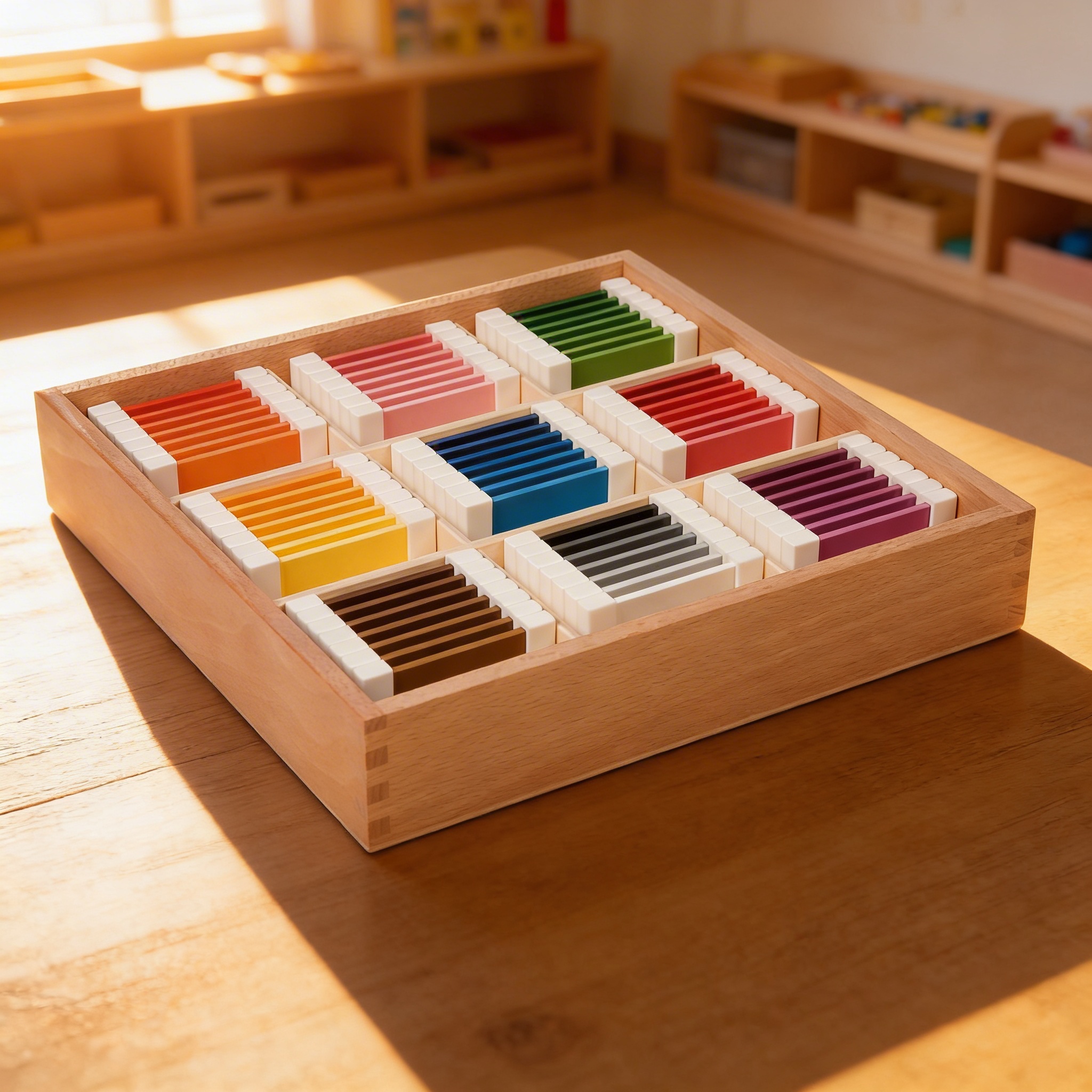
Each order includes everything needed for proper presentation and long-term use.
Follow the Montessori method of presentation for optimal child development.
Begin with one color family, removing all seven tablets randomly onto the mat
Find the darkest and lightest tablets, placing them at opposite ends of the workspace
Find the middle shade and place it between the extremes
Continue finding intermediate shades, building the complete gradation
Perform a three-period lesson with specific tablets: 'This is dark blue, this is medium blue, this is light blue'
Mix the tablets and invite the child to grade them independently
Every material is carefully selected for durability, safety, and authentic Montessori experience.
Each tablet is carefully calibrated to show subtle variations in hue, training the eye to perceive minute differences in color intensity
Each material supports multiple areas of child development simultaneously.
Refines the ability to perceive subtle differences in color intensity and develops vocabulary for describing gradations.
Arranging tablets from light to dark builds logical thinking and prepares for mathematical concepts of seriation.
The challenging nature of distinguishing similar shades promotes sustained focus and attention to detail.
Prepares for art activities, understanding value in drawing, and scientific observation of natural phenomena.
Designed for child-sized hands
Professional tips from AMI-trained guides to maximize the educational value of this material.
“Present this material only after mastery of the First and Second Color Boxes—readiness is crucial for success”
Always grade colors yourself before presenting to ensure accuracy in natural light conditions
Store tablets in their compartments consistently to maintain order and facilitate independent work
Observe which color families children gravitate toward—this reveals individual sensory preferences and development
Everything you need to know about this material.
Children should have mastered Color Box 1 (primary colors) and Color Box 2 (secondary colors) first. They should be able to match colors accurately and have developed the concentration needed for more detailed work, typically around age 4-5.
Start with one color family of 7 tablets. Mix them randomly, then show the child how to arrange them from lightest to darkest. Use minimal language initially, allowing the child to rely on visual discrimination. Once mastered, introduce vocabulary like 'lighter than' and 'darker than.'
Extensions include matching tablets to objects in the environment, creating color wheels, combining multiple color families in patterns, memory games with specific shades, and artistic activities like painting to match the gradations. Children can also explore complementary colors and color mixing.
The seven gradations provide the optimal challenge for developing refined visual discrimination without overwhelming the child. This number allows children to perceive subtle differences while maintaining the ability to sequence the entire set, supporting both perceptual development and logical thinking.
Store in the original wooden box with compartments to prevent mixing. Handle tablets by the edges to avoid fingerprints on the colored surfaces. Keep away from direct sunlight to prevent fading. Clean gently with a dry cloth. Check periodically that all 63 tablets are present and in good condition.
Can't find what you're looking for?
Contact Our Experts
Share your experience with this material and help other educators and parents.
Bundle related materials and save. Free curriculum guide included with every set.


