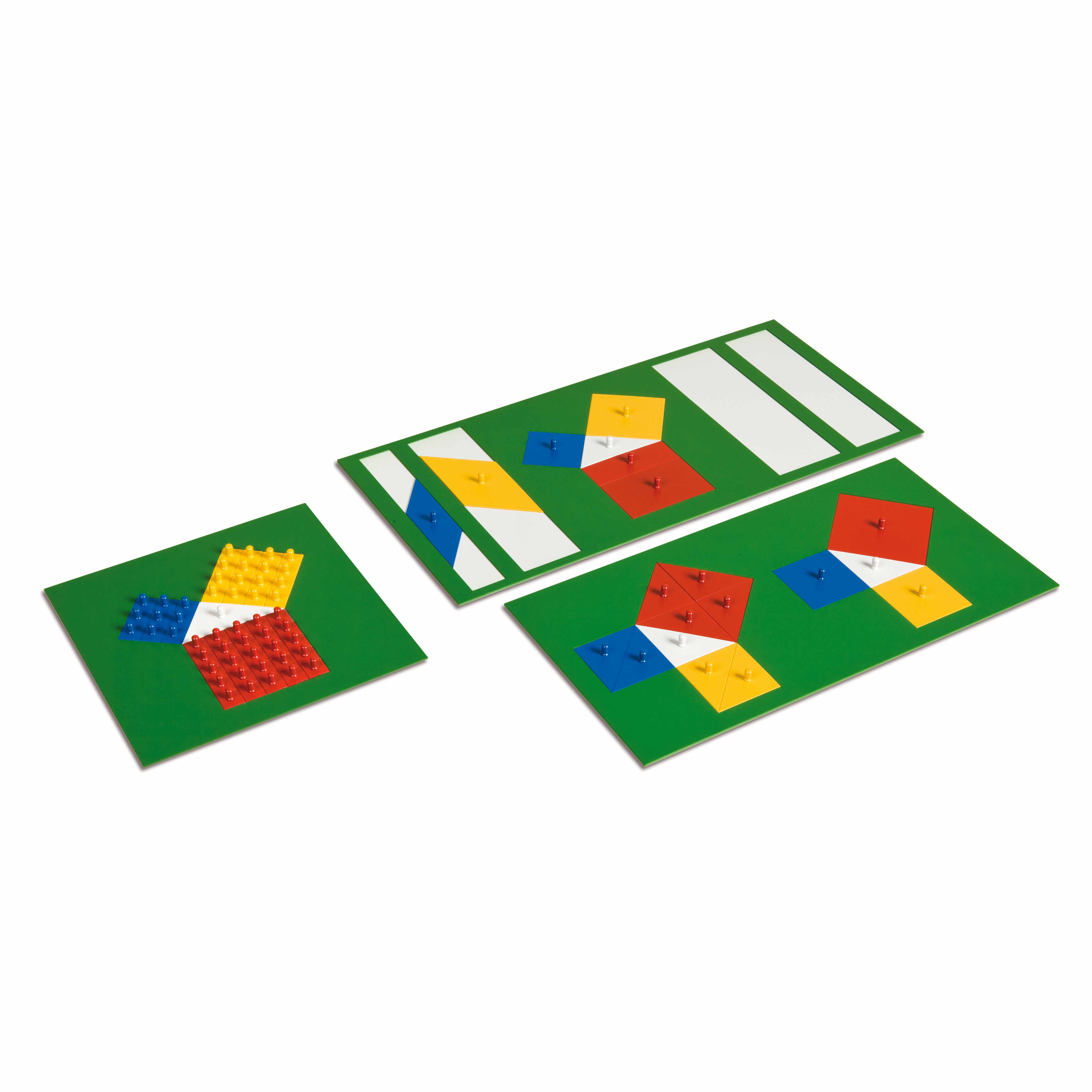
The Theorem Of Pythagoras is a Mathematics Montessori material designed for children aged 6-12, crafted by Nienhuis Montessori to AMI standards.
This innovative Pythagorean theorem demonstration material features three color-coded boards that visually prove the mathematical relationship a² + b² = c² through manipulative square pieces. The textured foam squares allow children to physically arrange and compare areas, transforming an abstract geometric concept into a concrete, hands-on experience that deepens mathematical understanding.
“Children display a universal love of mathematics, which is par excellence the science of precision, order, and intelligence.”— Maria MontessoriThe Discovery of the Child
“The greatest sign of success for a teacher is to be able to say, 'The children are now working as if I did not exist.'”
— Maria Montessori, The Absorbent Mind
The Theorem of Pythagoras material transforms one of geometry's most fundamental relationships into a tangible experience through its three color-coded boards and manipulative foam squares. In Montessori mathematics, the textured foam pieces serve as sensorial bridges between concrete manipulation and abstract reasoning, allowing children to physically construct and deconstruct the equation a² + b² = c². The color-coded boards create visual distinction between the three squares, enabling children to discover independently that the combined areas of squares on the triangle's legs equal the area of the square on the hypotenuse. This progression from handling foam squares to understanding geometric relationships exemplifies how mathematical abstraction emerges from repeated concrete experiences. The Theorem of Pythagoras material addresses the developmental need for geometric proof through movement and touch, preparing the mathematical mind for advanced reasoning while the hands still require tangible verification of abstract concepts.
Each order includes everything needed for proper presentation and long-term use.
Follow the Montessori method of presentation for optimal child development.
Introduce the right triangle formed by the three boards, identifying the legs and hypotenuse
Fill the square on the first leg completely with the corresponding foam pieces
Fill the square on the second leg with its foam pieces
Transfer all foam pieces from both leg squares to the hypotenuse square
Verify that all pieces fit exactly, proving a² + b² = c²
Each material supports multiple areas of child development simultaneously.
Transforms algebraic concepts into concrete visual and tactile experiences, building deep mathematical intuition.
Develops spatial reasoning through hands-on manipulation of area relationships and geometric proofs.
Encourages independent exploration and verification of mathematical theorems through self-directed investigation.
Strengthens analytical thinking by allowing children to physically construct and deconstruct mathematical proofs.
Designed for child-sized hands
Professional tips from AMI-trained guides to maximize the educational value of this material.
“Present this material only after the child has worked extensively with squares and square roots using other Montessori materials”
Allow multiple repetitions with the same triangle before introducing variations - mastery comes through repetition
Connect this work to the geometric cabinet and metal insets to reinforce shape relationships
legs, hypotenuse, right angle, theorem
Everything you need to know about this material.
This material is designed for children ages 6-12, though it's most effectively introduced around age 9-10 when children have developed strong spatial reasoning and are ready for more abstract mathematical concepts. Younger children can explore the material concretely, while older children can delve into the mathematical proofs.
The three color-coded boards with textured foam squares allow children to physically manipulate and arrange pieces to see that the area of squares on the two shorter sides of a right triangle equals the area of the square on the longest side. This concrete representation transforms the abstract formula a² + b² = c² into a tangible, visual proof.
This material develops spatial reasoning, geometric thinking, mathematical proof concepts, area calculation, algebraic thinking, and problem-solving skills. It also strengthens the connection between concrete manipulation and abstract mathematical formulas, preparing children for advanced geometry.
Children should have a solid understanding of squares, area concepts, and basic multiplication before using this material effectively. Familiarity with right triangles and the concept of sides of a triangle is helpful. The material works best when introduced after children have worked with geometry materials like the geometric cabinet.
The high cost reflects the precision manufacturing of three separate demonstration boards, high-quality textured foam pieces cut to exact mathematical specifications, durable materials designed for years of classroom use, and the specialized design that allows multiple theorem proofs. This is an advanced mathematical material that provides concrete understanding of a fundamental geometric principle.
Can't find what you're looking for?
Contact Our Experts
Share your experience with this material and help other educators and parents.

