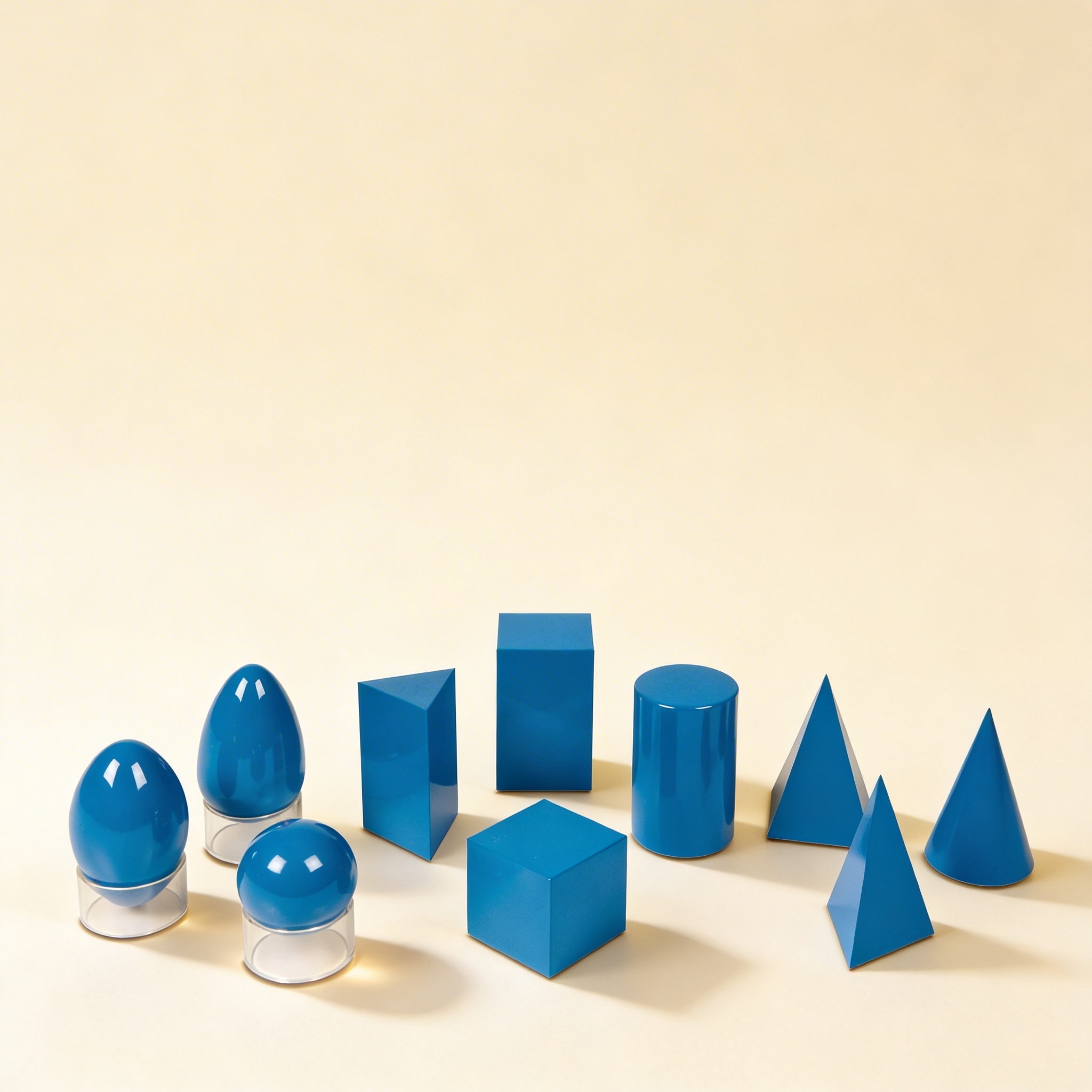
The Geometric Solids — Ten 3D Forms for Tactile Shape Exploration is a Sensorial Montessori material designed for children aged 3-6, crafted by Nienhuis Montessori to AMI standards.
The Geometric Solids introduce children to three-dimensional forms through tactile exploration. This essential Sensorial material features ten distinct geometric shapes in a vibrant blue finish, allowing children to discover relationships between 2D and 3D forms while developing stereognostic sense and mathematical vocabulary.
“The child is both a hope and a promise for mankind.”— Maria MontessoriEducation and Peace
“The hands are the instruments of man's intelligence.”
— Maria Montessori, The Absorbent Mind
The Geometric Solids embody Dr. Montessori's principle that the hand is the instrument of the mind. Through tactile exploration of these three-dimensional forms, children build concrete experiences that later support abstract mathematical understanding. This material bridges the gap between the child's sensorial experiences and mathematical concepts, allowing them to absorb the essential qualities of each solid through touch before they can name or define them. The stereognostic sense - the ability to recognize forms through touch alone - is refined as children explore these shapes with closed eyes, creating mental impressions that become the foundation for geometry. This work satisfies the child's need for order and classification while preparing the mathematical mind through concrete manipulation of perfect geometric forms.
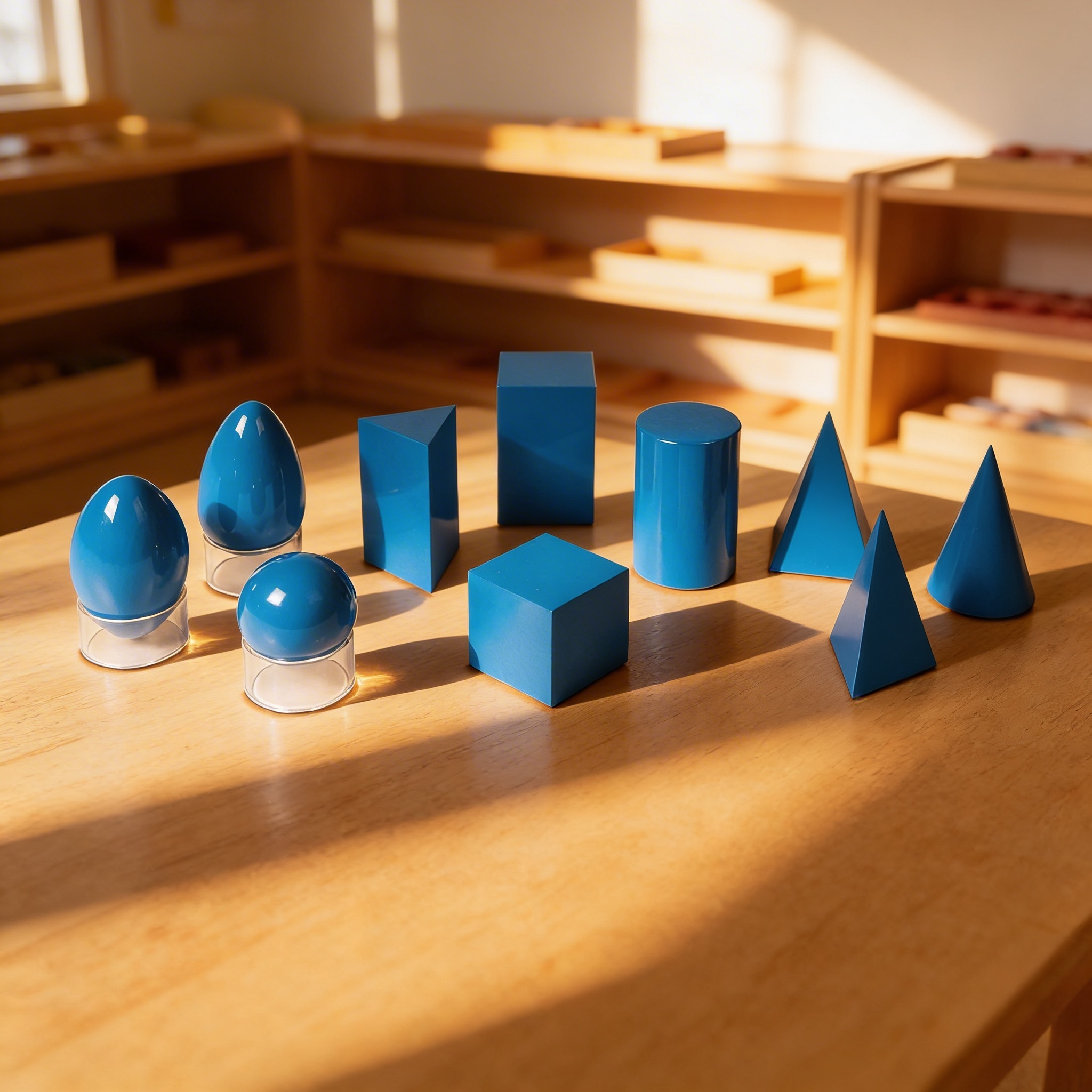
Each order includes everything needed for proper presentation and long-term use.
Follow the Montessori method of presentation for optimal child development.
Invite the child and bring one solid at a time to the mat, handling each with care using both hands
Take the sphere first, roll it between your palms and on the mat, emphasizing its continuous curved surface
Introduce the cube, exploring its flat faces, straight edges, and sharp vertices with fingertips
Present contrasting pairs (sphere/cube, ovoid/ellipsoid) to highlight differences
Introduce stereognostic exercise: child closes eyes while you place a solid in their hands to identify
Conduct three-period lesson for vocabulary once child knows solids through touch
Every material is carefully selected for durability, safety, and authentic Montessori experience.
The smooth, blue-painted surface allows children to focus on form without texture distractions, essential for isolating the geometric concept.
Transparent stands for curved solids maintain visual focus on the shape while providing necessary stability.
Each material supports multiple areas of child development simultaneously.
Children develop the ability to recognize forms through touch, building neural pathways for spatial understanding.
Direct preparation for geometry by experiencing 3D forms that correspond to their 2D representations.
Introduces precise geometric vocabulary through concrete, manipulable objects that children can explore.
Refines the ability to perceive subtle differences in form, preparing for later mathematical concepts.
Designed for child-sized hands
Professional tips from AMI-trained guides to maximize the educational value of this material.
“Present solids in order of contrast: sphere, cube, ovoid, ellipsoid, cylinder, cone, triangular prism, square-based pyramid, triangular-based pyramid, rectangular prism”
Always handle solids with both hands to model their three-dimensional nature and weight
Maintain silence during initial explorations - language comes after sensorial experience
Observe which solids attract each child and note readiness for related materials like the Geometric Cabinet
Everything you need to know about this material.
The set includes 10 geometric solids: sphere, cube, cylinder, cone, triangular prism, rectangular prism, ovoid, ellipsoid, triangular pyramid, and square pyramid. Each solid is crafted with smooth surfaces and precise dimensions for optimal tactile exploration.
Children explore the solids through touch with eyes closed to develop stereognostic sense, match them to corresponding 2D base cards, sort by properties like curved vs. straight surfaces, and learn mathematical vocabulary. Activities progress from simple exploration to complex classification and comparison exercises.
Children develop stereognostic sense (recognizing forms through touch), visual discrimination, mathematical vocabulary, spatial reasoning, and preparation for geometry. The material also enhances fine motor control, concentration, and establishes connections between 2D and 3D forms.
Typically introduced around age 3.5-4, after children have worked with other sensorial materials like the Pink Tower and Brown Stair. The child should demonstrate good motor control and ability to concentrate. The material remains engaging through age 6 as children discover more complex relationships.
Yes, the solids are crafted from high-quality wood with a smooth, vibrant blue finish. The blue color is traditional in Montessori materials as it provides visual consistency while allowing children to focus on the forms themselves rather than being distracted by varying colors or wood grains.
Can't find what you're looking for?
Contact Our Experts
Share your experience with this material and help other educators and parents.
Bundle related materials and save. Free curriculum guide included with every set.


