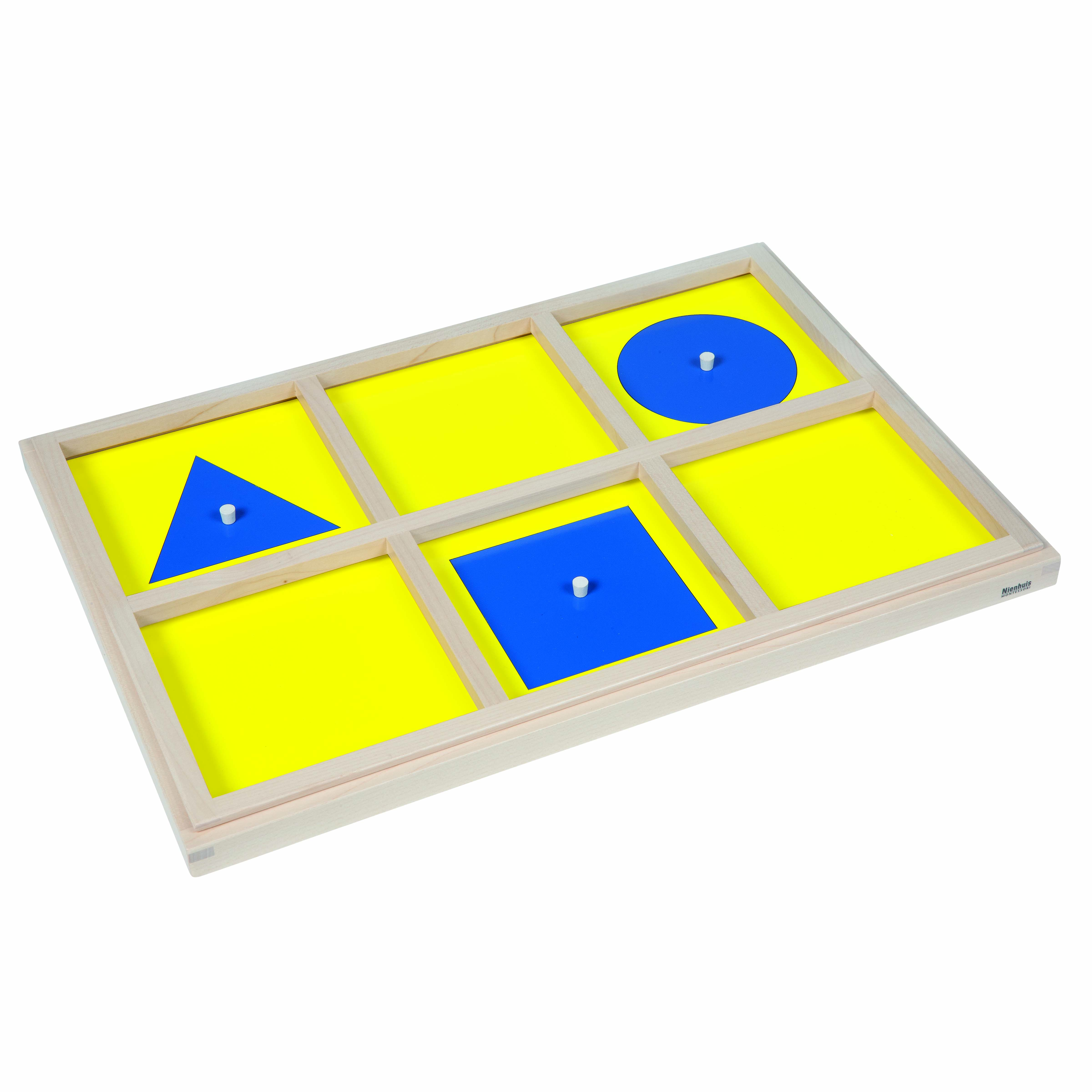
The The Demonstration Tray is a Educational Materials Montessori material designed for children aged 3-6, crafted by Nienhuis Montessori to AMI standards.
The Demonstration Tray provides a structured presentation format for introducing geometric shapes to young learners. This wooden tray features six compartments arranged in a 2×3 grid, containing three fundamental geometric forms (triangle, circle, and rectangle) with central knobs for easy manipulation. The organized layout supports the Montessori principle of isolation of difficulty, allowing children to focus on shape recognition and discrimination.
“The child is both a hope and a promise for mankind.”— Maria MontessoriEducation and Peace
“The hands are the instruments of man's intelligence.”
— Maria Montessori, The Absorbent Mind
The Demonstration Tray embodies the Montessori principle of presenting abstract concepts through concrete manipulation. Its six-compartment wooden structure creates an ordered environment where triangle, circle, and rectangle shapes become isolated subjects of study. Each geometric form within the tray features a central knob precisely sized for three-year-old fingers, transforming shape recognition from passive observation into active exploration. The 2×3 grid arrangement of the Demonstration Tray establishes visual patterns that prepare young minds for mathematical thinking, while the compartmentalized design prevents shapes from overlapping or creating confusion. This wooden tray addresses the developmental need for classification and discrimination that emerges around age three, when children begin organizing their understanding of the world into categories. The knobbed shapes within the Demonstration Tray invite repeated handling, allowing muscle memory to reinforce visual discrimination of geometric properties.
Each order includes everything needed for proper presentation and long-term use.
Follow the Montessori method of presentation for optimal child development.
Remove the circle by grasping its knob with thumb and two fingers, lifting slowly and deliberately
Trace the circle's edge with your index finger, moving clockwise from top
Name the shape clearly: 'This is a circle' while holding it at child's eye level
Return the circle to its compartment, demonstrating precise placement
Repeat the process with triangle and rectangle, emphasizing different properties
Invite the child to choose a shape and repeat the exploration
Every material is carefully selected for durability, safety, and authentic Montessori experience.
The natural wood frame provides durability while offering children a connection to natural materials, supporting the Montessori emphasis on authentic, high-quality learning tools.
Each material supports multiple areas of child development simultaneously.
The contrasting blue shapes against the natural wood background enhance visual perception and shape recognition skills.
Central knobs encourage proper pincer grip, preparing the hand for writing while building dexterity.
Introduces fundamental geometric forms that serve as the foundation for later mathematical understanding.
The structured compartments teach concepts of classification and proper material placement.
Designed for child-sized hands
Professional tips from AMI-trained guides to maximize the educational value of this material.
“Present only one shape per lesson initially, adding others only after mastery of individual forms”
'This is...', 'Show me...', 'What is...?' for vocabulary development
Store the tray at child-accessible height to encourage independent selection during work time
Observe which shapes children gravitate toward - this reveals their current sensitive period
Everything you need to know about this material.
The Demonstration Tray includes three fundamental geometric shapes: a triangle, a circle, and a rectangle. Each shape is presented with a central knob for easy handling and manipulation by young children.
The tray features six compartments in a 2×3 grid layout, following the Montessori principle of isolation of difficulty. This organized structure helps children focus on one concept at a time, making shape recognition and discrimination more accessible and less overwhelming.
The Demonstration Tray is specifically designed for children ages 3-6 years, aligning with the sensitive period for sensorial exploration and geometric shape recognition in early childhood development.
The central knobs on each geometric shape support the development of the pincer grip, preparing children for future writing activities. They also make it easier for small hands to manipulate the shapes independently, promoting self-directed learning.
Yes, the Demonstration Tray can be used for various extensions including sorting activities, matching exercises, tracing work, and language development as children learn shape vocabulary. The compartments can also hold related materials for comprehensive geometry lessons.
Can't find what you're looking for?
Contact Our Experts
Share your experience with this material and help other educators and parents.


