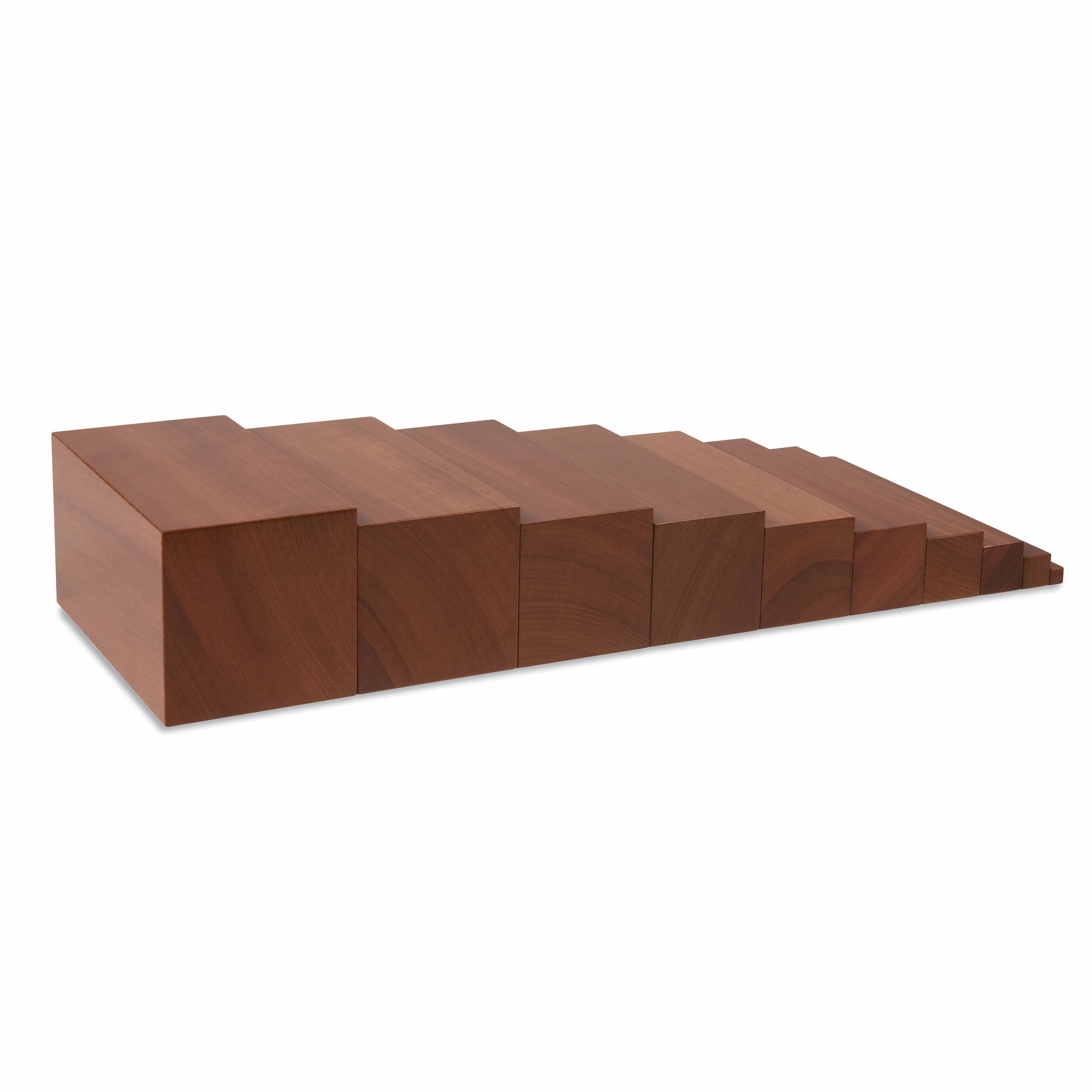
The The Brown Stair is a Sensorial Montessori material designed for children aged 3-6, crafted by Nienhuis Montessori to AMI standards.
The Brown Stair is a fundamental Montessori Sensorial material consisting of ten solid wooden prisms that vary in width and height while maintaining the same length. This precision-crafted material isolates the concept of dimension, helping children develop visual discrimination of size while building essential vocabulary for mathematical concepts and spatial relationships.
“The senses, being explorers of the world, open the way to knowledge.”— Maria MontessoriThe Discovery of the Child
“Children display a universal love of mathematics, which is par excellence the science of precision, order, and intelligence.”
— Maria Montessori, The Discovery of the Child
The Brown Stair introduces children to systematic variations in dimension through ten precisely graduated wooden prisms. Each prism increases by one centimeter in width and height while maintaining a constant twenty-centimeter length, creating a material that isolates the concept of thickness. The Brown Stair's wooden construction provides substantial weight differences that children experience kinesthetically as they carry each prism individually to their work mat. This deliberate one-piece-at-a-time movement develops muscular memory of dimensional relationships. The Brown Stair prepares the mathematical mind by offering concrete experiences with the base-ten system through its ten distinct prisms. Children build the stair horizontally or vertically, discovering relationships between sizes through trial and error. The material's self-correcting nature becomes apparent when an incorrectly placed prism creates visual disharmony in the graduated sequence. These wooden blocks serve as indirect preparation for geometry, volume calculation, and the decimal system, while their precise dimensions establish a sensorial foundation for understanding mathematical relationships.
Each order includes everything needed for proper presentation and long-term use.
Follow the Montessori method of presentation for optimal child development.
Begin building by selecting the thickest prism as the base
Continue selecting the next thickest prism, placing it precisely on top or beside the previous one
Complete the stair with all ten prisms in order
Invite the child to observe the stair from different angles
Dismantle by removing one prism at a time, returning each to the shelf
Every material is carefully selected for durability, safety, and authentic Montessori experience.
Each prism is crafted from carefully selected hardwood, chosen for its durability and smooth grain. The natural wood allows children to feel the weight difference between sizes, adding a tactile dimension to the visual discrimination exercise.
Each material supports multiple areas of child development simultaneously.
Refines the ability to perceive subtle differences in dimension, preparing the visual sense for reading and mathematics.
Introduces concepts of graduation, sequence, and the decimal system through concrete manipulation.
Builds vocabulary for comparative and superlative terms: thick/thin, thicker/thinner, thickest/thinnest.
The precise sequence required for building the stair develops sustained attention and appreciation for order.
Designed for child-sized hands
Professional tips from AMI-trained guides to maximize the educational value of this material.
“Present this material after the child has worked successfully with the Pink Tower”
Ensure prisms are carried horizontally with both hands to prevent dropping
Store the Brown Stair on a low shelf where children can access it independently
Check regularly that all edges remain smooth and splinter-free for safe handling
Everything you need to know about this material.
The Brown Stair consists of 10 wooden prisms, each 20cm in length. The smallest prism measures 1cm x 1cm in cross-section, increasing by 1cm increments up to the largest at 10cm x 10cm. This systematic progression helps children understand dimensional relationships.
While both materials teach dimension discrimination, the Brown Stair focuses on two dimensions (width and height) with constant length, whereas the Pink Tower varies in all three dimensions. Children often use them together to explore relationships between 2D and 3D concepts.
Children develop visual discrimination of size, hand-eye coordination, concentration, and order. They also build vocabulary (thick/thin, thicker/thinner, thickest/thinnest) and prepare for mathematical concepts like measurement, seriation, and the decimal system.
Most children begin working with the Brown Stair around age 3-3.5, after mastering simpler sensorial materials. They should have developed adequate hand control and be able to carry the prisms carefully. Interest typically continues through age 6.
Extensions include combining with the Pink Tower to create patterns, using with the Red Rods for length comparison, tracing prisms to create designs, building various structures, and eventually measuring with rulers to connect to mathematical concepts.
Can't find what you're looking for?
Contact Our Experts
Share your experience with this material and help other educators and parents.


