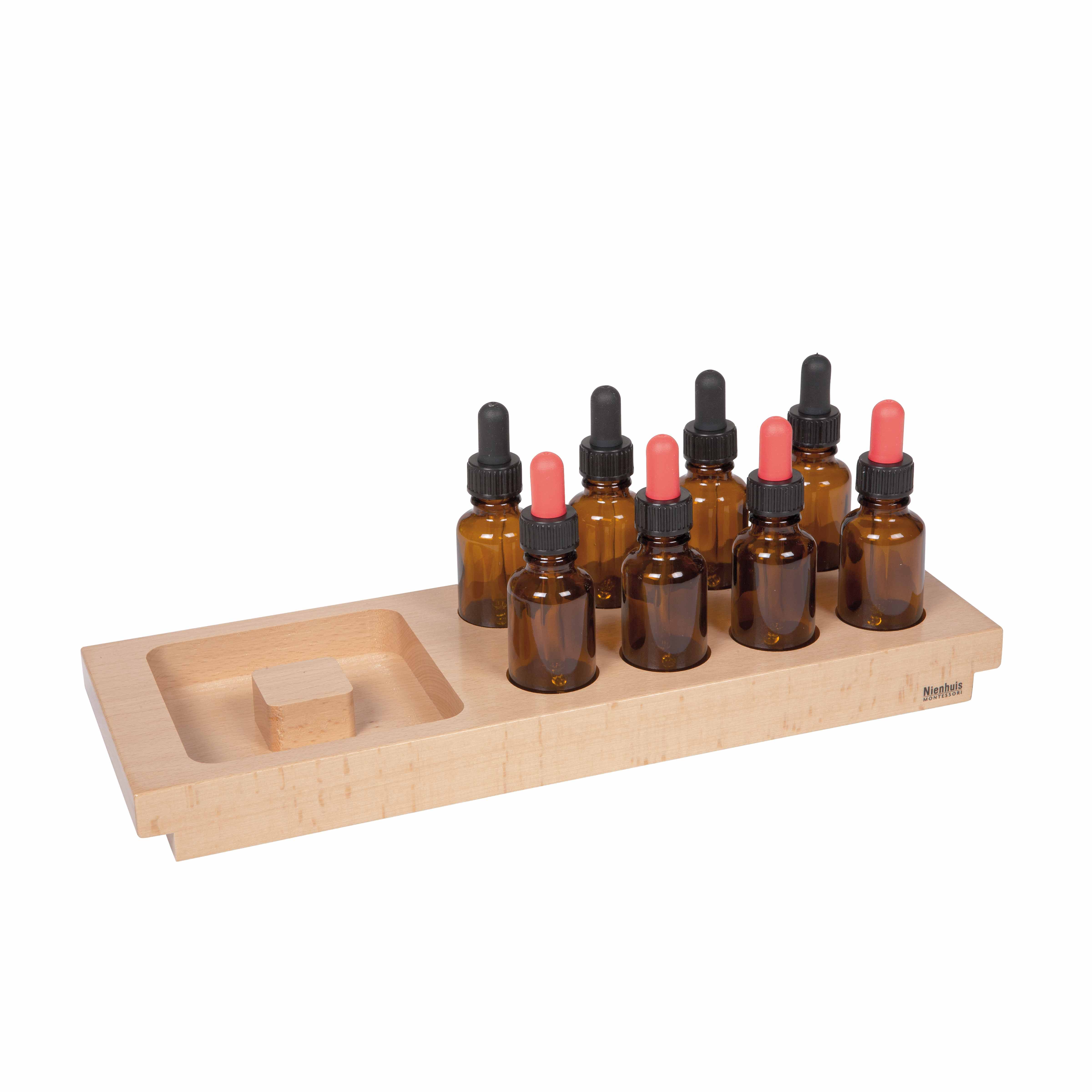
The Tasting Exercise is a Educational Materials Montessori material designed for children aged 3-6, crafted by Nienhuis Montessori to AMI standards.
This professional-grade Tasting Exercise set from Nienhuis features nine amber glass dropper bottles housed in a beautifully crafted wooden tray with recessed compartments for organized storage. The alternating black and pink rubber droppers provide visual distinction while children explore gustatory discrimination through carefully prepared taste samples, developing their sensory perception and vocabulary for describing flavors.
“The child is both a hope and a promise for mankind.”— Maria MontessoriEducation and Peace
“The hands are the instruments of man's intelligence.”
— Maria Montessori, The Absorbent Mind
The Tasting Exercise with amber glass dropper bottles addresses the child's critical need to refine gustatory discrimination during the sensorial sensitive period. Between ages three and six, children actively seek experiences that isolate and clarify each sense, and the Tasting Exercise provides precise control through its dropper bottles that release exact amounts of liquid. The wooden tray's recessed compartments create an ordered environment where children can methodically explore sweet, salty, sour, and bitter tastes. The alternating black and pink rubber droppers enable children to establish a system for organizing their taste explorations, transforming abstract flavor concepts into concrete experiences. Through repeated work with these nine bottles, children build the neural pathways necessary for refined taste discrimination, laying groundwork for future appreciation of subtle flavors in foods. The amber glass protects taste solutions from light degradation while allowing children to observe the careful handling required for this precise sensorial work.
Each order includes everything needed for proper presentation and long-term use.
Follow the Montessori method of presentation for optimal child development.
Demonstrate proper dropper technique: squeeze bulb before inserting, release slowly to draw liquid, squeeze gently to dispense one drop
Show child how to place one drop on tongue tip, close mouth, and experience the taste fully
Introduce taste vocabulary: 'This tastes sweet' while child experiences the sensation
Progress to matching exercises: taste from one bottle, then find its pair
Every material is carefully selected for durability, safety, and authentic Montessori experience.
The amber-colored glass bottles protect taste samples from UV light degradation, ensuring the integrity of natural flavors while providing a safe, non-reactive storage solution.
The solid wood construction provides a warm, inviting presentation while teaching children to handle delicate materials with care and respect.
Each material supports multiple areas of child development simultaneously.
Refines the sense of taste by isolating and comparing different flavors, building sensory awareness and discrimination skills.
Expands descriptive language as children learn to articulate subtle differences between sweet, sour, salty, and bitter tastes.
Introduces systematic exploration through controlled tastings, developing observation and comparison skills essential for scientific thinking.
Using the droppers strengthens pincer grip and hand-eye coordination while teaching precise, controlled movements.
Designed for child-sized hands
Professional tips from AMI-trained guides to maximize the educational value of this material.
“Replace solutions weekly and label bottle bottoms with taste types for quick verification”
rinse droppers between different tastes to prevent contamination
Observe children's facial expressions as valuable assessment of their taste discrimination development
Create a taste journal where children can draw or describe their taste experiences
Everything you need to know about this material.
Prepare four basic tastes: sweet (sugar water), salty (salt water), sour (diluted lemon juice), and bitter (tonic water). Start with mild concentrations and adjust based on children's sensitivity. You can also introduce umami (mild broth) for older children.
Begin with just two contrasting tastes (sweet and salty). Demonstrate placing one drop on your tongue using the dropper, describe the taste, then invite the child to try. Gradually introduce more tastes as the child becomes comfortable with the exercise.
The extra bottles allow for variations in concentration, creating a grading exercise where children can sequence tastes from mild to strong. They also enable matching exercises with duplicate taste samples and provide flexibility for introducing additional flavors like umami or herbal tastes.
Replace taste solutions weekly or biweekly depending on usage. Always use distilled water for preparations, store the tray in a cool area away from direct sunlight, and check solutions before each use. Label preparation dates on the tray's underside.
Start with basic taste names: sweet, salty, sour, bitter. Gradually introduce descriptive language like 'mild,' 'strong,' 'pleasant,' 'sharp.' Encourage comparisons to familiar foods and discuss where we taste different flavors on our tongue.
Can't find what you're looking for?
Contact Our Experts
Share your experience with this material and help other educators and parents.


