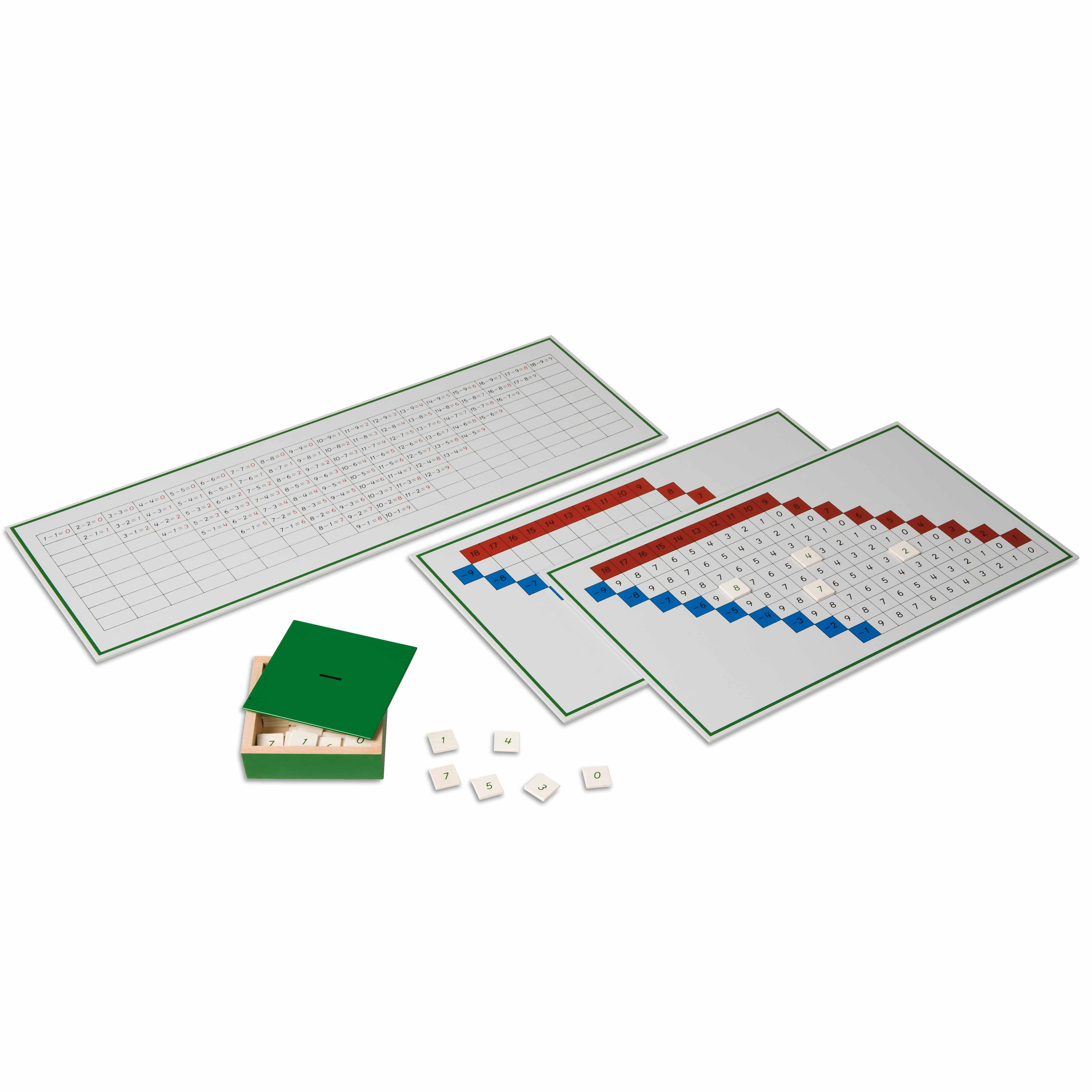
The Subtraction Working Charts is a Mathematics Montessori material designed for children aged 3-6, crafted by Nienhuis Montessori to AMI standards.
The Subtraction Working Charts provide systematic practice for memorizing subtraction facts through hands-on manipulation of number tiles. Children work through color-coded grid patterns on laminated charts, building fluency with subtraction combinations while the wooden storage box keeps materials organized and accessible for repeated practice.
“Children display a universal love of mathematics, which is par excellence the science of precision, order, and intelligence.”— Maria MontessoriThe Discovery of the Child
“The greatest sign of success for a teacher is to be able to say, 'The children are now working as if I did not exist.'”
— Maria Montessori, The Absorbent Mind
The Subtraction Working Charts fulfill the mathematical mind's need for precision and pattern recognition during the absorbent mind period. These laminated charts with their color-coded grid patterns provide the concrete manipulation necessary before abstract mathematical thinking emerges. The systematic arrangement of subtraction facts on each chart allows children to discover mathematical relationships through repeated handling of number tiles. The wooden storage box serves as both a practical organizer and a visual cue for the work's importance in the prepared environment. Unlike random practice, these charts present subtraction combinations in a structured sequence that reveals the inherent order within mathematics. The tactile experience of placing tiles on specific grid positions creates muscle memory that reinforces numerical understanding. Through independent work with these charts, children build the foundation for mental arithmetic while satisfying their innate drive for exactness and completion.
Each order includes everything needed for proper presentation and long-term use.
Follow the Montessori method of presentation for optimal child development.
Begin with the first subtraction fact on Chart 1, reading '9-1'
Find the answer tile '8' and place it in the corresponding grid position
Continue systematically through all facts on the chart
Remove all tiles and return them to storage before moving to Chart 2
Every material is carefully selected for durability, safety, and authentic Montessori experience.
The smooth wooden box with sliding lid teaches children proper material care while providing tactile feedback during daily use.
Each material supports multiple areas of child development simultaneously.
Systematic practice with subtraction facts builds automatic recall through repetitive, hands-on work with number tiles.
Color-coded grids help children identify mathematical relationships and patterns within subtraction families.
Precise placement of small tiles in grid squares refines pincer grip and hand-eye coordination.
Working through charts systematically develops logical thinking and understanding of number relationships.
Designed for child-sized hands
Professional tips from AMI-trained guides to maximize the educational value of this material.
“Introduce charts only after solid understanding of subtraction with golden beads”
Observe which facts cause hesitation and note for targeted three-period lessons
Create a progress chart where children mark completed worksheets to track mastery
Use the color patterns to highlight mathematical relationships during group lessons
Everything you need to know about this material.
While suitable for ages 3-6, most children begin using these charts around age 5, after mastering addition concepts and having experience with concrete subtraction materials like the strip board. The child should understand quantity relationships before memorizing facts.
The color coding visually organizes subtraction combinations by patterns, helping children recognize relationships between facts. For example, all combinations that equal the same difference share colors, making it easier to identify and memorize fact families systematically.
The complete set includes multiple laminated working charts with color-coded grids, numbered tiles for creating equations, control charts for self-correction, and a wooden storage box with compartments to organize all materials for easy access and maintenance.
Children typically begin with Chart 1, working through simple combinations systematically. As they gain proficiency, they move to Chart 2 which presents facts in different patterns. The progression builds from concrete understanding to abstract memorization of all subtraction facts through 18-9.
Yes, after initial presentations, children can work independently with these charts. The self-correcting nature of the control charts allows children to check their own work, building confidence and autonomy while practicing subtraction facts at their own pace.
Can't find what you're looking for?
Contact Our Experts
Share your experience with this material and help other educators and parents.


