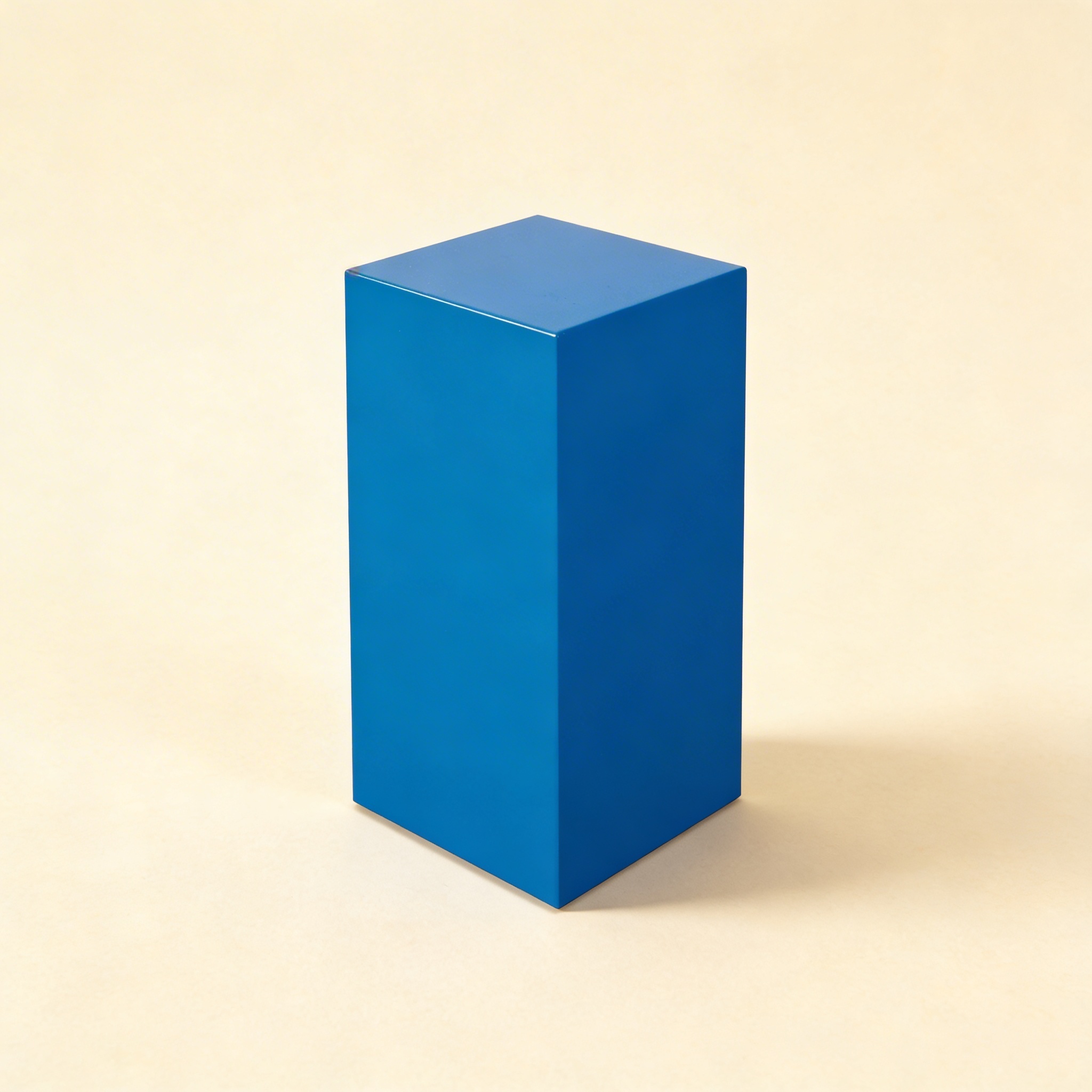
The Square Based Prism — Geometric Solid for Spatial Exploration is a Sensorial Montessori material designed for children aged 6-12, crafted by Nienhuis Montessori to AMI standards.
This Square Based Prism is a fundamental geometric solid from the Montessori sensorial curriculum, featuring a glossy lacquered finish that invites tactile exploration. The rectangular prism with its square base introduces children to three-dimensional geometry concepts while developing spatial awareness and mathematical thinking through hands-on manipulation.
“The greatest sign of success for a teacher is to be able to say, 'The children are now working as if I did not exist.'”— Maria MontessoriThe Absorbent Mind
“Free the child's potential, and you will transform him into the world.”
— Maria Montessori, To Educate the Human Potential
The Square Based Prism embodies Dr. Montessori's principle of educating the senses as the foundation for intellectual development. Through the manipulation of this geometric solid, children move from concrete sensorial experiences to abstract mathematical concepts. The material's precise dimensions and smooth finish provide clear sensorial feedback, allowing the child to internalize geometric properties through touch and movement. This aligns with Montessori's observation that children construct their intelligence through purposeful interaction with scientifically designed materials. The prism serves as a bridge between the early sensorial work with the Geometric Solids and the advanced mathematical explorations in elementary, demonstrating the spiral curriculum where concepts are revisited with increasing complexity and abstraction.

Each order includes everything needed for proper presentation and long-term use.
Follow the Montessori method of presentation for optimal child development.
Invite the child to carry the prism carefully to the mat, holding it with both hands
Explore the prism tactilely, running fingers along edges and counting faces, edges, and vertices
Compare the square base with the rectangular faces, noting similarities and differences
Trace around the base and sides on paper to create a net of the prism
Find objects in the environment that have the same form
Every material is carefully selected for durability, safety, and authentic Montessori experience.
The smooth, glossy surface provides important tactile feedback while the weight of solid wood helps children understand mass and volume relationships
Each material supports multiple areas of child development simultaneously.
Introduces rectangular prisms and square bases, building foundation for advanced geometry and volume calculations
Develops three-dimensional thinking through exploration of faces, edges, and vertices
Concrete representation of abstract mathematical principles including area, perimeter, and volume
The smooth surface and precise edges refine tactile discrimination and visual perception
Designed for child-sized hands
Professional tips from AMI-trained guides to maximize the educational value of this material.
“Introduce this material after the child has worked extensively with the basic Geometric Solids and can identify them stereognostically”
use it in language for descriptive writing, in art for observational drawing, and in cultural studies when examining architecture
Create a 'family of prisms' display showing various prisms with different polygonal bases to highlight the defining characteristics
Use the material to bridge sensorial and mathematical work by introducing measurement activities and formula derivation when the child is ready
Everything you need to know about this material.
While specific measurements vary by manufacturer, this square based prism is typically designed to be proportional to other Montessori geometric solids, usually measuring between 10-15cm in height with a square base of approximately 5-7cm per side, making it comfortable for children's hands to manipulate.
The Square Based Prism is part of the geometric solids series, typically introduced after children have mastered basic sensorial materials. It helps bridge sensorial exploration with mathematical concepts, preparing children for advanced geometry work including volume calculations, surface area studies, and understanding of three-dimensional shapes.
The high-quality lacquered finish serves multiple purposes: it provides a smooth, appealing tactile experience that engages the child's sense of touch, makes the material durable and easy to clean, and creates visual appeal that draws children to explore the material independently, which is essential in Montessori education.
Children develop spatial reasoning, three-dimensional visualization, mathematical vocabulary (edges, vertices, faces), fine motor control through handling, comparison and classification skills, and preparation for advanced geometry concepts. It also supports cross-curricular connections with art, architecture, and engineering concepts.
Begin by allowing sensorial exploration, then introduce vocabulary (square base, rectangular faces, edges, vertices). Progress to comparing with other geometric solids, creating impressions in sand or clay, drawing different perspectives, measuring dimensions, and eventually calculating surface area and volume as children advance mathematically.
Can't find what you're looking for?
Contact Our Experts
Share your experience with this material and help other educators and parents.
Bundle related materials and save. Free curriculum guide included with every set.


