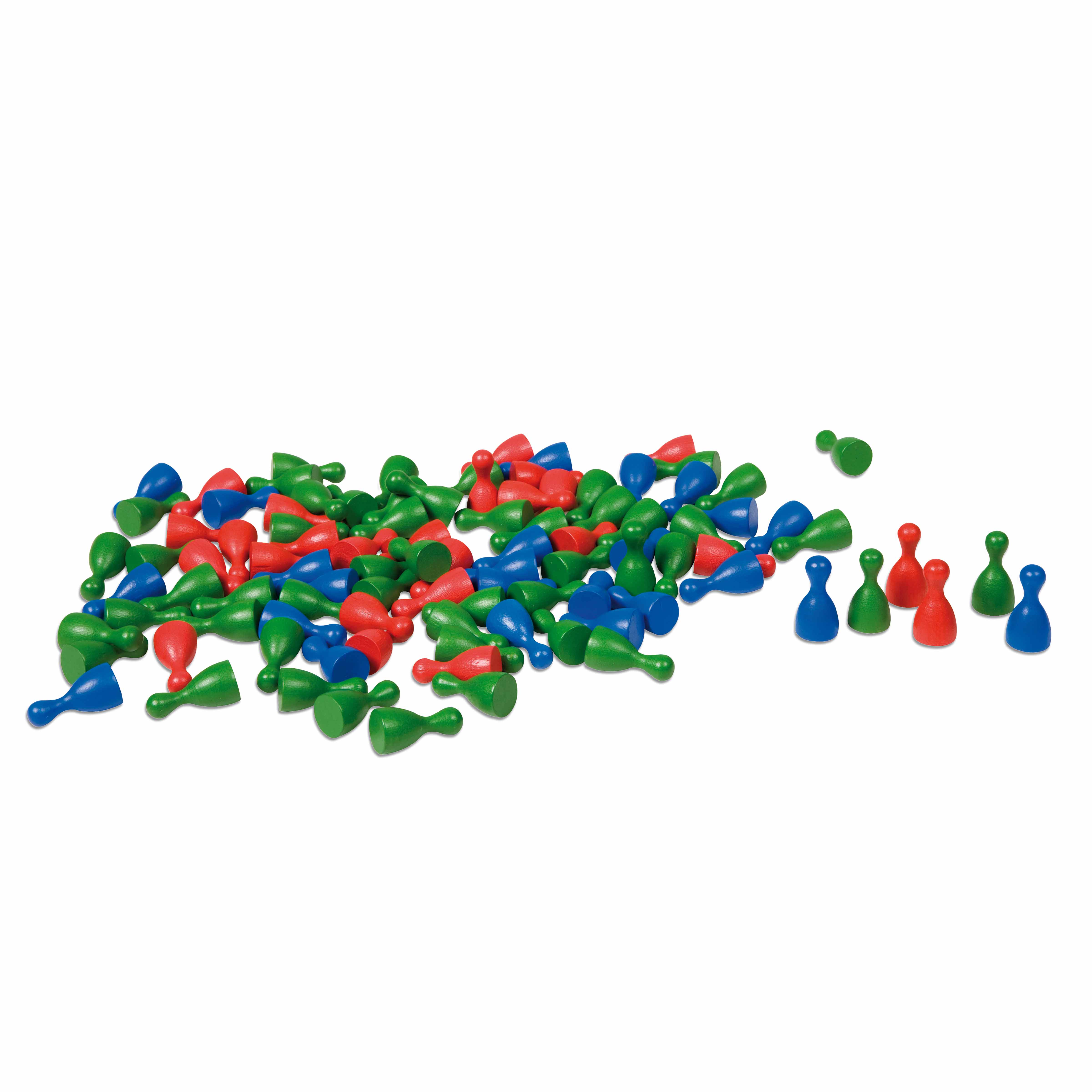
The Small Skittles: Green, Blue, Red, (100) is a Educational Materials Montessori material designed for children aged 3-6, crafted by Nienhuis Montessori to AMI standards.
These vibrant plastic skittles in green, blue, and red support essential Montessori activities for counting, sorting, and pattern work. The smooth, lightweight pieces are perfectly sized for young hands to grasp and manipulate, making them ideal for developing mathematical concepts and fine motor control in the primary classroom.
“The child is both a hope and a promise for mankind.”— Maria MontessoriEducation and Peace
“The hands are the instruments of man's intelligence.”
— Maria Montessori, The Absorbent Mind
The Small Skittles set introduces mathematical thinking through tangible manipulation of 100 colorful pieces. Each green, blue, and red skittle serves as a concrete unit for understanding quantity, allowing children to physically experience numbers before abstracting them. The three distinct colors enable classification work, where children group skittles by shared attributes, building logical thinking foundations. These lightweight plastic pieces invite repeated handling as children create patterns, count quantities, and explore mathematical relationships through direct manipulation. The skittles' uniform size and shape eliminate distractions, focusing attention on number concepts and color attributes. When children arrange ten red skittles in a row or sort all blue pieces into a container, they internalize mathematical order through purposeful movement. The 100-piece quantity specifically allows exploration of the decimal system, as children can physically group skittles into tens and experience how ten groups of ten creates one hundred.
Each order includes everything needed for proper presentation and long-term use.
Follow the Montessori method of presentation for optimal child development.
Invite the child to sort the skittles by color into the three containers
Once sorted, count each color group separately, placing skittles in rows of ten
Create simple patterns using two colors (red-blue-red-blue)
Introduce skip counting by arranging skittles in groups of 2, 5, or 10
Each material supports multiple areas of child development simultaneously.
Supports one-to-one correspondence, counting to 100, and early arithmetic through hands-on manipulation.
Develops logical thinking through sorting by color and creating patterns with three distinct colors.
The small size and smooth shape enhance pincer grasp and hand-eye coordination.
Bright, contrasting colors support color recognition and visual perception skills.
Designed for child-sized hands
Professional tips from AMI-trained guides to maximize the educational value of this material.
“Store sorted colors in separate containers to allow focused work with single colors”
'You've made three groups of ten blue skittles'
Create pattern cards for children to replicate using the skittles
'How many red skittles fit in this small box?'
Everything you need to know about this material.
The set contains 100 skittles total, distributed among green, blue, and red colors. The exact distribution per color may vary but provides sufficient quantities for sorting, counting, and pattern activities.
The skittles are specifically designed for small hands aged 3-6, with smooth edges and lightweight plastic construction. They are appropriately sized to prevent choking hazards while being easy for young children to grasp and manipulate.
These skittles support numerous Montessori math activities including one-to-one correspondence, counting 1-100, sorting by color, creating patterns, skip counting, simple addition/subtraction, and developing pre-multiplication concepts through grouping.
Yes, these plastic skittles are designed for regular classroom use with smooth, durable construction that withstands repeated handling by young children while maintaining their vibrant colors.
Absolutely! These skittles complement other Montessori materials like counting boards, number cards, sorting trays, and can be used alongside bead materials for comparative counting and mathematical concept development.
Can't find what you're looking for?
Contact Our Experts
Share your experience with this material and help other educators and parents.

