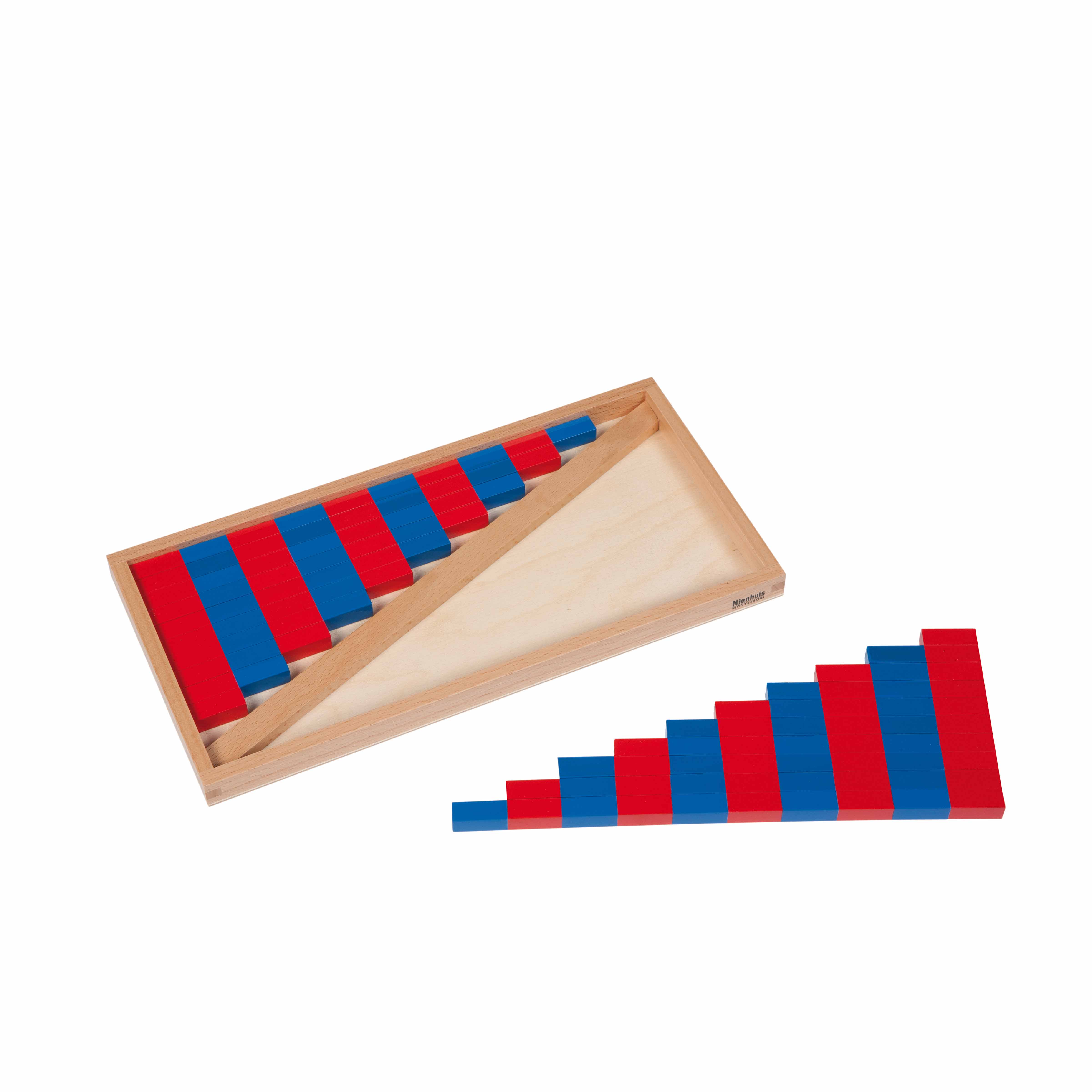
The Small Numerical Rods is a Educational Materials Montessori material designed for children aged 3-6, crafted by Nienhuis Montessori to AMI standards.
The Small Numerical Rods introduce children to the mathematical concepts of quantity and linear measurement through hands-on exploration. Each wooden rod increases in length by one unit, with alternating red and blue segments that provide a visual representation of numbers 1-10, supporting the development of mathematical reasoning and preparing children for more advanced number work.
“The child is both a hope and a promise for mankind.”— Maria MontessoriEducation and Peace
“The hands are the instruments of man's intelligence.”
— Maria Montessori, The Absorbent Mind
The Small Numerical Rods fulfill a critical developmental need by making abstract numerical concepts tangible through wooden segments children can hold, compare, and arrange. Each rod's alternating red and blue sections transform counting from memorization into physical discovery, where the child experiences that 'three' is literally three connected units painted in sequence. The precise incremental lengths of these wooden rods allow children to feel mathematical relationships in their hands—that four is one unit longer than three, creating sensorial memory of quantity. Unlike abstract number symbols, these painted wooden pieces let children build their understanding of the decimal system through manipulation, as they discover that the ten-rod contains exactly ten alternating colored segments. The Small Numerical Rods bridge the gap between the child's concrete thinking and mathematical abstraction by providing a material representation where each number has physical weight, length, and distinctive red-blue patterning that corresponds to its value.
Each order includes everything needed for proper presentation and long-term use.
Follow the Montessori method of presentation for optimal child development.
Invite the child to carry one rod at a time to build a stair pattern, starting with the shortest
Once arranged, trace along each rod from left to right, counting the segments aloud
Select any rod and count its segments, then find its position in the stair
Introduce combinations by placing rod 2 and rod 3 end-to-end beside rod 5
Every material is carefully selected for durability, safety, and authentic Montessori experience.
Each rod is crafted from durable hardwood, providing the weight and substance children need to understand the physical representation of quantity.
Each material supports multiple areas of child development simultaneously.
Introduces counting, sequence, and the decimal system through concrete manipulation of graduated lengths.
The alternating color pattern helps children visually distinguish individual units within each quantity.
Arranging rods by length develops understanding of mathematical relationships and progression.
Physical representation of numbers 1-10 creates a sensorial foundation for later abstract mathematical concepts.
Designed for child-sized hands
Professional tips from AMI-trained guides to maximize the educational value of this material.
“Store rods horizontally in a designated box to prevent warping and make selection easier”
Check regularly that paint edges remain crisp for clear segment distinction
Introduce vocabulary like 'unit,' 'length,' and 'quantity' during presentations
Allow ample repetition before introducing numeral cards to ensure concept mastery
Everything you need to know about this material.
The Small Numerical Rods teach quantity recognition, counting 1-10, linear measurement, number sequence, and the relationship between numbers and physical length. The alternating red and blue segments help children visually understand each unit, preparing them for addition and subtraction concepts.
Small Numerical Rods are more compact and portable, designed for individual work at a table, while Large Number Rods are floor materials. Both teach the same concepts, but the smaller size makes them ideal for home use, limited classroom space, and allows children to manipulate them more easily.
Children can arrange rods in order from shortest to longest, count the segments, match rods with number cards, create staircases, compare lengths, combine rods to explore addition, and use them for measuring objects. These activities develop mathematical thinking and number sense.
Each rod is divided into 10cm segments, with the shortest rod being 10cm and the longest 100cm (1 meter). They're made from smooth, high-quality wood with non-toxic red and blue paint. The set includes 10 rods stored in a wooden box for easy organization.
Children typically begin around age 3.5-4, after mastering one-to-one correspondence and showing interest in counting. They should have experience with sensorial materials like the Red Rods. Most children use them actively until age 5-6, though they remain valuable for introducing new mathematical concepts.
Can't find what you're looking for?
Contact Our Experts
Share your experience with this material and help other educators and parents.


