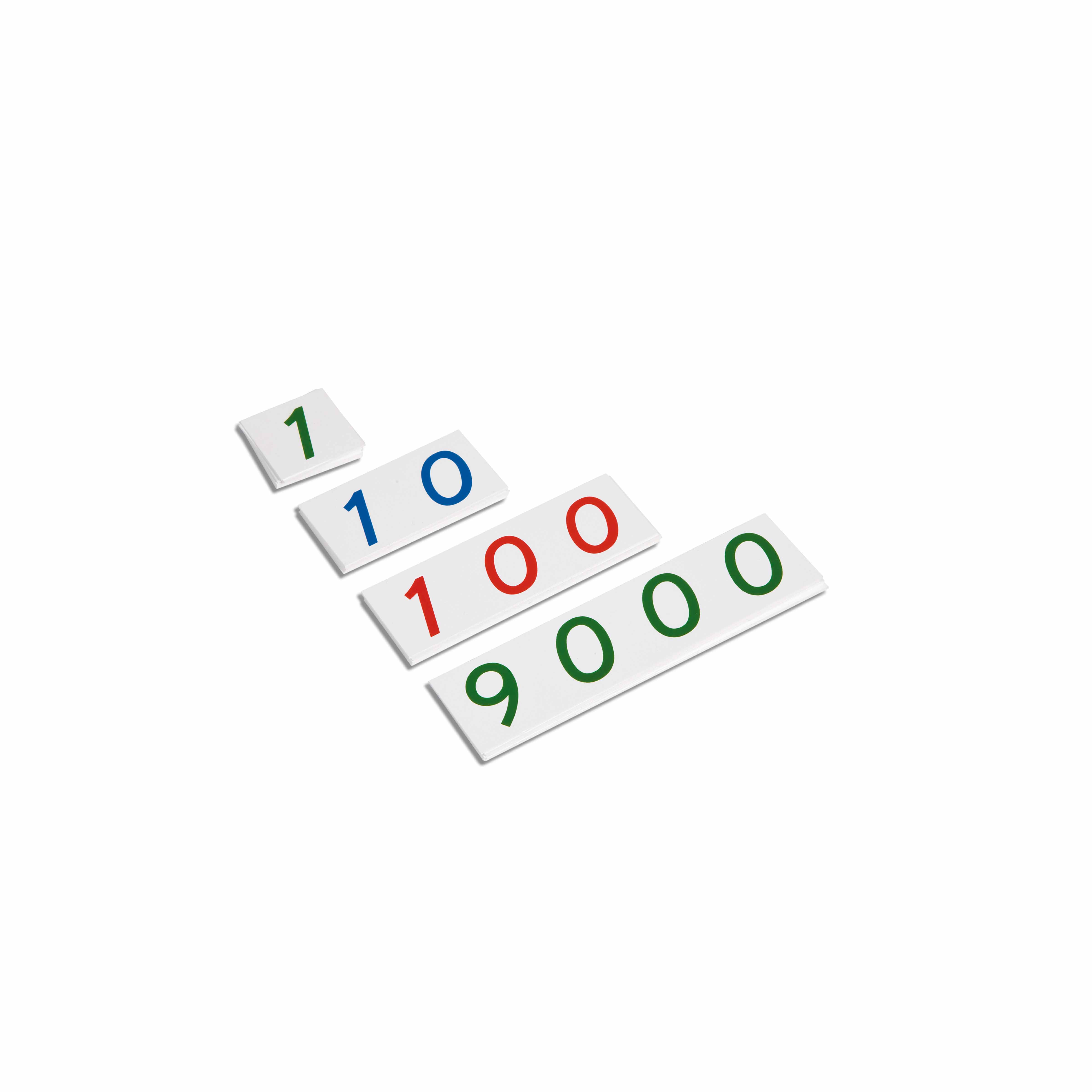
The Small Number Cards 1-9000: Plastic is a Mathematics Montessori material designed for children aged 3-6, crafted by Nienhuis Montessori to AMI standards.
These durable plastic Small Number Cards introduce children to the decimal system through hands-on exploration of numbers 1-9000. The color-coded design follows Montessori principles with green units, blue tens, red hundreds, and green thousands, enabling children to build and understand multi-digit numbers through visual and tactile manipulation. Essential for developing place value comprehension and preparing for advanced mathematical operations.
“Children display a universal love of mathematics, which is par excellence the science of precision, order, and intelligence.”— Maria MontessoriThe Discovery of the Child
“The greatest sign of success for a teacher is to be able to say, 'The children are now working as if I did not exist.'”
— Maria Montessori, The Absorbent Mind
The Small Number Cards 1-9000 embody Montessori's belief that children construct mathematical understanding through manipulation of concrete materials. These plastic cards with their distinctive color coding—green units, blue tens, red hundreds, and green thousands—make the abstract concept of place value visible and tangible. When children physically overlay a blue 40 card with a green 3 card to create 43, they experience the decimal system's hierarchical structure through their hands. The cards' systematic progression from 1 to 9000 respects the child's need to explore number relationships independently. Unlike static number representations, these moveable cards allow children to build, deconstruct, and reconstruct any number within their range, fostering deep comprehension of how our number system operates. The color-coding system provides immediate visual feedback about place value categories, enabling children to self-correct as they work with increasingly complex numbers.
Each order includes everything needed for proper presentation and long-term use.
Follow the Montessori method of presentation for optimal child development.
Introduce units first, having the child arrange green cards 1-9 vertically
Add tens column, showing how 10, 20, 30 progress with zeros
Demonstrate overlaying: place 40 on the mat, then slide 3 partially over it to show 43
Invite child to build specific numbers like 256 using appropriate cards
Challenge child to build numbers you say aloud: 'Please make 3,847'
Each material supports multiple areas of child development simultaneously.
Visual color-coding helps children internalize the decimal system structure and understand how numbers are composed.
Layering cards to create multi-digit numbers develops understanding of number composition and mathematical relationships.
Transitions children from concrete quantity work to abstract number symbols, preparing for advanced mathematical concepts.
Color-coded system enhances pattern recognition and helps children identify place value positions quickly.
Designed for child-sized hands
Professional tips from AMI-trained guides to maximize the educational value of this material.
“Store cards in separate containers by place value to maintain organization and support independent work”
Introduce only as many place values as the child can manage—some may work only with units and tens initially
'two thousand, four hundred, fifty-six' rather than 'twenty-four fifty-six'
Create number-building games where children race to construct numbers you call out
Everything you need to know about this material.
These cards are designed for children ages 3-6, aligning with the Montessori primary classroom curriculum for introducing the decimal system and place value concepts.
The Montessori color-coding system (green units, blue tens, red hundreds, green thousands) provides visual hierarchy that helps children distinguish between place values and understand the pattern of the decimal system.
Small Number Cards are individual cards for building numbers, while Large Number Cards are typically used for group lessons. Small cards allow children to physically manipulate and layer numbers to create quantities from 1-9999.
Plastic cards are more durable, water-resistant, and easier to clean than wooden alternatives. They maintain their shape better with frequent handling and are ideal for classroom environments with multiple children.
Children layer the cards to build numbers, practice reading large numbers, match quantities with symbols, and perform operations like addition and subtraction by physically manipulating the place values.
Can't find what you're looking for?
Contact Our Experts
Share your experience with this material and help other educators and parents.

