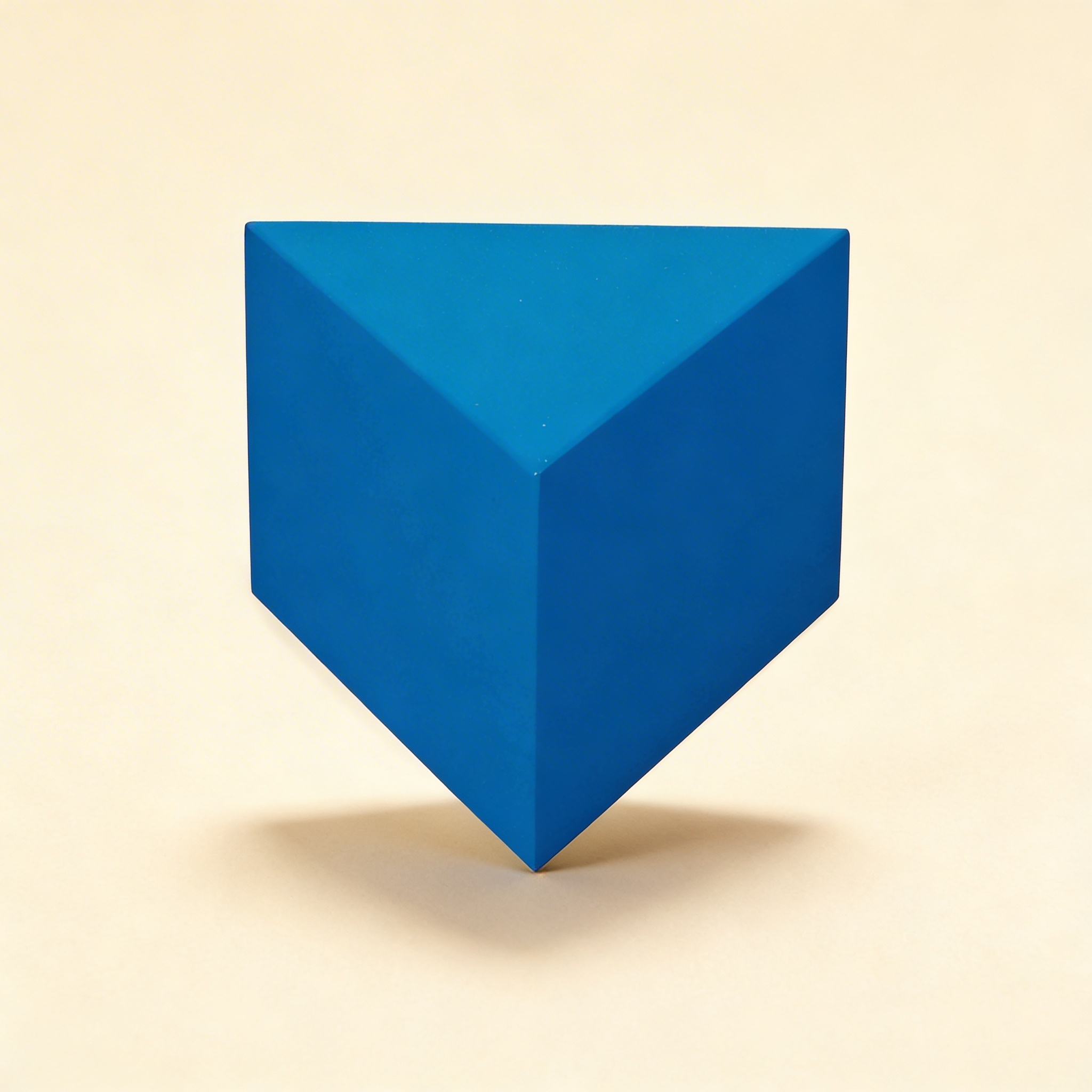
The Triangular Prism — Short Based Geometric Solid is a Sensorial Montessori material designed for children aged 6-12, crafted by Nienhuis Montessori to AMI standards.
This Short Triangular Based Prism is a fundamental geometric solid used in the Montessori elementary curriculum for exploring three-dimensional forms and their properties. Part of the geometric solids series, this painted wooden prism helps children understand the relationship between two-dimensional shapes and their three-dimensional counterparts, supporting advanced geometry studies.
“The greatest sign of success for a teacher is to be able to say, 'The children are now working as if I did not exist.'”— Maria MontessoriThe Absorbent Mind
“Free the child's potential, and you will transform him into the world.”
— Maria Montessori, To Educate the Human Potential
The Short Triangular Based Prism embodies Montessori's principle of concrete to abstract learning, allowing children to physically manipulate and explore geometric concepts before moving to theoretical understanding. This material supports the mathematical mind's development during the second plane, when children seek to understand the 'how' and 'why' of the world. Through sensorial exploration, children discover geometric relationships independently, building upon their earlier work with the geometric cabinet. The solid's tactile nature engages multiple senses, creating stronger neural pathways for geometric understanding. This material bridges the gap between the sensorial experiences of the first plane and the abstract reasoning required in advanced mathematics, honoring the child's need for both concrete manipulation and intellectual challenge during the elementary years.
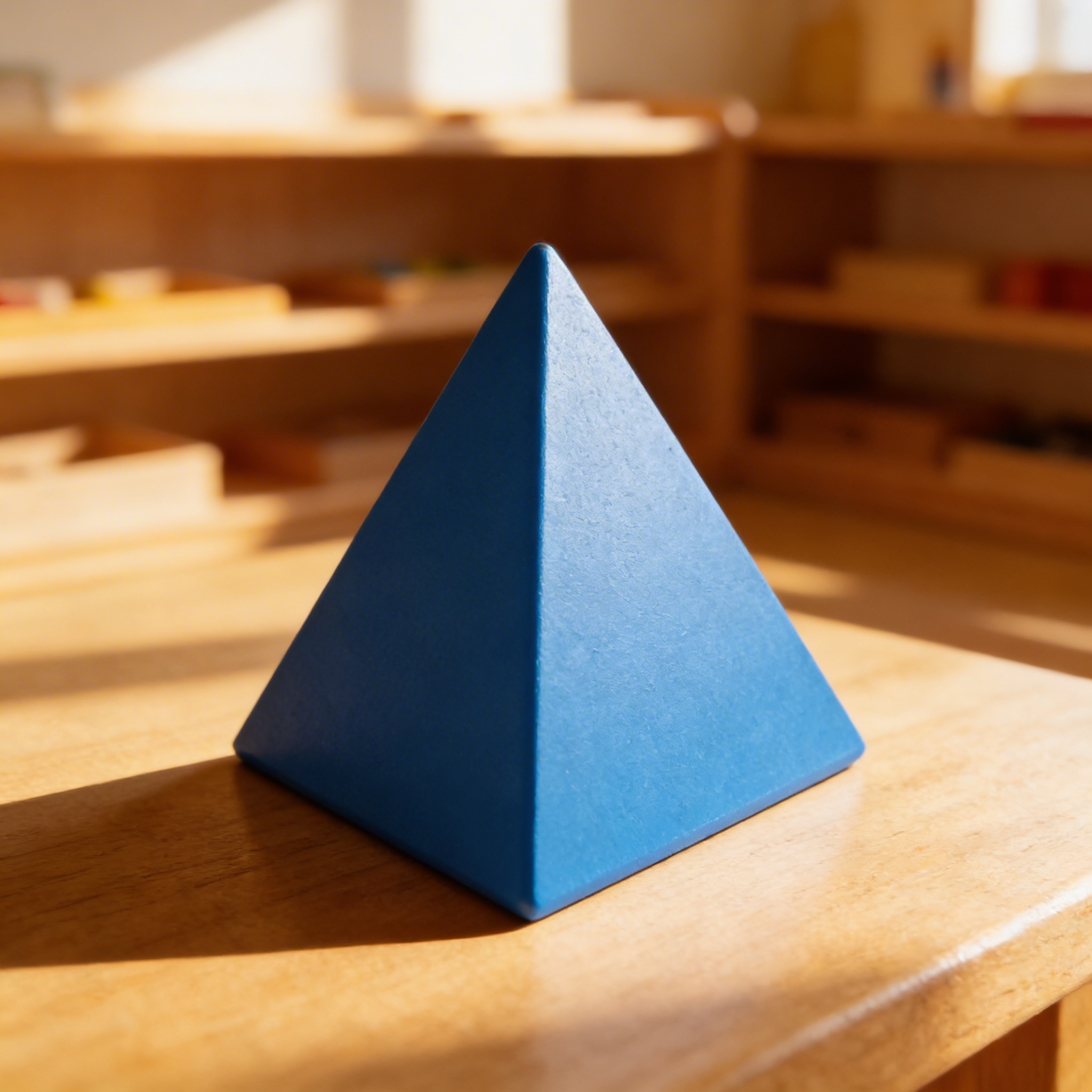
Each order includes everything needed for proper presentation and long-term use.
Follow the Montessori method of presentation for optimal child development.
Invite the child to explore the prism with closed eyes, feeling edges, vertices, and faces
Introduce vocabulary: base, lateral faces, edges, vertices, using the three-period lesson
Trace around each face on paper to create a net of the prism
Count and record the number of faces, edges, and vertices
Explore how the prism relates to the triangle from the geometric cabinet
Every material is carefully selected for durability, safety, and authentic Montessori experience.
The smooth painted finish provides a uniform surface that helps children focus on the geometric properties rather than wood grain patterns, while still offering the weight and solidity essential for sensorial exploration.
Each material supports multiple areas of child development simultaneously.
Develops the ability to recognize forms through touch and muscular memory, essential for abstract geometric thinking.
Introduces concepts of faces, edges, and vertices while building understanding of how 2D shapes create 3D forms.
Enhances visualization skills and understanding of three-dimensional relationships through hands-on exploration.
Provides concrete referent for geometric vocabulary including prism, triangular base, and rectangular faces.
Designed for child-sized hands
Professional tips from AMI-trained guides to maximize the educational value of this material.
“Present this material after the child has worked extensively with the geometric cabinet and basic geometric solids”
Connect to real-world examples like roof structures, camping tents, or chocolate bars to make learning relevant
Use precise mathematical language consistently - avoid simplified terms that children will need to unlearn later
Allow ample time for free exploration before introducing formal concepts or calculations
Everything you need to know about this material.
This Montessori geometric solid typically measures approximately 10cm in length with a triangular base of about 5cm per side, making it ideal for elementary-aged children to handle and explore comfortably during geometry lessons.
The short triangular prism helps children understand 3D shapes, calculate surface area and volume, identify faces, edges, and vertices, and make connections between 2D triangular shapes and their 3D forms, essential for elementary geometry curriculum.
Children can trace faces to create nets, explore cross-sections, calculate measurements, sort and classify with other solids, study light and shadows, and use it for advanced nomenclature work identifying parts of three-dimensional shapes.
Yes, this triangular prism is designed to work with the complete Montessori geometric solids collection, including cubes, spheres, cylinders, pyramids, and other prisms, allowing comprehensive exploration of three-dimensional geometry concepts.
Elementary students can create architectural models, study crystal formations, explore volume formulas (V = base area × height), investigate real-world applications of prisms, and connect to studies in physics, engineering, and natural sciences.
Can't find what you're looking for?
Contact Our Experts
Share your experience with this material and help other educators and parents.
Bundle related materials and save. Free curriculum guide included with every set.


