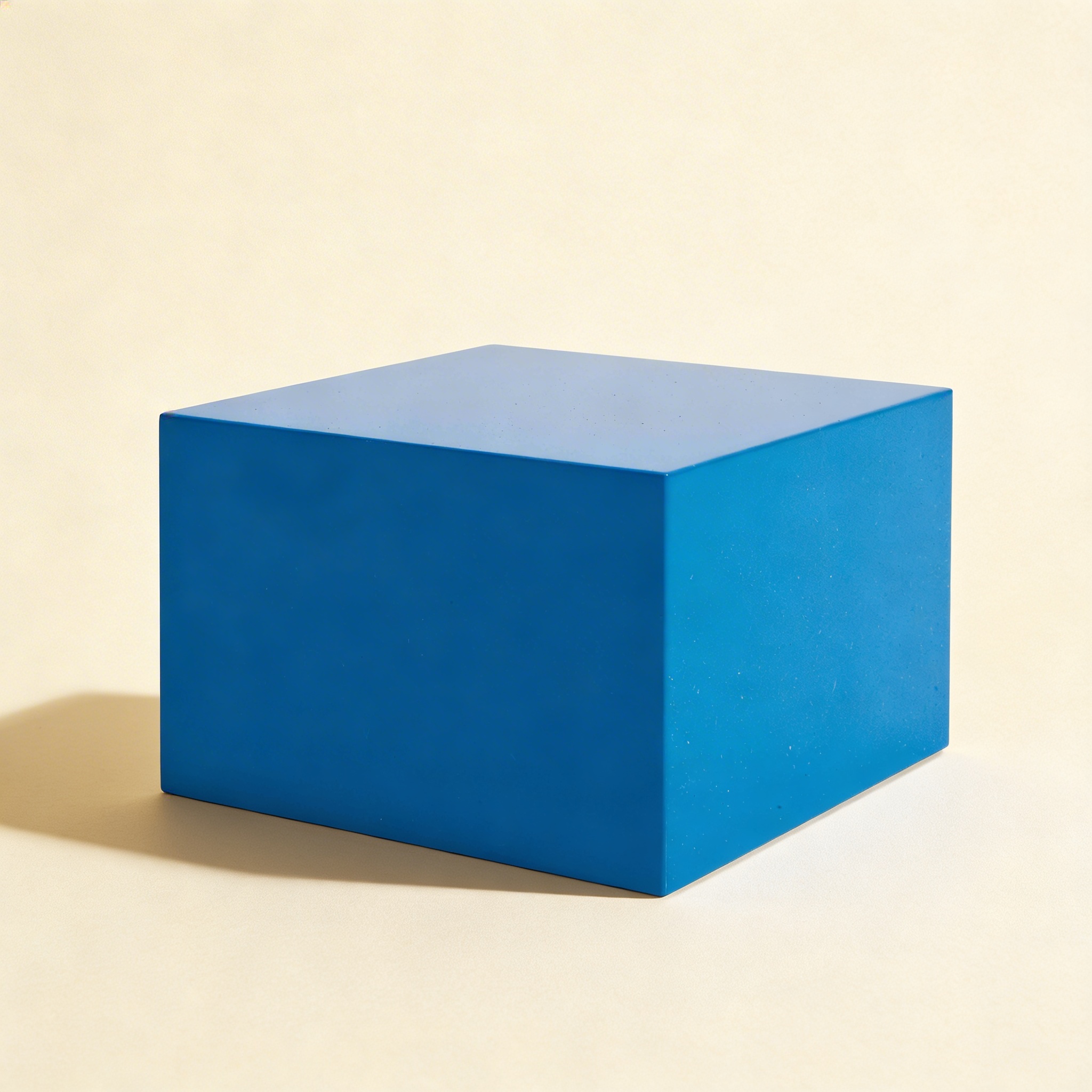
The Square Prism — Short Based Geometric Solid is a Sensorial Montessori material designed for children aged 6-12, crafted by Nienhuis Montessori to AMI standards.
This Short Square Based Prism is a fundamental Montessori geometric solid that helps children develop spatial awareness and mathematical concepts. Part of the elementary geometry materials, this precisely crafted blue prism introduces children to three-dimensional forms, supporting their understanding of volume, surface area, and the relationship between two-dimensional and three-dimensional shapes.
“The child is both a hope and a promise for mankind.”— Maria MontessoriEducation and Peace
“The hands are the instruments of man's intelligence.”
— Maria Montessori, The Absorbent Mind
The Short Square Based Prism embodies Montessori's principle of concrete to abstract learning, where children manipulate tangible objects before advancing to abstract geometric concepts. This material honors the child's mathematical mind during the second plane of development (6-12 years), when they seek to understand the how and why of the world. Through sensorial exploration, children discover geometric relationships independently, building upon their earlier work with the geometric cabinet and constructive triangles. The material's precise dimensions and smooth surfaces provide clear, isolated concepts that allow children to internalize the properties of three-dimensional forms through repeated handling and investigation.

Each order includes everything needed for proper presentation and long-term use.
Follow the Montessori method of presentation for optimal child development.
Invite the child to explore the prism with their hands, feeling all surfaces and edges
Identify and count the faces (6), edges (12), and vertices (8)
Trace around each face on paper to discover the 2D shapes that compose the solid
Measure edges to calculate surface area of each face
Build the net of the prism using the traced shapes
Every material is carefully selected for durability, safety, and authentic Montessori experience.
Each prism is manufactured to exact specifications, ensuring mathematical accuracy for geometric studies and sensorial exploration.
Each material supports multiple areas of child development simultaneously.
Introduces rectangular prisms and the concept of square bases versus rectangular bases through tactile exploration.
Prepares for advanced geometry concepts including volume calculation, surface area, and spatial relationships.
Develops stereognostic sense through handling and comparing three-dimensional forms.
Bridges concrete manipulation to abstract geometric concepts through hands-on experience with precise forms.
Designed for child-sized hands
Professional tips from AMI-trained guides to maximize the educational value of this material.
“Present after child has mastered geometric cabinet and has experience with area calculations”
Use precise mathematical language consistently - avoid casual terms like 'box' or 'block'
Connect to cultural studies by identifying prisms in architecture from different civilizations
Prepare sets of measurement cards for independent work with surface area and volume
Everything you need to know about this material.
The Short Square Based Prism typically measures approximately 10cm in height with a 10cm x 10cm square base, making it proportionally shorter than the tall version while maintaining the same base dimensions for comparative work.
This prism helps children ages 6-12 understand 3D shapes, calculate volume and surface area, identify faces, edges, and vertices, and make connections between 2D nets and 3D forms through hands-on exploration.
Children can trace faces to create nets, compare with other prisms, calculate volume using unit cubes, explore surface area concepts, sort and classify shapes, and use it for shadow work and perspective drawing exercises.
The blue color is part of Montessori's systematic approach to geometric solids, where consistent coloring helps children focus on the shape's properties rather than color variations, supporting clear visual discrimination and classification work.
Children should have experience with the Geometric Solids from the sensorial area, basic measurement skills, and familiarity with squares and rectangles before working with calculations involving this prism.
Can't find what you're looking for?
Contact Our Experts
Share your experience with this material and help other educators and parents.
Bundle related materials and save. Free curriculum guide included with every set.


