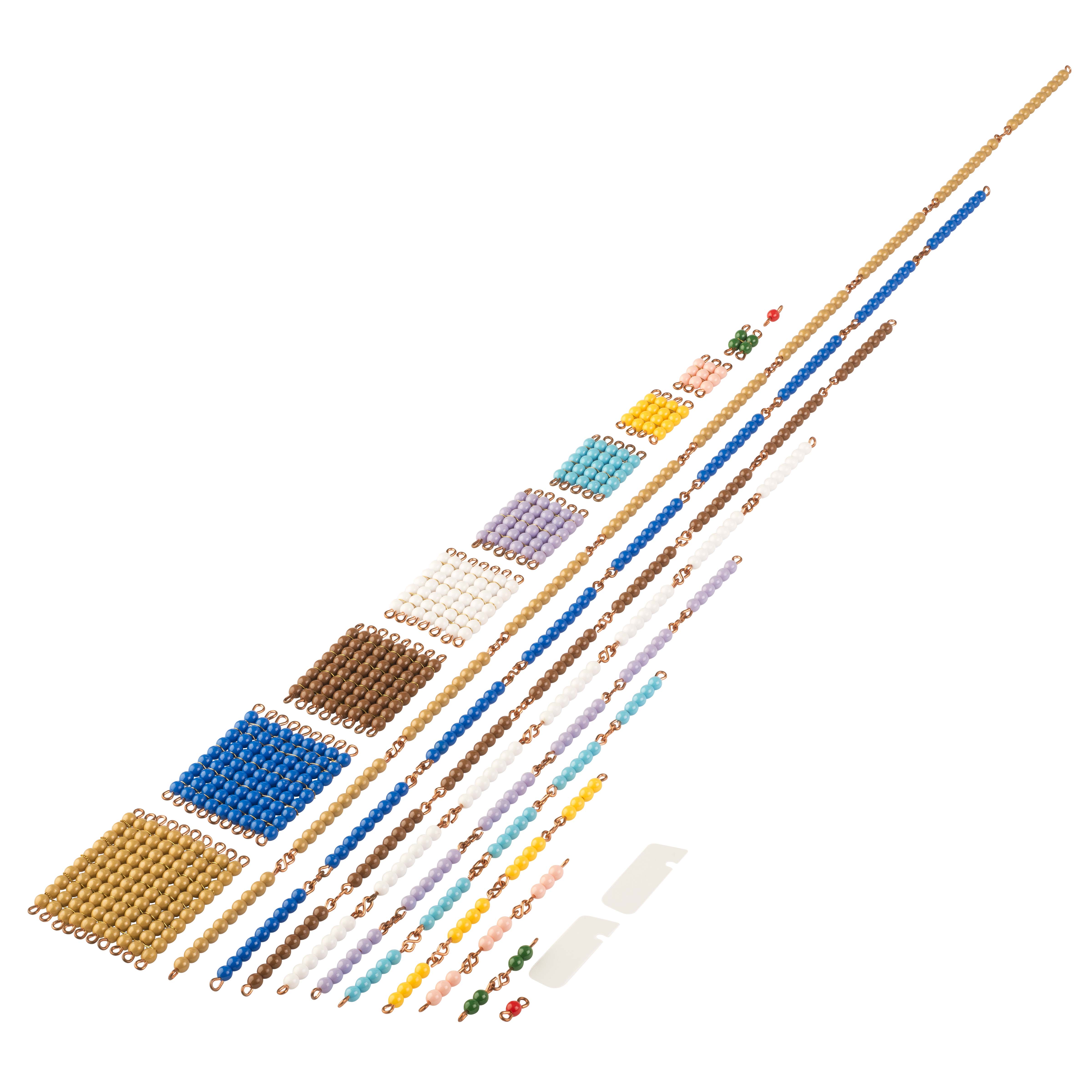
The Short Bead Chains: Individual Beads Nylon is a Mathematics Montessori material designed for children aged 3-6, crafted by Nienhuis Montessori to AMI standards.
This Short Bead Chain set features color-coded plastic beads strung on durable nylon cords, providing a concrete representation of numbers 1-10 in both square and linear chain formats. The set includes bead squares and their corresponding chains, with metal loop connectors that allow children to explore skip counting, squaring, and the relationship between linear and square representations of numbers.
“Children display a universal love of mathematics, which is par excellence the science of precision, order, and intelligence.”— Maria MontessoriThe Discovery of the Child
“The greatest sign of success for a teacher is to be able to say, 'The children are now working as if I did not exist.'”
— Maria Montessori, The Absorbent Mind
The Short Bead Chains with their color-coded plastic beads strung on nylon cords transform abstract numerical concepts into tangible experiences for young children. Each chain's specific length—from one bead to ten beads squared—allows children to physically count, compare, and internalize mathematical relationships through repeated handling. The metal loop connectors between beads create natural counting points that invite skip counting exploration, while the corresponding bead squares reveal the geometric relationship between linear counting and squared numbers. These nylon-strung chains address the developmental need for concrete mathematical experiences before abstraction, as children between ages 3-6 require physical manipulation to understand quantity. The durable plastic beads withstand countless repetitions as children build their understanding through touching, moving, and arranging each chain. By presenting both linear chains and their square formations together, this material bridges the gap between counting and more complex mathematical operations, preparing the mathematical mind through sensorial exploration.
Each order includes everything needed for proper presentation and long-term use.
Follow the Montessori method of presentation for optimal child development.
Begin with the chain of 1, counting the single bead and matching it to the square of 1
Progress to chain of 2, counting 1, 2 and then showing how two groups of 2 make the square
Continue with longer chains, introducing skip counting at the metal connectors
Compare the stretched chain length to its corresponding square formation
Each material supports multiple areas of child development simultaneously.
Provides concrete representation of squaring numbers and the relationship between linear counting and square numbers.
Chains enable practice of skip counting by 2s, 3s, 4s, etc., laying foundation for multiplication.
Color-coded system helps children recognize number patterns and develop visual memory for quantities.
Handling individual beads and chains refines pincer grasp and hand-eye coordination.
Designed for child-sized hands
Professional tips from AMI-trained guides to maximize the educational value of this material.
“Store chains on individual hooks or pegs to prevent tangling and teach careful material handling”
Introduce chains gradually—master chains 1-5 before presenting 6-10
Use number tickets to mark skip counting points and reinforce numeral recognition
Create a dedicated chain-counting rug or runner to accommodate the full length of stretched chains
Everything you need to know about this material.
These Short Bead Chains are designed for children ages 3-6, aligning with the Montessori early childhood curriculum for introducing mathematical concepts through concrete, hands-on materials.
The Short Bead Chains teach skip counting, squaring numbers, number sequences 1-10, and the relationship between linear counting and square representations. Children also develop understanding of multiplication and mathematical patterns.
The beads are made from durable color-coded plastic, strung on strong nylon cords with metal loop connectors. This construction ensures longevity in classroom use while maintaining the precise bead arrangement needed for mathematical work.
Children lay out the linear chain and fold it to match the bead square, discovering that 3x3=9 or 4x4=16. This concrete manipulation helps them understand squaring as repeated addition and see the physical relationship between linear and square formats.
While the chains can be used independently, they work best with number arrows for labeling, a mat for layout work, and ideally coordinate with the Montessori bead cabinet. The chains also prepare children for later work with long bead chains and cubing materials.
Can't find what you're looking for?
Contact Our Experts
Share your experience with this material and help other educators and parents.

