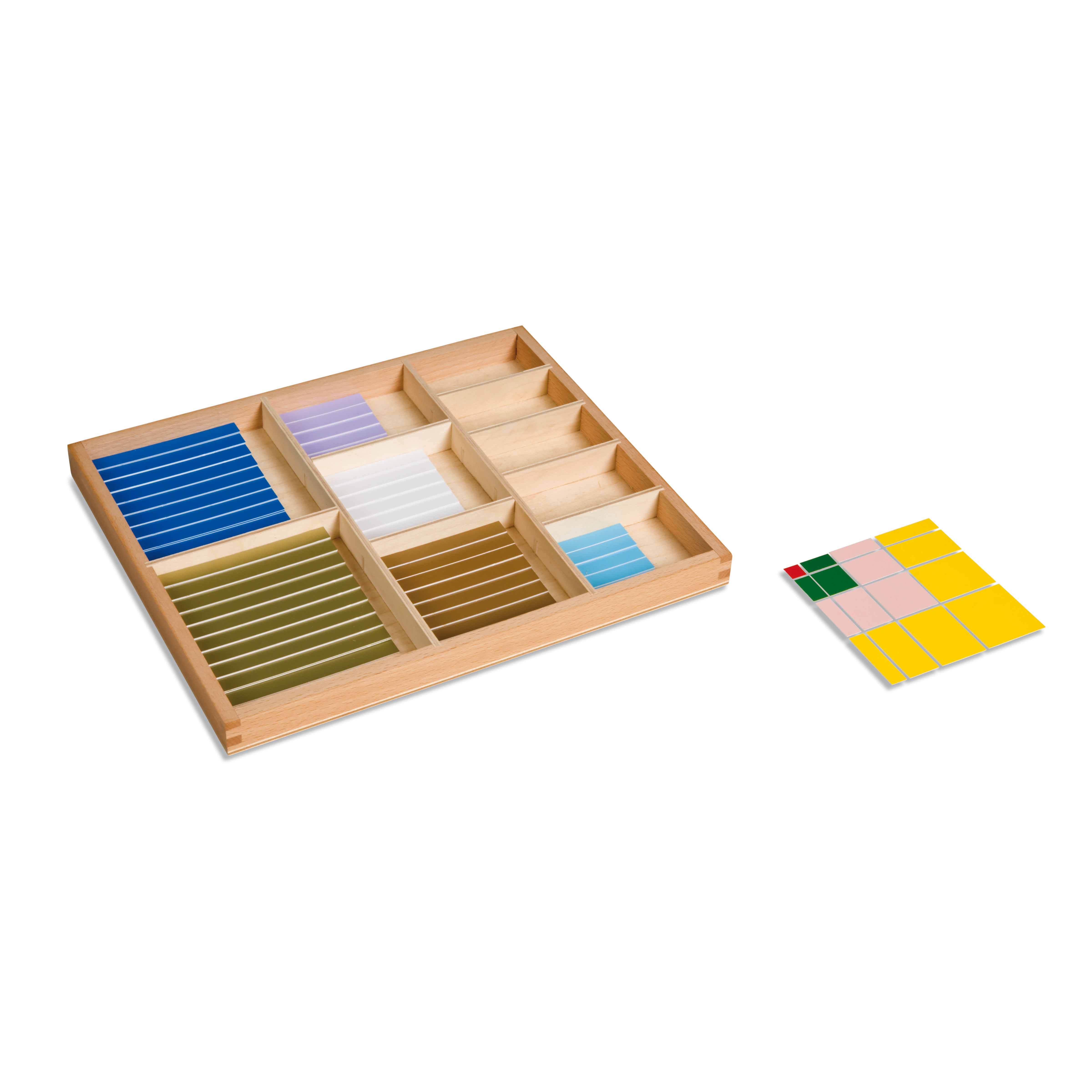
The Sensorial Decanomial is a Mathematics Montessori material designed for children aged 3-6, crafted by Nienhuis Montessori to AMI standards.
The Sensorial Decanomial is a fundamental Montessori mathematics material that provides a concrete representation of algebraic concepts through color-coded wooden tiles. This precisely crafted set enables children to build the decanomial square, exploring mathematical relationships and patterns while developing visual discrimination and preparation for advanced mathematics.
“Children display a universal love of mathematics, which is par excellence the science of precision, order, and intelligence.”— Maria MontessoriThe Discovery of the Child
“The greatest sign of success for a teacher is to be able to say, 'The children are now working as if I did not exist.'”
— Maria Montessori, The Absorbent Mind
The Sensorial Decanomial introduces algebraic thinking through color-coded wooden tiles that children manipulate to construct the decanomial square. Each tile's distinct color represents a specific numerical value, allowing the child to physically build (a+b)² = a² + 2ab + b² without abstract symbols. The Sensorial Decanomial bridges sensorial exploration with mathematical abstraction by presenting algebraic relationships as visible, tangible patterns. Unlike abstract number work, these wooden tiles enable children to discover mathematical laws through their own construction and observation. The material's progression from sensorial pattern-building to recognizing algebraic formulas demonstrates Montessori's principle of moving from concrete to abstract understanding. By physically arranging the Sensorial Decanomial's tiles to form perfect squares and rectangles, children internalize mathematical relationships years before encountering formal algebra.
Each order includes everything needed for proper presentation and long-term use.
Follow the Montessori method of presentation for optimal child development.
Sort all tiles by color into separate piles on the mat
Begin with the red unit square, placing it in the top left corner
Add the green rectangles (1x2) along the top and left edges
Continue building outward, following the color pattern for each value
Complete the square by filling in all positions according to the pattern
Every material is carefully selected for durability, safety, and authentic Montessori experience.
Each tile is carefully crafted from solid wood to exact proportions, ensuring mathematical accuracy and durability for years of classroom use.
The non-toxic paint colors follow Montessori's specific color-coding system, creating visual associations that support mathematical understanding.
Each material supports multiple areas of child development simultaneously.
Bridges concrete manipulation to abstract algebraic thinking through visual and tactile exploration of the decanomial square.
Develops ability to identify and predict mathematical patterns through systematic arrangement of color-coded pieces.
Refines visual perception through work with graduated sizes and specific color relationships.
Provides sensorial foundation for understanding binomial and trinomial theorems in later mathematical work.
Designed for child-sized hands
Professional tips from AMI-trained guides to maximize the educational value of this material.
“Present this material only after the child has mastered the binomial and trinomial cubes”
Allow extensive exploration time - pattern discovery requires unhurried observation
Connect the visual patterns to skip counting and multiplication facts the child knows
Document the child's square construction with photos to track understanding progression
Everything you need to know about this material.
The Sensorial Decanomial introduces algebraic concepts including squaring, multiplication, factoring, and the commutative property. Children visually explore the relationship between (a+b)² and a²+2ab+b², building a concrete foundation for algebra through color-coded tiles that represent different numerical values.
The Sensorial Decanomial focuses on visual and sensorial exploration of mathematical patterns using color-coded wooden tiles, while the regular Decanomial involves numerical calculations. This material emphasizes pattern recognition and spatial relationships, making it accessible to younger children who aren't yet ready for complex calculations.
Children should be familiar with basic Montessori sensorial materials, have developed fine motor control, and show interest in patterns and building. Prior experience with the Pink Tower, Brown Stair, and Color Tablets helps, though direct mathematical knowledge isn't required as this material introduces concepts sensorially.
The complete set includes 55 different tile sizes in 10 distinct colors, with multiple pieces of each size totaling several hundred tiles. Each color represents numbers 1-10, with precise dimensions allowing children to build the complete decanomial square when all pieces are correctly arranged.
Begin by introducing one color family at a time, showing how pieces fit together. Progress to building simple squares (1x1, 2x2), then demonstrate the commutative property using rectangles. Finally, guide children to construct the complete decanomial square, encouraging independent exploration of patterns throughout.
Can't find what you're looking for?
Contact Our Experts
Share your experience with this material and help other educators and parents.


