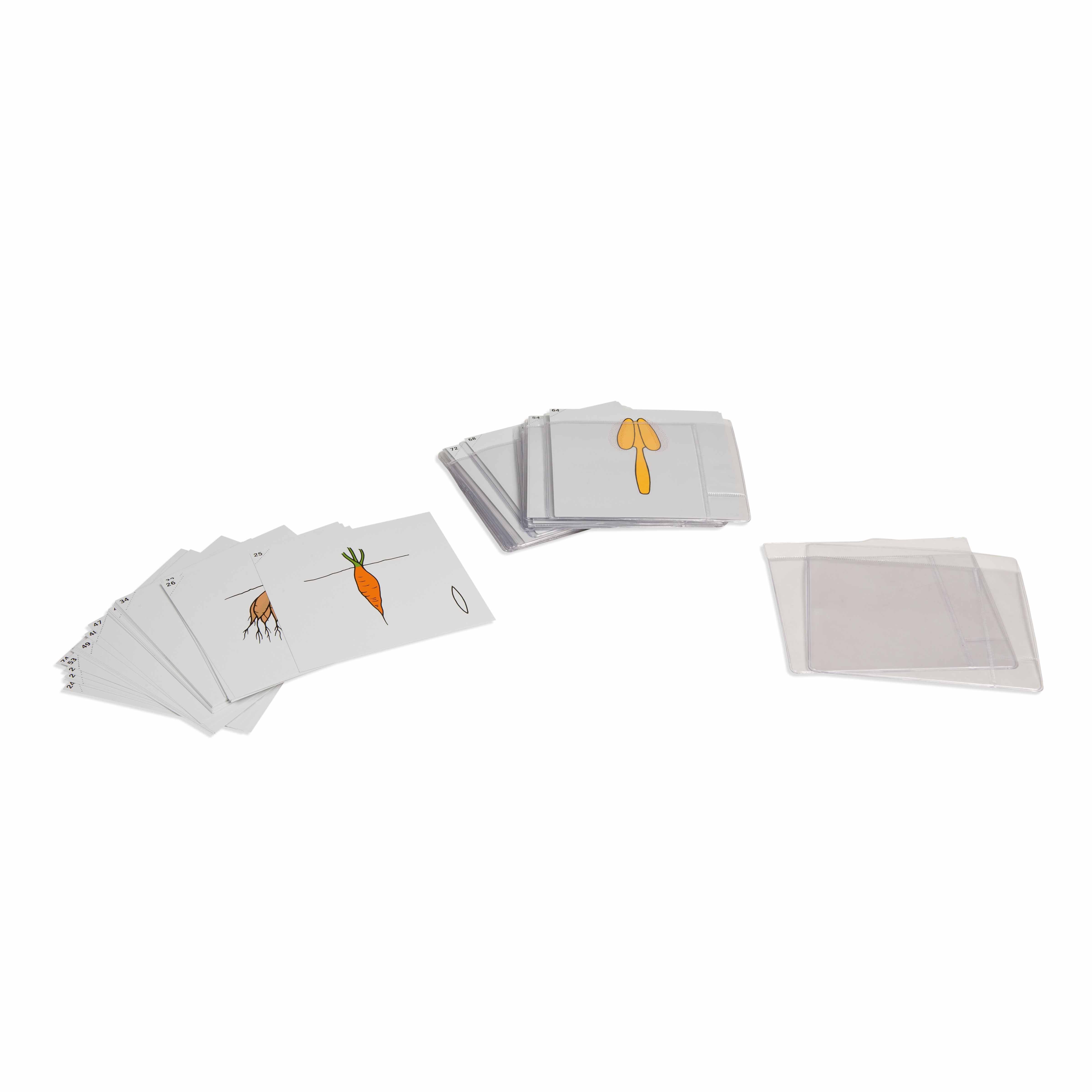
The Second Set Of Botany Cards is a category.biology Montessori material designed for children aged 3-6, crafted by Nienhuis Montessori to AMI standards.
These Second Set of Botany Cards expand children's botanical knowledge through detailed illustrated nomenclature cards featuring root vegetables, fungi, and plant structures. Each card is protected in durable plastic sleeves, providing a comprehensive visual reference for understanding plant diversity and morphology in the Montessori Biology curriculum.
“Education is a natural process spontaneously carried out by the human individual, and is acquired not by listening to words but by experiences upon the environment.”— Maria MontessoriEducation for a New World
“The child is both a hope and a promise for mankind.”
— Maria Montessori, Education and Peace
The Second Set of Botany Cards presents root vegetables, fungi, and plant structures through precise illustrated nomenclature cards, addressing the child's need to classify and understand the natural world beyond basic plant forms. These cards in protective plastic sleeves build upon foundational botanical knowledge by introducing specialized plant categories that children encounter in daily life but rarely examine systematically. The detailed illustrations on each card isolate specific botanical features, allowing children to perceive subtle differences between underground stems and true roots, or between various fungi types. This second set fulfills the developmental need for increasingly refined classification skills as children progress from general to specific understanding. The cards' focus on root vegetables connects botanical study to familiar foods, while fungi cards introduce life forms that blur traditional plant-animal boundaries. By presenting these diverse plant structures through clear visual nomenclature, the cards satisfy the absorbent mind's hunger for precise language and detailed observation of nature's variations.
Each order includes everything needed for proper presentation and long-term use.
Follow the Montessori method of presentation for optimal child development.
Begin with root vegetables, presenting 3-4 cards showing carrots, turnips, and radishes
Introduce vocabulary using three-period lesson: 'This is a taproot,' showing the carrot card
Compare fungi cards, noting differences between mushrooms, bracket fungi, and molds
Match plant structure cards to real specimens when available
Create sorting games: 'grows underground' versus 'grows above ground'
Each material supports multiple areas of child development simultaneously.
Children learn to categorize and identify different plant types, developing scientific thinking and observation skills essential for biological studies.
Precise botanical terminology expands language skills while building a foundation for advanced plant studies and scientific nomenclature.
Detailed illustrations help children recognize subtle differences between plant structures, enhancing perceptual skills and attention to detail.
Building upon the first set, children deepen their understanding of plant diversity and develop systematic approaches to learning.
Designed for child-sized hands
Professional tips from AMI-trained guides to maximize the educational value of this material.
“Present root vegetables first as children often have prior experience with these foods”
Use fungi cards to introduce decomposer concept without overwhelming technical terms
Create connection between lunch foods and botanical studies using the root vegetable cards
Prepare supplementary materials like cross-sections of actual roots for comparison
Everything you need to know about this material.
This set includes detailed illustrated nomenclature cards featuring root vegetables, fungi, and various plant structures, expanding upon basic botanical concepts to provide a more comprehensive understanding of plant diversity and morphology.
The Second Set advances botanical learning by introducing more complex plant classifications including root vegetables and fungi, while the First Set typically covers basic plant parts like leaves, flowers, and trees. This set provides deeper exploration of plant structures and diversity.
While children can use these cards independently, having experience with the First Set provides a helpful foundation. The Second Set builds upon basic botanical concepts, so familiarity with fundamental plant parts and vocabulary enhances the learning experience.
Each card is protected in durable plastic sleeves, making them resistant to spills, frequent handling, and daily classroom use. This protective coating ensures the detailed illustrations remain clear and vibrant through years of hands-on learning activities.
These cards complement botany lessons through three-part card activities, matching exercises, and vocabulary building. They support classification work, enhance observation skills, and can be used alongside real specimens, nature walks, and gardening activities to create comprehensive botanical studies.
Can't find what you're looking for?
Contact Our Experts
Share your experience with this material and help other educators and parents.

