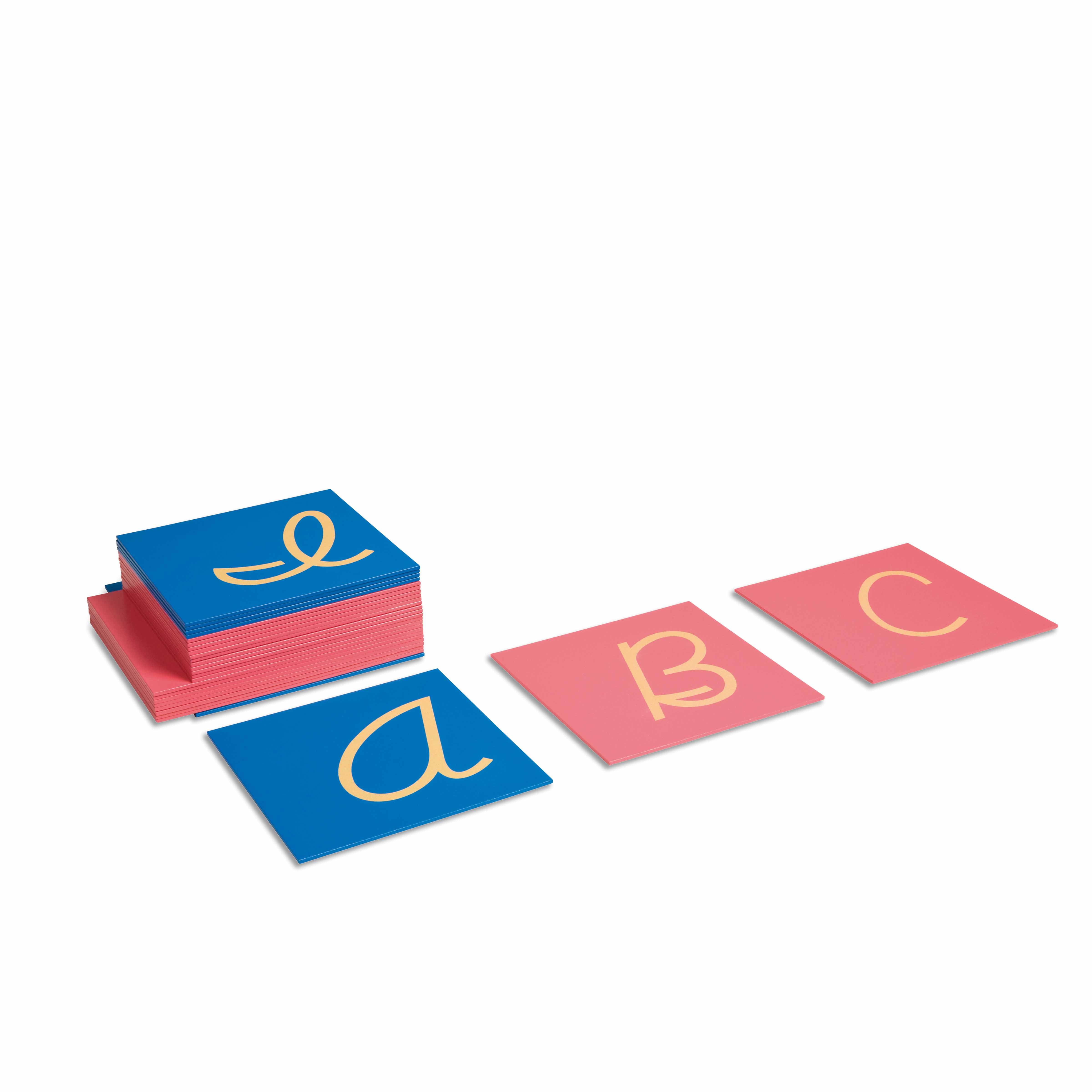
The Sandpaper Capitals: US Cursive is a Language Montessori material designed for children aged 3-6, crafted by Nienhuis Montessori to AMI standards.
These Sandpaper Capitals in US Cursive provide a tactile introduction to cursive letter formation, featuring sandpaper letters mounted on color-coded cardboard squares. The rough texture of the sandpaper guides the child's fingers along the correct letter strokes, creating muscle memory essential for cursive writing while the contrasting backgrounds distinguish vowels from consonants.
“The greatest sign of success for a teacher is to be able to say, 'The children are now working as if I did not exist.'”— Maria MontessoriThe Absorbent Mind
“Free the child's potential, and you will transform him into the world.”
— Maria Montessori, To Educate the Human Potential
Sandpaper Capitals in US Cursive connect the concrete sensation of touch with abstract letter recognition, addressing the young child's need to explore language through multiple senses. The sandpaper's rough texture creates a distinct sensory impression as fingers trace each capital letter's cursive form, establishing neural pathways before the hand is physically ready to hold a pencil. Color-coded cardboard squares—pink for vowels and blue for consonants—provide visual categorization that helps children recognize patterns in language structure. This material exists because children between three and six years old learn best when movement and touch accompany visual input. The sandpaper creates resistance that slows finger movement to match the careful pace needed for accurate letter formation. Each textured letter becomes a concrete object the child can manipulate and explore repeatedly, transforming the abstract concept of written language into a tangible experience. The capitals specifically introduce cursive's flowing movements through larger, simpler forms before the complexity of lowercase letters.
Each order includes everything needed for proper presentation and long-term use.
Follow the Montessori method of presentation for optimal child development.
Trace the first letter slowly with your index and middle fingers, following the sandpaper's texture
Invite the child to trace the same letter, observing their finger placement
Name the letter's sound (not its name) as the child traces
Introduce the second and third letters using the same process
Play the three-period lesson: 'Show me /m/', 'What is this?'
Every material is carefully selected for durability, safety, and authentic Montessori experience.
The fine-grain sandpaper provides crucial tactile feedback, allowing children to feel the letter's shape and direction through their fingertips, engaging multiple senses in the learning process.
The sturdy cardboard backing in pink and blue creates visual distinction between vowels and consonants, supporting the child's understanding of letter categories in language.
Each material supports multiple areas of child development simultaneously.
Tracing sandpaper letters creates muscle memory patterns essential for future cursive writing success.
Multi-sensory approach combining touch, sight, and movement accelerates cursive letter identification.
Develops correct letter formation habits and fine motor control needed for cursive handwriting.
Color-coding introduces the concept of vowels and consonants through visual discrimination.
Designed for child-sized hands
Professional tips from AMI-trained guides to maximize the educational value of this material.
“Store letters alphabetically in a box where children can access them independently after introduction”
Clean sandpaper monthly with a soft brush to maintain texture
Introduce letters in groups based on formation similarity (C, G, O share curved movements)
Observe which hand the child naturally uses for tracing—don't correct left-handed preference
Everything you need to know about this material.
Cursive sandpaper letters teach the flowing, connected strokes used in cursive handwriting, while print letters teach individual, unconnected letter formation. The cursive capitals prepare children for formal cursive writing by developing the specific muscle memory needed for continuous strokes and letter connections.
The color-coding follows Montessori language principles: vowels are mounted on blue backgrounds and consonants on pink backgrounds. This visual distinction helps children recognize and categorize letters while learning their sounds and formations, supporting both tactile and visual learning pathways.
Children typically begin cursive sandpaper letters around age 4-5, after mastering many sounds with print sandpaper letters. Some Montessori environments introduce cursive from the beginning, as the flowing movements are often easier for young children than the start-stop motions of print.
Children trace each letter with their index and middle fingers, following the sandpaper's texture from the correct starting point through the proper stroke sequence. They simultaneously say the letter's phonetic sound, creating a multi-sensory connection between touch, movement, sight, and sound.
These capitals work alongside lowercase cursive sandpaper letters, the moveable alphabet, metal insets for pre-writing preparation, and sand trays for additional letter formation practice. They form part of a complete Montessori language curriculum leading to reading and writing.
Can't find what you're looking for?
Contact Our Experts
Share your experience with this material and help other educators and parents.


