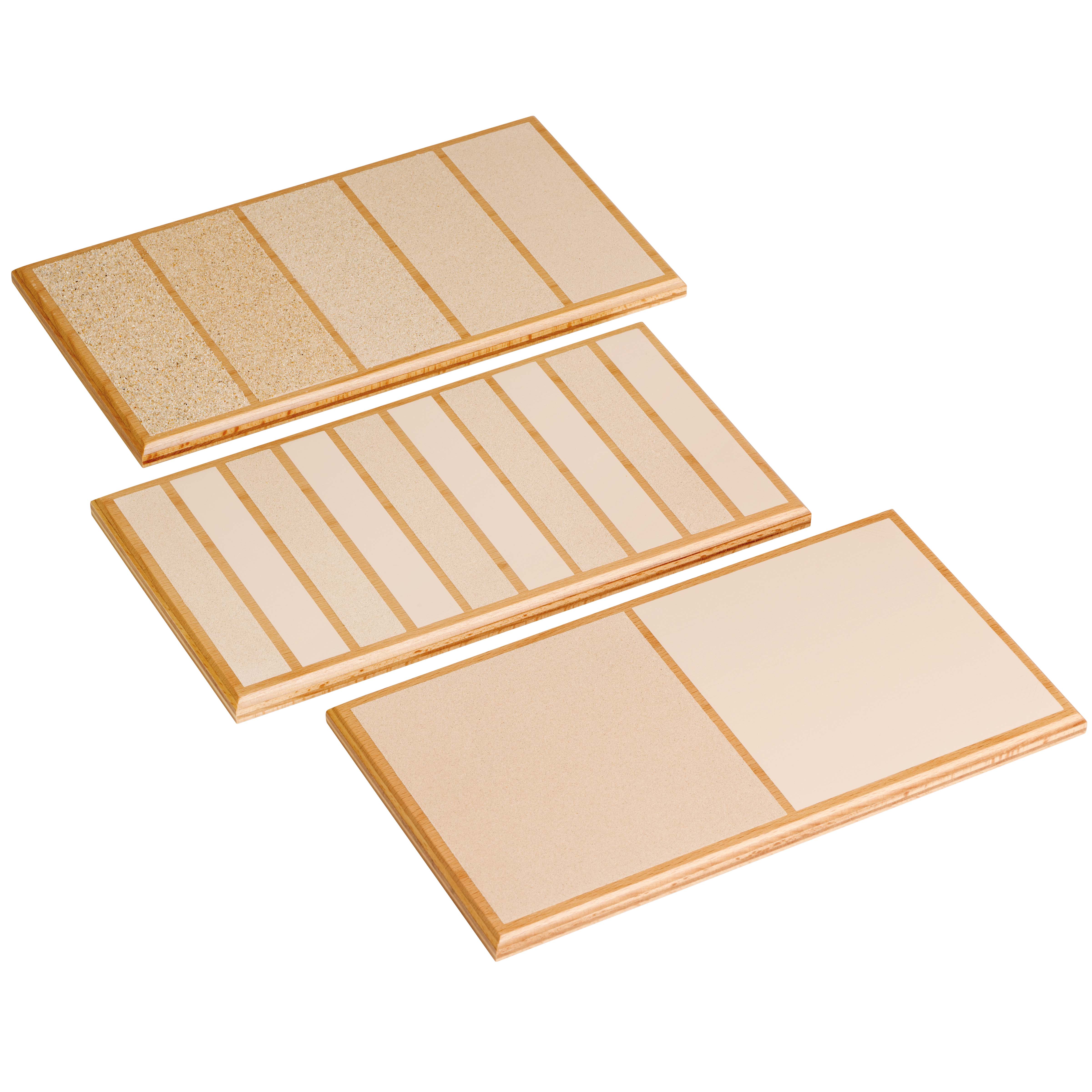
The Rough And Smooth Boards Set is a Educational Materials Montessori material designed for children aged 3-6, crafted by Nienhuis Montessori to AMI standards.
This essential sensorial material develops tactile discrimination through three carefully designed boards featuring graduated sandpaper textures and smooth surfaces. Children explore differences in roughness through systematic touch exercises, preparing the fingertips for writing while building vocabulary for texture descriptions and developing the lightness of touch needed for future pencil control.
“The child is both a hope and a promise for mankind.”— Maria MontessoriEducation and Peace
“The hands are the instruments of man's intelligence.”
— Maria Montessori, The Absorbent Mind
The Rough and Smooth Boards Set addresses the young child's critical need to refine tactile perception during the sensitive period for sensorial exploration. These three boards, with their precisely graduated sandpaper textures, isolate the quality of roughness, allowing children to perceive subtle differences through touch alone. Each board presents contrasting surfaces that train the fingertips to distinguish varying degrees of texture, developing the same light touch and finger sensitivity required for pencil grip and letter formation. The graduated sandpaper surfaces on these boards progress from coarse to fine, matching the child's increasing ability to discriminate subtle differences. By repeatedly tracing the rough and smooth sections with their fingertips, children internalize these tactile experiences, building neural pathways essential for writing readiness. The boards' systematic presentation allows children to develop precise vocabulary for describing textures while simultaneously preparing the hand for the delicate movements of writing.
Each order includes everything needed for proper presentation and long-term use.
Follow the Montessori method of presentation for optimal child development.
Sensitize fingertips by dipping them briefly in warm water and drying
Demonstrate touching the smooth section with two fingers, moving left to right slowly
Touch the rough section with the same gentle, left-to-right motion
Invite the child to feel both textures using the same movements
Introduce vocabulary: 'This is rough' and 'This is smooth' while touching each
Proceed to the three-period lesson for language acquisition
Every material is carefully selected for durability, safety, and authentic Montessori experience.
The smooth wooden borders provide a neutral reference point for the child's exploration, allowing clear distinction between frame and textured surfaces while offering durability for years of classroom use.
Carefully selected grades of sandpaper create a progression from very rough to nearly smooth, training the fingertips to perceive increasingly subtle differences in texture.
Each material supports multiple areas of child development simultaneously.
Refines the sense of touch through systematic exploration of texture differences, building sensory awareness and vocabulary.
Develops the light touch and finger sensitivity essential for proper pencil grip and controlled writing movements.
Introduces comparative and superlative concepts while building descriptive vocabulary for textures and sensations.
The focused tactile work requires sustained attention, strengthening the child's ability to concentrate on subtle sensory information.
Designed for child-sized hands
Professional tips from AMI-trained guides to maximize the educational value of this material.
“Present this material after the child has worked with other sensorial materials like the Pink Tower or Brown Stair”
Check sandpaper surfaces weekly - worn areas reduce the contrast needed for discrimination
Observe the child's touch pressure - heavy-handed exploration indicates need for preliminary activities
Store boards vertically in a specific spot to maintain consistency and preserve sandpaper surfaces
Everything you need to know about this material.
The set includes three boards: Board 1 alternates rough and smooth strips for contrast recognition, Board 2 features graduated sandpaper from roughest to smoothest for grading exercises, and Board 3 contains the finest gradations to refine tactile discrimination. Each board serves a specific developmental purpose in the sensorial curriculum.
The boards develop the lightness of touch essential for proper pencil grip and control. By tracing the sandpaper surfaces with their fingertips, children strengthen the same muscles used in writing while developing sensitivity to pressure. This tactile preparation complements the direct preparation provided by the sandpaper letters.
Demonstrate using the first two fingers (writing fingers) with a light, sweeping motion from left to right. Show the contrast between rough and smooth on Board 1, then grade the textures on Board 2 from roughest to smoothest. Board 3 requires the most refined touch. Always model the vocabulary: 'rough,' 'smooth,' 'rougher,' 'roughest,' 'smoother,' 'smoothest.'
Yes, working blindfolded is an excellent extension that isolates the tactile sense and increases concentration. Start with Board 1 for clear contrast recognition, then progress to grading exercises with Board 2. This stereognostic activity strengthens the child's ability to discriminate through touch alone.
Extensions include matching fabric textures, creating texture books, grading natural materials like leaves or shells, and playing texture matching games. Children can also explore textures in the environment, use comparative and superlative language in descriptions, and combine with other sensorial materials for integrated lessons.
Can't find what you're looking for?
Contact Our Experts
Share your experience with this material and help other educators and parents.


