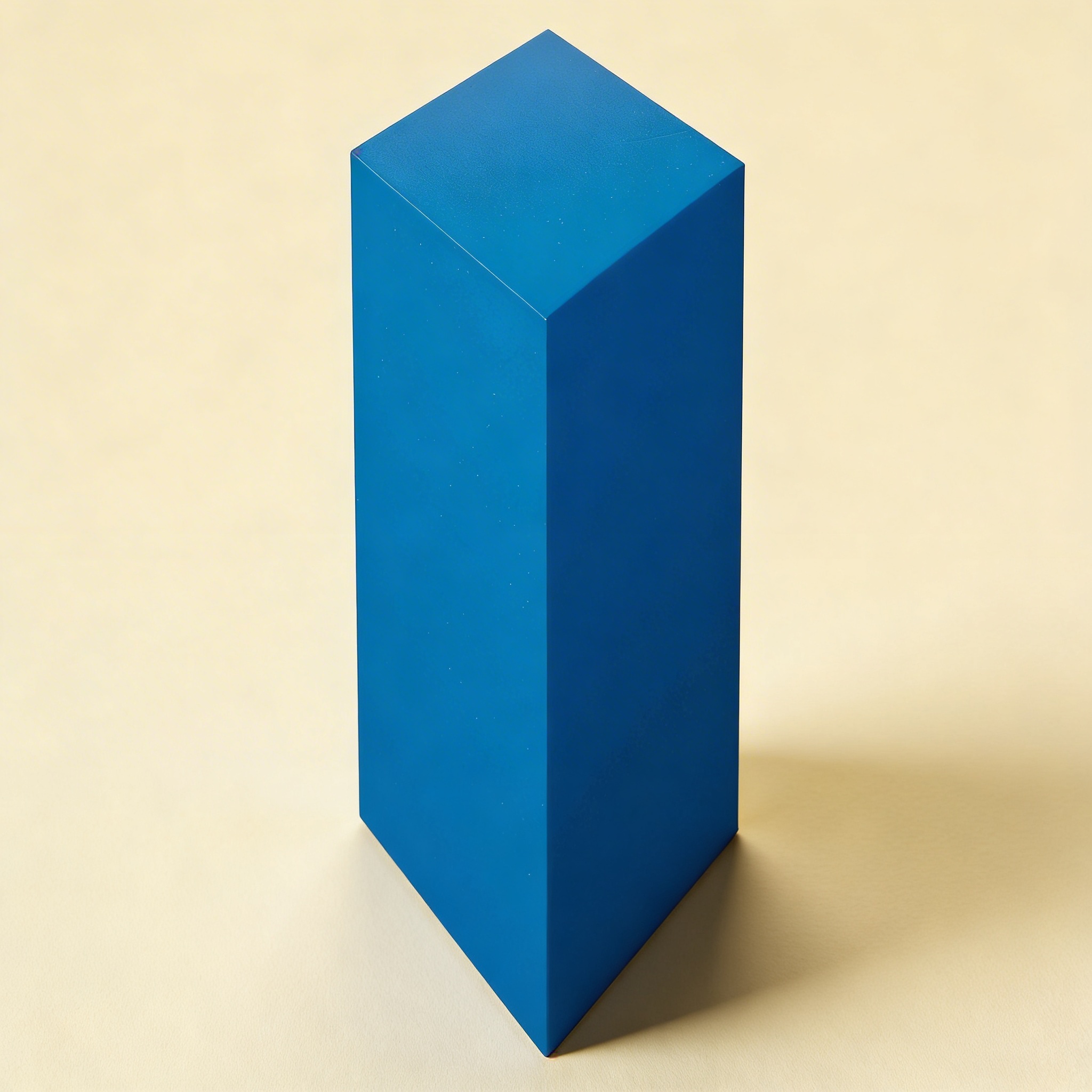
The Rhombic Based Prism — Complex 3D Geometric Form with Triangular Top is a Sensorial Montessori material designed for children aged 6-12, crafted by Nienhuis Montessori to AMI standards.
This Rhombic Based Prism introduces children to complex three-dimensional geometric forms, featuring a distinctive rhombic base that tapers to a triangular apex. Part of the Montessori geometric solids collection, this painted wooden solid helps children develop spatial reasoning and geometric vocabulary while exploring the relationships between two-dimensional shapes and three-dimensional forms.
“The hands are the instruments of man's intelligence.”— Maria MontessoriThe Absorbent Mind
“The senses, being explorers of the world, open the way to knowledge.”
— Maria Montessori, The Discovery of the Child
The Rhombic Based Prism embodies Montessori's principle of isolating difficulty by presenting one complex geometric concept through a concrete, manipulable form. As part of the geometric solids, it serves as a bridge between the sensorial experiences of early childhood and the abstract mathematical thinking of the elementary years. This material respects the child's need for sensorial exploration while introducing sophisticated geometric concepts. Through handling this solid, children develop what Montessori called 'stereognostic sense' - the ability to recognize forms through touch and movement. The material's precision and beauty invite repeated exploration, allowing children to internalize the properties of this unique form through their senses before moving to abstract understanding.
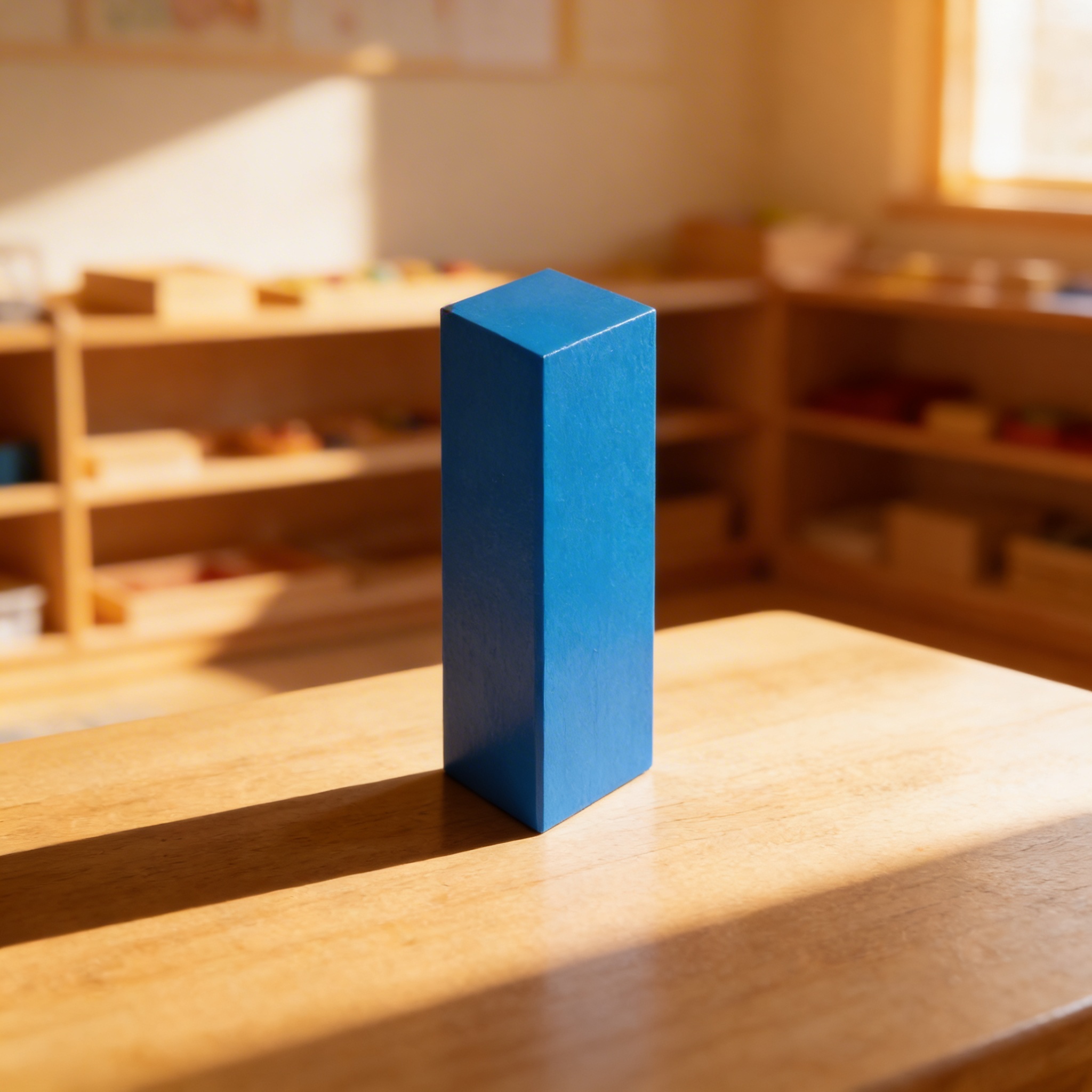
Each order includes everything needed for proper presentation and long-term use.
Follow the Montessori method of presentation for optimal child development.
Invite the child to explore the solid with both hands, tracing all edges and vertices with fingertips
Introduce the nomenclature: 'This is a rhombic based prism.' Point to the rhombic base and trace its four equal sides
Compare the rhombic base to the triangular apex, noting how the form tapers
Count and identify all faces, edges, and vertices together
Create impressions of each face in clay to explore the 2D shapes that compose the solid
Every material is carefully selected for durability, safety, and authentic Montessori experience.
The smooth painted surface allows children to focus on the geometric properties without distraction, while the substantial weight provides sensorial feedback about the solid's volume.
Each material supports multiple areas of child development simultaneously.
Handling and examining the rhombic prism develops three-dimensional thinking and understanding of how shapes transform in space.
Children learn precise mathematical language including terms like rhombus, apex, base, and prism through concrete experience.
Prepares for advanced geometry concepts including volume calculation and understanding of composite shapes.
Designed for child-sized hands
Professional tips from AMI-trained guides to maximize the educational value of this material.
“Present this solid after children are familiar with regular prisms and the rhombus shape from geometry cabinet work”
rhombic base, apex, lateral faces, ensuring mastery at each stage
Connect this work to crystallography and mineralogy studies, as many crystals form rhombic structures
Keep a collection of real objects with rhombic forms (certain crystals, architectural elements) to reinforce the concept
Everything you need to know about this material.
This geometric solid introduces children to complex 3D shapes, spatial relationships, geometric vocabulary (rhombus, apex, edges, vertices), and the connection between 2D shapes and 3D forms. It supports advanced geometry studies and develops spatial reasoning skills.
The teacher introduces the rhombic prism alongside other geometric solids, encouraging children to explore its unique properties through touch and observation. Children learn to identify the rhombic base, count edges and vertices, and compare it with other prisms and pyramids.
Children can trace the base to create 2D representations, compare it with other geometric solids, sort shapes by properties, create impressions in sand or clay, match with geometric cabinet shapes, and incorporate it into advanced geometry studies and architectural explorations.
The painted blue finish provides visual consistency with other Montessori geometric solids, helps children focus on the shape rather than wood grain patterns, and creates a uniform appearance that aids in classification and comparison activities.
The rhombic prism introduces complex geometric concepts including oblique angles, non-regular polygons, and transitional forms. It prepares children for crystallography, advanced geometry, architectural studies, and develops the spatial visualization skills essential for higher mathematics.
Can't find what you're looking for?
Contact Our Experts
Share your experience with this material and help other educators and parents.
Bundle related materials and save. Free curriculum guide included with every set.


