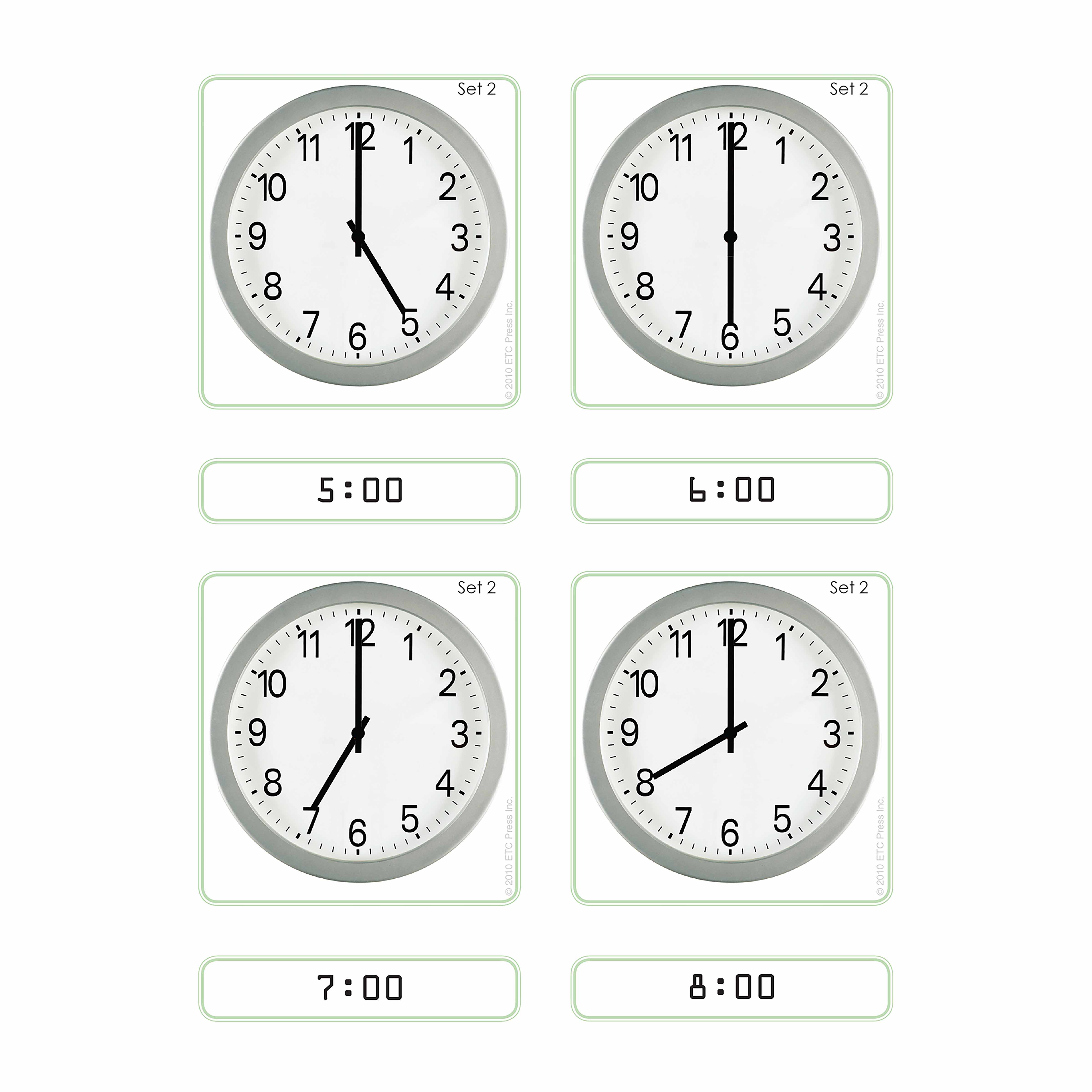
The Qué Hora Es? is a Educational Materials Montessori material designed for children aged 3-6, crafted by Nienhuis Montessori to AMI standards.
The Qué Hora Es? time matching cards help children connect analog clock faces with their digital representations through engaging visual correspondence activities. This bilingual material supports the development of time-telling skills while introducing Spanish vocabulary, perfect for the Montessori language and mathematics curriculum.
“The child is both a hope and a promise for mankind.”— Maria MontessoriEducation and Peace
“The hands are the instruments of man's intelligence.”
— Maria Montessori, The Absorbent Mind
The Qué Hora Es? time matching cards address the child's growing awareness of temporal order and their need to understand the abstract concept of time through concrete visual representations. Each card presents clock faces as tangible images that children can manipulate and compare, making the invisible passage of time visible through matching activities. The bilingual aspect of these cards respects the child's capacity to absorb multiple languages naturally during the sensitive period for language acquisition. By pairing analog clock faces with digital displays, the cards bridge traditional and modern time-telling methods that children encounter in daily life. The visual correspondence work inherent in matching these time representations builds the discrimination skills essential for mathematical thinking. Through repeated practice with the Qué Hora Es? cards, children internalize both the circular progression of hours and the numerical sequence of minutes, preparing them for more advanced temporal concepts.
Each order includes everything needed for proper presentation and long-term use.
Follow the Montessori method of presentation for optimal child development.
Select one analog clock card and examine the position of the hour and minute hands
Look through the digital time cards to find the matching numerical representation
Place the digital card below its matching analog clock
Continue matching until all pairs are complete, then review by reading each time
Every material is carefully selected for durability, safety, and authentic Montessori experience.
Sourced from sustainably managed European forests. Beechwood is chosen for its exceptional durability, smooth grain, and natural warmth that invites touch.
Natural, unbleached cotton in child-friendly colors. The fabric provides the right amount of friction for developing fingers while being gentle on sensitive skin.
Water-based, child-safe finish that meets the strictest European safety standards. Designed to withstand years of daily use without chipping or peeling.
Each material supports multiple areas of child development simultaneously.
Develops time-telling skills and numerical recognition through visual matching of analog and digital formats.
Introduces Spanish time vocabulary while reinforcing mathematical concepts in a bilingual context.
Enhances ability to distinguish between different clock positions and their corresponding digital representations.
Supports multicultural education by presenting time concepts in Spanish, broadening linguistic exposure.
Designed for child-sized hands
Professional tips from AMI-trained guides to maximize the educational value of this material.
“Present hour times first (1:00, 2:00) before introducing half-hours (1:30, 2:30)”
Use the cards alongside a real clock during circle time to reinforce connections
Create sorting games by time of day (morning, afternoon, evening) using the cards
Incorporate movement by having children position their arms like clock hands
Everything you need to know about this material.
Qué Hora Es? is designed for children ages 3-6, aligning with the Montessori sensitive period for order and language development. The material grows with the child, starting with simple hour matching and progressing to more complex time concepts.
Each card features analog clock faces paired with digital time displays and Spanish time vocabulary. Children learn to read clocks while naturally absorbing Spanish phrases for telling time, making it an integrated language and mathematics lesson.
Children develop visual discrimination, time-telling abilities, number recognition, Spanish vocabulary, and mathematical concepts of hours and minutes. The material also enhances concentration and supports the transition from concrete to abstract thinking.
The set includes cards covering key times throughout the day, focusing on hours and half-hours appropriate for beginners. Cards progress from simple on-the-hour times to more challenging half-hour increments.
Yes! While designed as bilingual material, it works excellently for monolingual environments too. Teachers can focus solely on time-telling skills or incorporate the Spanish element as an enrichment activity, depending on their curriculum needs.
Can't find what you're looking for?
Contact Our Experts
Share your experience with this material and help other educators and parents.


