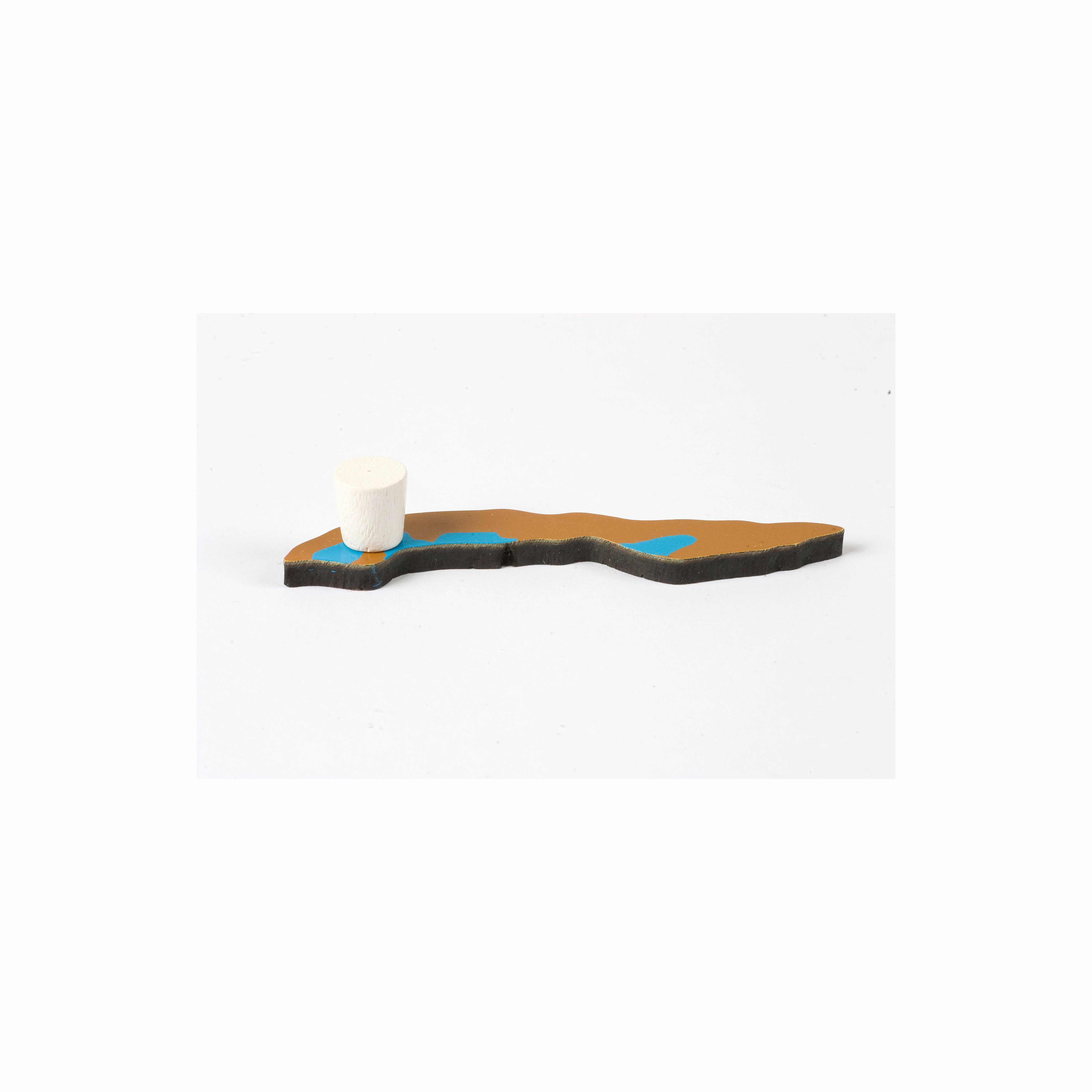
The Puzzle Piece Of North America: Cuba is a category.geography Montessori material designed for children aged 3-6, crafted by Nienhuis Montessori to AMI standards.
This wooden puzzle piece represents Cuba, part of the North America puzzle map series. The piece features detailed topographical relief with painted water areas in turquoise, allowing children to explore the physical geography of this Caribbean island nation. The cylindrical control knob enables precise manipulation while building fine motor skills and geographic knowledge.
“Education is a natural process spontaneously carried out by the human individual, and is acquired not by listening to words but by experiences upon the environment.”— Maria MontessoriEducation for a New World
“The child is both a hope and a promise for mankind.”
— Maria Montessori, Education and Peace
The Cuba puzzle piece exists within Montessori geography education to address young children's need for concrete, manipulable representations of abstract political boundaries. This wooden piece with its cylindrical control knob allows three-to-six-year-olds to physically hold and examine Cuba's distinctive elongated shape, transforming an abstract map concept into tangible reality. The topographical relief molded into the wood provides sensorial feedback about Cuba's mountainous regions and coastal plains, while turquoise-painted water areas clearly delineate the island's boundaries. Through repeated handling of this puzzle piece, children internalize Cuba's location relative to other Caribbean islands and the North American mainland. The control knob positioned at Cuba's approximate center serves dual purposes: enabling precise placement within the larger puzzle framework and developing the refined finger movements necessary for later writing. This individual country piece satisfies children's desire to isolate and study specific geographic regions during their sensitive period for order and classification.
Each order includes everything needed for proper presentation and long-term use.
Follow the Montessori method of presentation for optimal child development.
Remove the Cuba piece using the control knob with thumb and two fingers
Trace the outline of Cuba with your index finger, starting at the western tip
Feel the topographical relief, noting mountain ranges and lowland areas
Observe the turquoise painted areas representing surrounding waters
Return the piece to its place in the puzzle using the control knob
Every material is carefully selected for durability, safety, and authentic Montessori experience.
Crafted from durable wood to provide the weight and texture essential for sensorial learning in Montessori geography work.
Each material supports multiple areas of child development simultaneously.
Children learn to identify Cuba's shape, location, and physical features while developing spatial reasoning skills.
The control knob promotes proper pincer grip and precise hand movements essential for later writing skills.
Tactile exploration of topographical features helps children understand elevation and terrain through touch.
Introduces children to Caribbean geography and Cuba's place within North America's broader geographic context.
Designed for child-sized hands
Professional tips from AMI-trained guides to maximize the educational value of this material.
“Store the Cuba piece separately occasionally to create interest in its unique characteristics”
Pair this work with the sandpaper globe to show Cuba's location on a spherical Earth
Create a basket with items representing Cuban culture to extend geographic learning
Use the piece for vocabulary lessons about island geography terms
Everything you need to know about this material.
The dimensions vary based on the geographic scale of the North America puzzle map series. This piece is proportionally sized to represent Cuba's actual landmass relative to other North American countries, typically measuring approximately 15-20cm in length.
While designed as part of the North America puzzle map series, this Cuba piece can be used independently for focused study. However, it reaches its full educational potential when used with the complete puzzle frame, allowing children to understand Cuba's geographic relationship to neighboring countries.
The piece features detailed topographical relief showing Cuba's mountain ranges, valleys, and coastal areas. Water areas surrounding the island are painted in turquoise, helping children distinguish between land and sea while learning about Cuba's island geography.
The control knob is positioned strategically to develop the pincer grasp essential for writing preparation. It allows children to manipulate the piece with precision while maintaining focus on the geographic content, supporting both fine motor development and concentration.
Children can trace the outline to create maps, use it for sensory exploration of the textured surface, practice vocabulary related to islands and water bodies, and engage in cultural discussions about Caribbean geography. It also supports lessons on capital cities, flags, and basic cultural awareness.
Can't find what you're looking for?
Contact Our Experts
Share your experience with this material and help other educators and parents.


