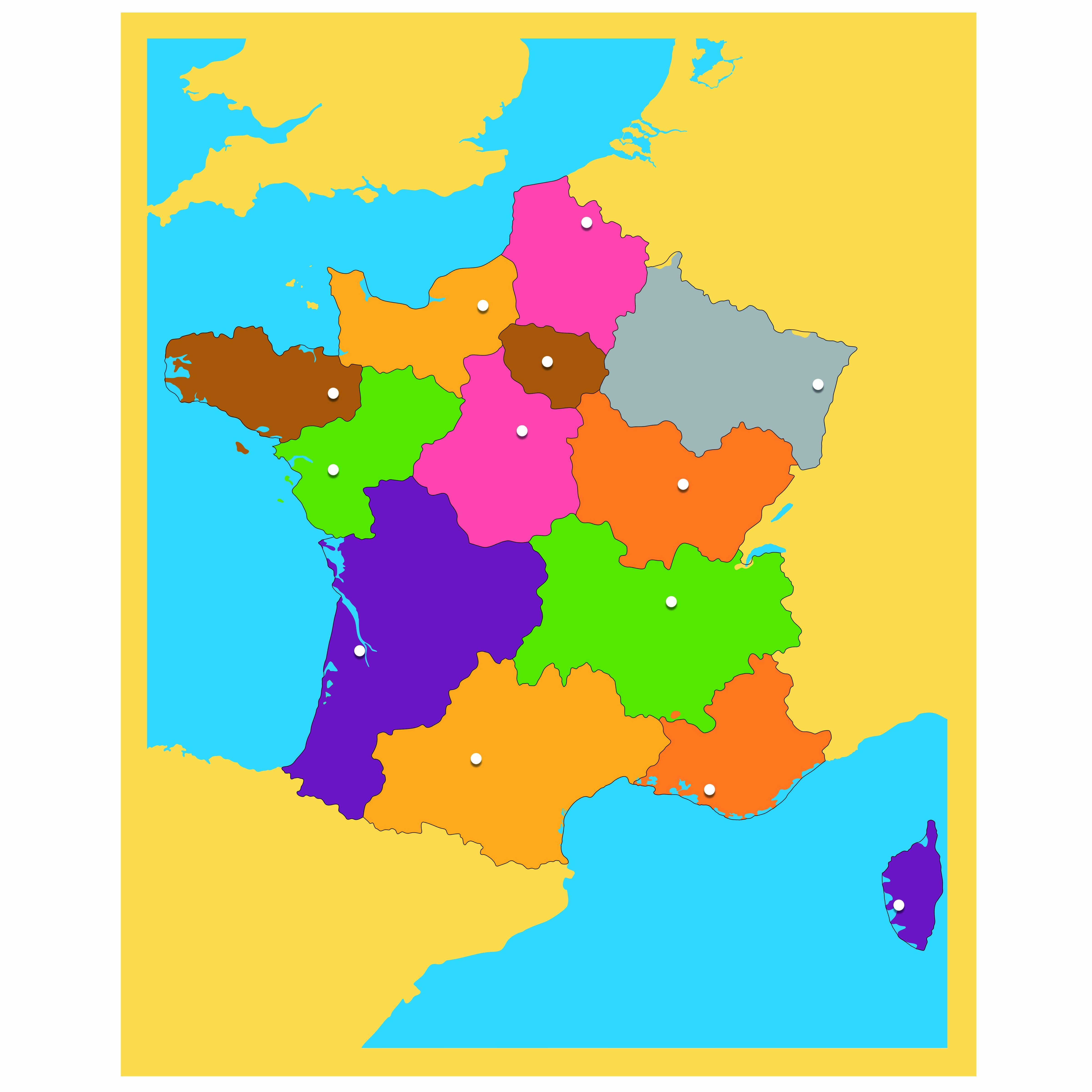
The Puzzle Map: France is a category.geography Montessori material designed for children aged 3-6, crafted by Nienhuis Montessori to AMI standards.
This beautifully crafted wooden puzzle map introduces children to the geography of France through hands-on exploration. Each color-coded region is a removable piece with a white knob handle, allowing children to trace, match, and rebuild the country while developing spatial awareness and fine motor control. The large format and precise craftsmanship make this an essential material for cultural geography studies in the Montessori classroom.
“Education is a natural process spontaneously carried out by the human individual, and is acquired not by listening to words but by experiences upon the environment.”— Maria MontessoriEducation for a New World
“The child is both a hope and a promise for mankind.”
— Maria Montessori, Education and Peace
The Puzzle Map of France represents geography as living knowledge, where each wooden region becomes a tactile invitation to explore cultural identity. Through lifting each color-coded piece by its white knob handle, children physically internalize France's regional boundaries while their hands trace the actual contours of provinces and departments. This large-format wooden map transforms abstract political divisions into concrete, manipulable objects that children can remove, examine, and precisely replace. The distinct colors of each removable region create visual memory patterns that connect physical geography to cultural understanding. By rebuilding France piece by piece, children construct their understanding of how geographical features shape human communities. The puzzle map's precise wooden craftsmanship ensures each region fits exactly within France's borders, teaching children that geography follows natural and historical patterns rather than arbitrary lines.
Each order includes everything needed for proper presentation and long-term use.
Follow the Montessori method of presentation for optimal child development.
Invite the child to remove one region at a time, starting with larger pieces
Name each region as you remove it, placing pieces on the mat in geographical relation
Trace around each wooden piece on paper, creating regional outlines
Return pieces one at a time, naming regions and discussing what makes each unique
Every material is carefully selected for durability, safety, and authentic Montessori experience.
Each puzzle piece is carefully crafted from solid wood to fit perfectly within the frame, teaching children about boundaries and spatial relationships through tactile exploration.
Each material supports multiple areas of child development simultaneously.
Children develop understanding of France's regional divisions and spatial relationships through concrete manipulation.
Grasping knobs and fitting pieces precisely strengthens pincer grip and hand-eye coordination.
Color-coded regions help children distinguish and memorize different areas of France.
Hands-on exploration creates meaningful connections to French geography and culture.
Designed for child-sized hands
Professional tips from AMI-trained guides to maximize the educational value of this material.
“Present the puzzle after children master simpler geography materials like land and water forms”
Create a 'regions of France' basket with pictures of regional foods, landmarks, and traditions
Use the puzzle alongside French language materials to connect geography with vocabulary
Demonstrate careful handling by always using the knob to lift pieces, never prying edges
Everything you need to know about this material.
The puzzle map measures approximately 57cm x 50cm, providing a large-format workspace that allows children to see regional boundaries clearly and manipulate pieces comfortably. The frame is crafted from solid beech wood with a water-based finish.
The puzzle contains 13 removable pieces representing the administrative regions of metropolitan France. Each region is painted in a distinct color to help children distinguish boundaries and develop visual discrimination skills.
In Montessori education, we introduce geography concretely through sensorial experiences. Young children can successfully remove and replace pieces, trace regions, and absorb geographical shapes through repetition. This prepares them for more abstract geographical concepts later.
Begin with a three-period lesson naming 2-3 regions. Demonstrate removing pieces gently using the knob, tracing the outline, and replacing them. Progress to matching exercises with control cards, creating regional maps, and eventually learning capitals and cultural features.
Yes, parents can support learning by allowing free exploration, naming regions as the child shows interest, and extending activities through songs about French regions, foods from different areas, or finding where relatives live. The key is following the child's interest without overwhelming them with information.
Can't find what you're looking for?
Contact Our Experts
Share your experience with this material and help other educators and parents.


