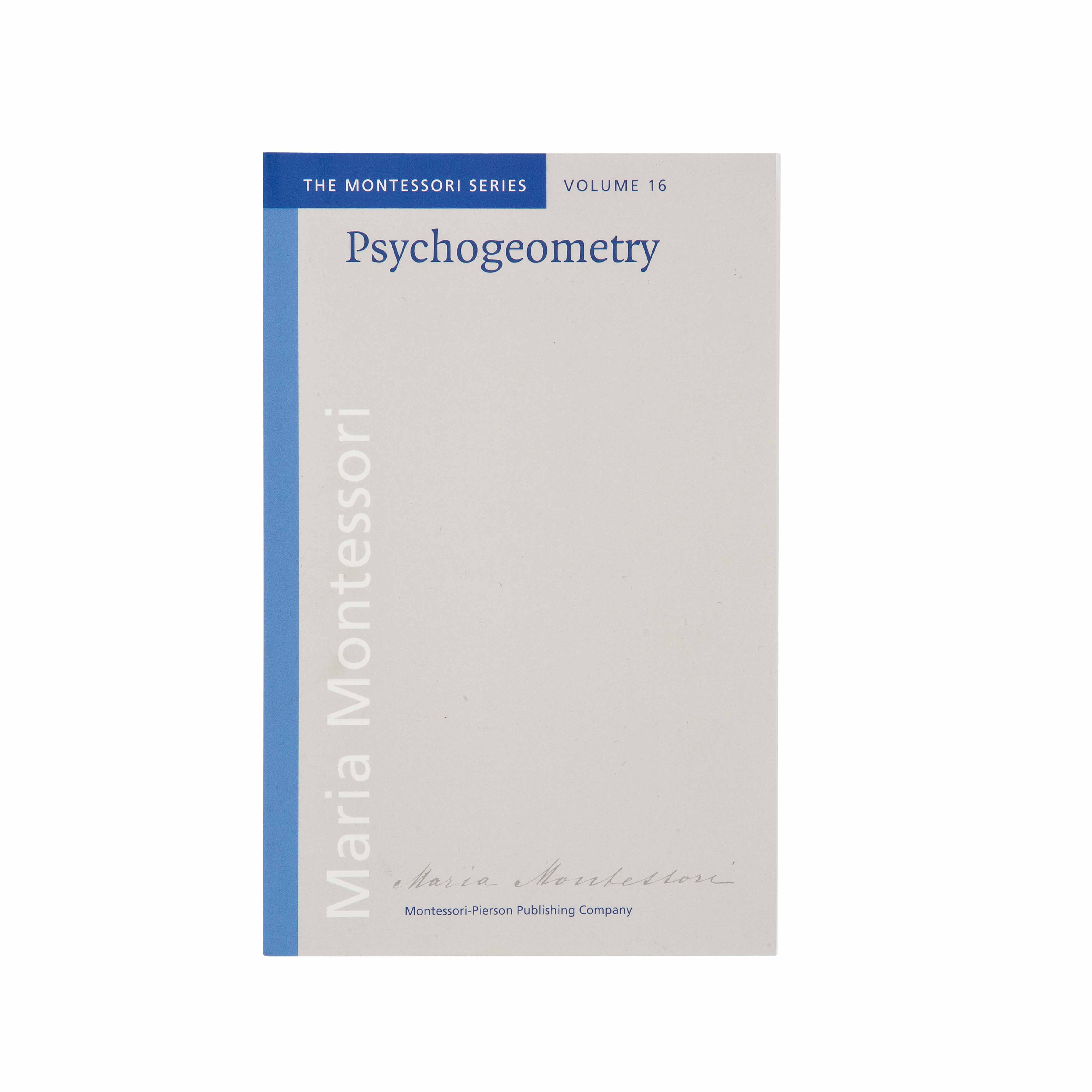
The Psychogeometry: Soft Cover is a Educational Materials Montessori material designed for children aged 3-6, crafted by Nienhuis Montessori to AMI standards.
An essential text from Maria Montessori exploring the psychological principles underlying geometry education in the Montessori Method. This soft cover edition, Volume 16 of The Montessori Series, provides educators with deep insights into how children develop geometric understanding through sensorial exploration and abstraction. Published by Montessori-Pierson, this foundational work guides teachers in presenting geometry materials and concepts to support the child's natural mathematical mind.
“The child is both a hope and a promise for mankind.”— Maria MontessoriEducation and Peace
“The hands are the instruments of man's intelligence.”
— Maria Montessori, The Absorbent Mind
Psychogeometry reveals Maria Montessori's discovery that geometric understanding emerges from the child's sensorial experiences with concrete materials. This soft cover volume illuminates how the Sensorial materials prepare the mathematical mind by isolating geometric properties—the Pink Tower isolates dimension, the Brown Stair isolates width, the Red Rods isolate length. Through Psychogeometry's insights, educators understand why children must physically manipulate these materials before abstracting geometric concepts. The text explains how each geometric cabinet inset, each constructive triangle, each geometric solid serves a precise developmental purpose. Montessori recognized that children possess an innate geometric sense that unfolds through ordered exploration. Psychogeometry guides teachers in recognizing when a child has internalized sensorial impressions and is ready for nomenclature, classification, and abstract geometric reasoning. This foundational text transforms how educators view every sphere, cube, and prism in the classroom—not as teaching tools, but as keys to the child's mathematical intelligence.
Each order includes everything needed for proper presentation and long-term use.
Follow the Montessori method of presentation for optimal child development.
Read chapters on sensorial preparation, noting connections to specific classroom materials
Study Montessori's observations about children's geometric discoveries
Review the progression from concrete to abstract geometric understanding
Examine the role of language in geometric abstraction
Apply insights to observe children working with geometric materials
Every material is carefully selected for durability, safety, and authentic Montessori experience.
Sourced from sustainably managed European forests. Beechwood is chosen for its exceptional durability, smooth grain, and natural warmth that invites touch.
Natural, unbleached cotton in child-friendly colors. The fabric provides the right amount of friction for developing fingers while being gentle on sensitive skin.
Water-based, child-safe finish that meets the strictest European safety standards. Designed to withstand years of daily use without chipping or peeling.
Each material supports multiple areas of child development simultaneously.
Deepens understanding of how children develop geometric thinking through concrete to abstract progression.
Provides theoretical foundation for presenting geometry materials in logical developmental sequence.
Reveals the psychological processes children experience when discovering geometric principles.
Enhances ability to guide children's mathematical discoveries through prepared environment design.
Designed for child-sized hands
Professional tips from AMI-trained guides to maximize the educational value of this material.
“Read Psychogeometry alongside The Discovery of the Child for complete understanding of sensorial-mathematical connections”
Use the text to inform your presentations—understanding the 'why' transforms how you present materials
Create study groups with colleagues to discuss practical applications of Montessori's geometric psychology
Reference specific chapters when planning geometry extensions and variations
Everything you need to know about this material.
While the book discusses methods for teaching children ages 3-6, it is actually written for adult educators, teachers, and parents who want to understand Maria Montessori's approach to geometry education in the early childhood classroom.
While prior Montessori knowledge is helpful, the book is written to be accessible to anyone interested in understanding how children develop geometric thinking. It explains the psychological principles behind the Montessori approach to geometry education.
The book explores how children naturally develop geometric understanding through sensorial exploration, the progression from concrete to abstract thinking, the psychological foundations of mathematical learning, and practical guidance for presenting geometry materials in the classroom.
Psychogeometry combines both theoretical insights into child psychology and practical applications for the classroom. It provides the philosophical foundation while also offering guidance on how to present geometric concepts and materials to young children.
As Volume 16 of The Montessori Series, this book specifically focuses on the geometric aspect of the mathematical mind. It works alongside other mathematics albums and guides, providing deeper psychological understanding of why and how Montessori geometry materials work.
Can't find what you're looking for?
Contact Our Experts
Share your experience with this material and help other educators and parents.


