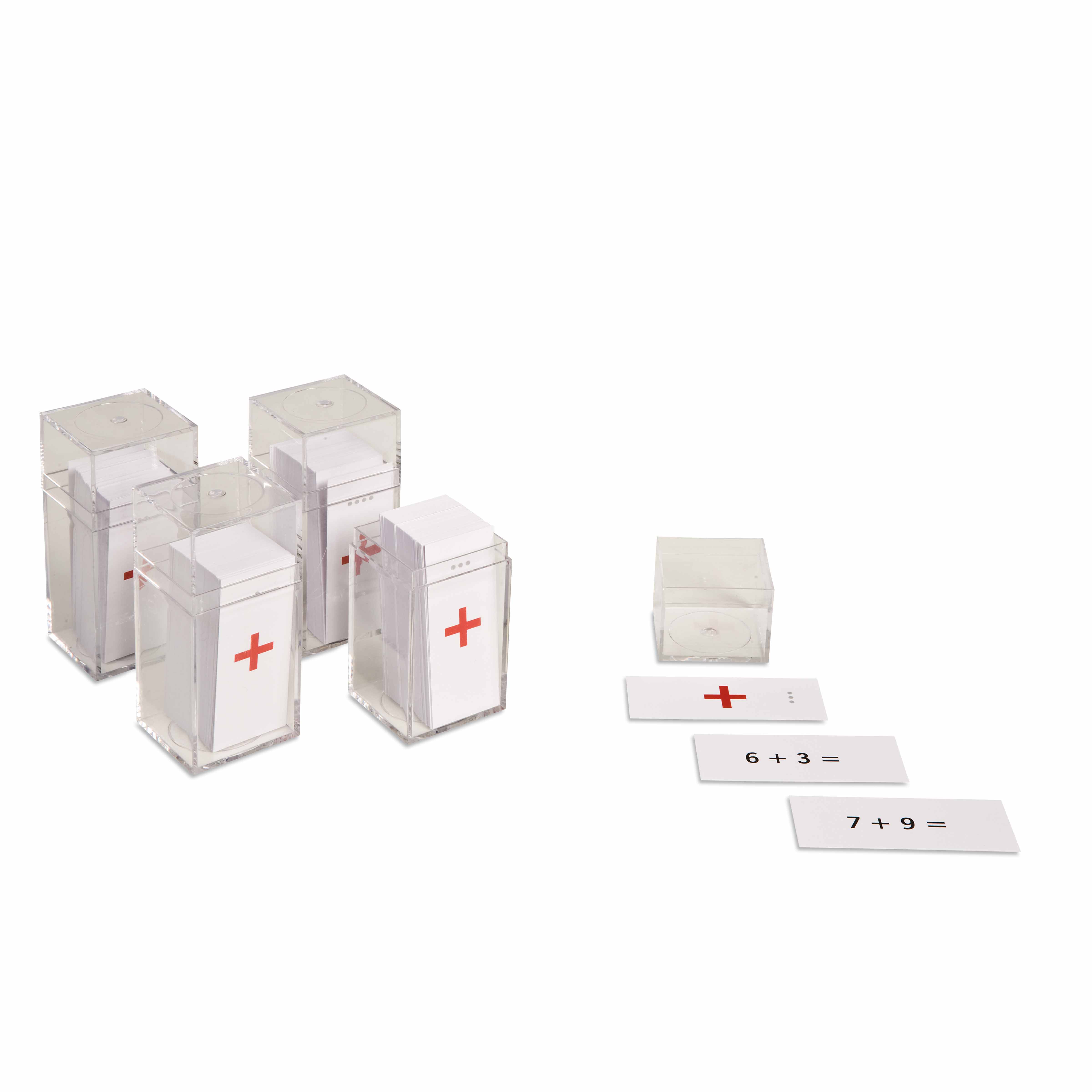
The Problem Slips: Addition Working Charts is a Mathematics Montessori material designed for children aged 3-6, crafted by Nienhuis Montessori to AMI standards.
This comprehensive addition problem slip set supports the child's work with the Addition Working Charts, providing systematic practice cards organized in clear acrylic containers. Each compartment holds equation cards featuring single and double-digit addition problems with tactile braille elements, enabling children to progress from concrete manipulation to abstract mathematical thinking while developing computational fluency.
“Children display a universal love of mathematics, which is par excellence the science of precision, order, and intelligence.”— Maria MontessoriThe Discovery of the Child
“The greatest sign of success for a teacher is to be able to say, 'The children are now working as if I did not exist.'”
— Maria Montessori, The Absorbent Mind
The Problem Slips for Addition Working Charts address the child's need for repeated, varied practice with addition equations during the critical period for mathematical abstraction. Each equation card in the acrylic containers presents a specific addition problem, allowing children to work systematically through increasingly complex calculations. The tactile braille elements on each problem slip provide multi-sensory engagement, reinforcing number concepts through touch while the child solves equations. The clear compartment organization reflects Maria Montessori's principle of prepared environment, where materials are arranged to promote independent selection and sequential work. These problem slips bridge the gap between manipulating concrete materials like golden beads and working with abstract numbers, as children can still reference physical quantities while practicing computational skills. The systematic progression from single to double-digit problems respects the child's natural mathematical development, allowing mastery at each level before advancing.
Each order includes everything needed for proper presentation and long-term use.
Follow the Montessori method of presentation for optimal child development.
Select a compartment of problem slips appropriate to current skill level
Remove one equation card and read the problem, feeling the braille elements
Work out the answer using the Addition Working Chart or mental calculation
Record the equation and answer on paper
Continue with remaining cards in the compartment
Return completed cards to their compartment when finished
Every material is carefully selected for durability, safety, and authentic Montessori experience.
Sourced from sustainably managed European forests. Beechwood is chosen for its exceptional durability, smooth grain, and natural warmth that invites touch.
Natural, unbleached cotton in child-friendly colors. The fabric provides the right amount of friction for developing fingers while being gentle on sensitive skin.
Water-based, child-safe finish that meets the strictest European safety standards. Designed to withstand years of daily use without chipping or peeling.
Each material supports multiple areas of child development simultaneously.
Bridges the gap between concrete manipulatives and abstract number operations through systematic problem-solving practice.
Repeated work with equation cards strengthens recall of addition facts and number combinations.
The compartmented storage system teaches children to organize materials systematically and maintain mathematical order.
Braille elements on cards provide multi-sensory engagement, supporting diverse learning styles and inclusive education.
Designed for child-sized hands
Professional tips from AMI-trained guides to maximize the educational value of this material.
“Observe which compartments children select to assess their self-awareness of skill level”
Note any patterns in errors to identify specific number combinations needing practice
Introduce problem slips after concrete work with golden beads and stamp game
Create a tracking system so children can monitor their progress through compartments
Everything you need to know about this material.
The set includes systematically organized addition equation cards in clear acrylic containers. Each compartment contains problem slips featuring single and double-digit addition problems with tactile braille elements, designed to work seamlessly with the Addition Working Charts.
The problem slips guide children from concrete manipulation to abstract thinking by providing structured practice opportunities. The tactile braille elements offer sensory feedback, while the systematic organization helps children build computational fluency through repeated, meaningful practice.
Yes, the tactile braille elements and visual number representations allow pre-readers to work with the material. Children can match the problem slips to the Addition Working Charts using pattern recognition and the tactile features before developing reading skills.
The set includes comprehensive coverage of addition equations organized in clear acrylic containers with separate compartments. Problems progress systematically from simple single-digit additions to more complex double-digit problems, allowing children to work at their own pace.
While designed specifically to complement the Addition Working Charts, these problem slips can be used for additional practice activities such as sorting, matching, or creating equation books. However, they achieve maximum educational benefit when used with the corresponding charts.
Can't find what you're looking for?
Contact Our Experts
Share your experience with this material and help other educators and parents.


