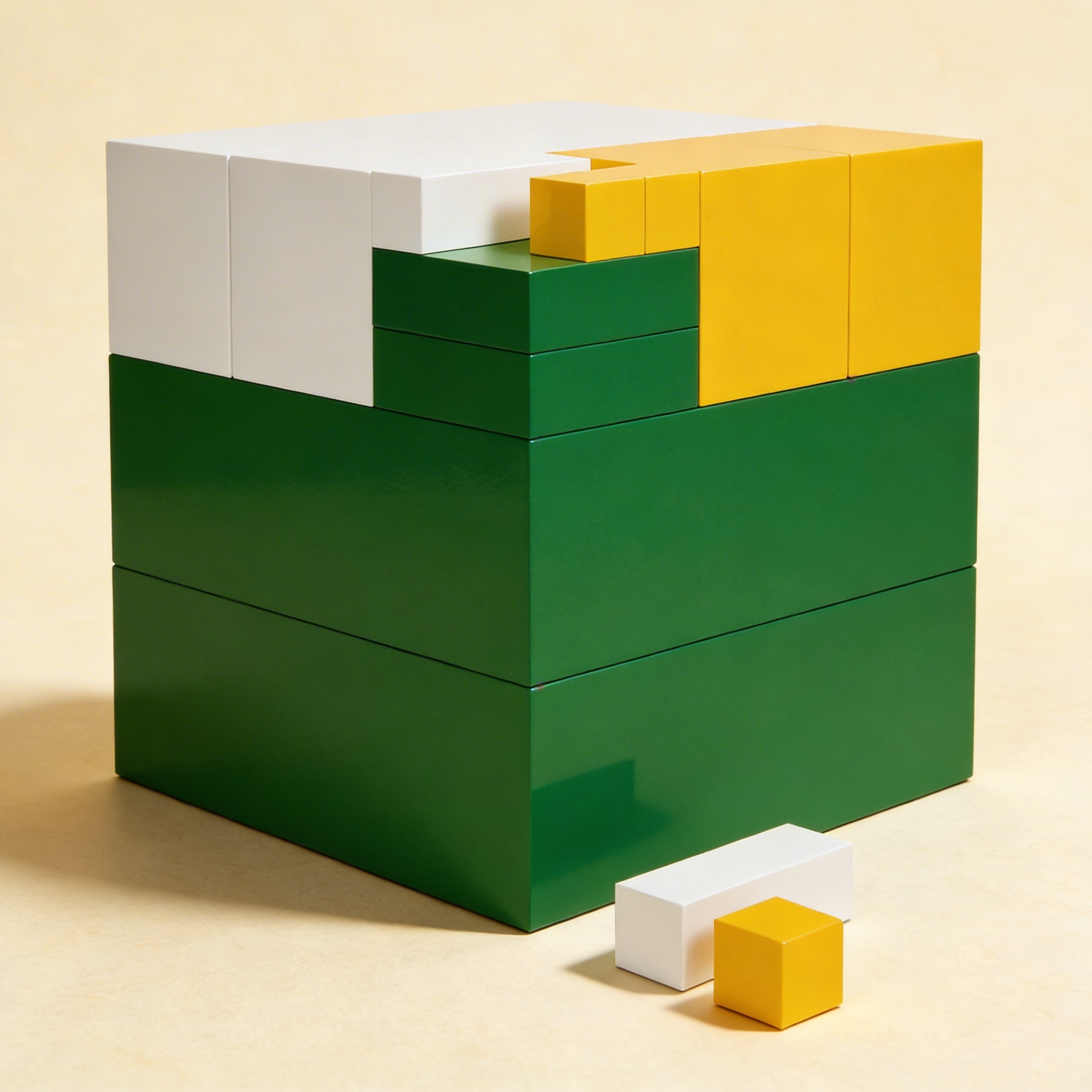
The Power of Three Cube — Cubic Relationships & Exponential Growth is a Sensorial Montessori material designed for children aged 6-12, crafted by Nienhuis Montessori to AMI standards.
The Power of Three Cube introduces children to mathematical concepts through hands-on exploration of cubic relationships and exponential growth. This beautifully crafted wooden material allows students to visualize and manipulate the progression from 1³ to 10³, building foundational understanding of algebraic concepts while developing spatial reasoning skills.
“Free the child's potential, and you will transform him into the world.”— Maria MontessoriTo Educate the Human Potential
“Education is a natural process spontaneously carried out by the human individual, and is acquired not by listening to words but by experiences upon the environment.”
— Maria Montessori, Education for a New World
The Power of Three Cube exemplifies Montessori's belief that mathematical concepts should be introduced through concrete, manipulable materials before abstract understanding. This material honors the child's natural progression from concrete to abstract thinking by making the invisible concept of cubing numbers tangible and visually compelling. The self-correcting nature of the interlocking design allows children to work independently, fostering intrinsic motivation and confidence. Each cube's precise proportions and color-coding support the Montessori principle of isolation of difficulty, helping children focus on one mathematical relationship at a time. The material's beautiful craftsmanship reflects Montessori's emphasis on providing children with aesthetically pleasing tools that inspire respect and careful handling. By allowing children to physically construct and deconstruct cubic relationships, this material transforms abstract algebraic thinking into a sensorial experience, perfectly aligning with Montessori's understanding that the hand teaches the mind.
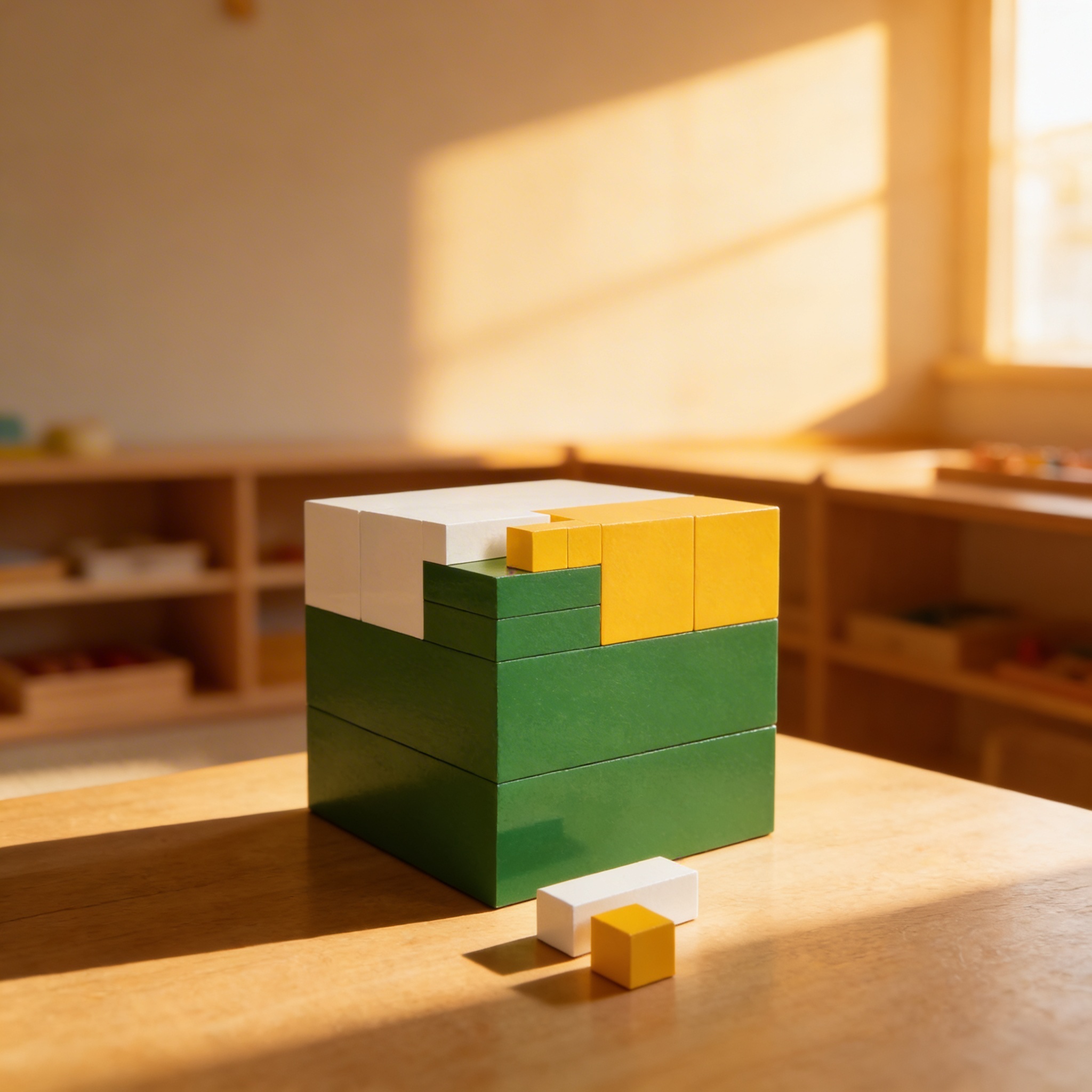
Each order includes everything needed for proper presentation and long-term use.
Follow the Montessori method of presentation for optimal child development.
Begin with the 1³ cube, inviting the child to hold and examine it, noting its perfect cube shape
Introduce the 2³ cube, showing how it can be built using eight 1³ cubes arranged in a 2x2x2 pattern
Progress systematically through 3³, 4³, and 5³, having the child build each cube and observe the growing pattern
Challenge the child to predict what 6³ will look like before building it, encouraging mathematical reasoning
Every material is carefully selected for durability, safety, and authentic Montessori experience.
Carefully selected hardwood provides the durability needed for repeated mathematical manipulations while maintaining precise edges essential for accurate stacking. The natural weight of wood offers satisfying tactile feedback that reinforces learning through movement.
The smooth matte paint finish ensures safety while providing clear visual distinction between mathematical relationships. Colors are carefully chosen to support mathematical progression understanding without overwhelming young learners.
Each material supports multiple areas of child development simultaneously.
Children develop foundational understanding of exponential relationships and cubic progression through concrete manipulation before moving to abstract mathematical concepts.
Three-dimensional construction and deconstruction activities strengthen spatial intelligence and geometric understanding essential for advanced mathematics.
Color-coding and physical manipulation help children visualize mathematical relationships, making abstract concepts concrete and understandable.
The progressive nature of the cubes supports logical thinking development and understanding of mathematical sequences and patterns.
Designed for child-sized hands
Professional tips from AMI-trained guides to maximize the educational value of this material.
“Present this material only after children have mastered the Pink Tower and Brown Stair to ensure readiness for cubic concepts”
Use minimal language during initial presentations, allowing the material itself to teach the mathematical relationships
Encourage children to work collaboratively, as the larger cubes benefit from teamwork and peer learning
Connect this work to other mathematical materials like the Decanomial and algebraic materials for integrated learning
Everything you need to know about this material.
Yes, this material is specifically designed for children ages 6-12 in the Elementary Montessori environment. Six-year-olds who have mastered basic counting and show readiness for abstract mathematical concepts can begin exploring with this material. The concrete nature of the wooden cubes allows younger children to physically manipulate and visualize mathematical relationships before moving to abstract understanding.
Absolutely! While designed for Montessori classrooms, this material works beautifully in homeschool environments. The self-correcting nature of the cubes and clear mathematical progression make it accessible for parents. We recommend familiarizing yourself with the basic presentations through Montessori training resources or albums to maximize the material's educational potential.
Our Power of Three Cube is crafted from premium hardwood with precise measurements essential for mathematical accuracy. The smooth finish and substantial weight provide the sensorial feedback crucial to Montessori learning. Built to withstand years of classroom use, this investment-quality material maintains its precision and beauty, making it suitable for multiple children over many years.
Begin with the concrete exploration of 1³, allowing the child to handle and examine the single unit cube. Gradually introduce 2³, 3³, and so forth, emphasizing the visual and tactile progression. Children naturally discover the exponential growth pattern through manipulation. Focus on the sensorial experience first - counting, comparing, and building - before introducing mathematical notation or terminology.
AMI-standard materials like our Power of Three Cube are precisely manufactured to exact specifications developed through decades of research. The dimensions, proportions, and sensorial qualities are carefully calibrated to support optimal learning. Cheaper alternatives often lack the precision necessary for mathematical concepts, potentially leading to confusion rather than clarity in your child's mathematical development.
Can't find what you're looking for?
Contact Our Experts
Share your experience with this material and help other educators and parents.
Bundle related materials and save. Free curriculum guide included with every set.


