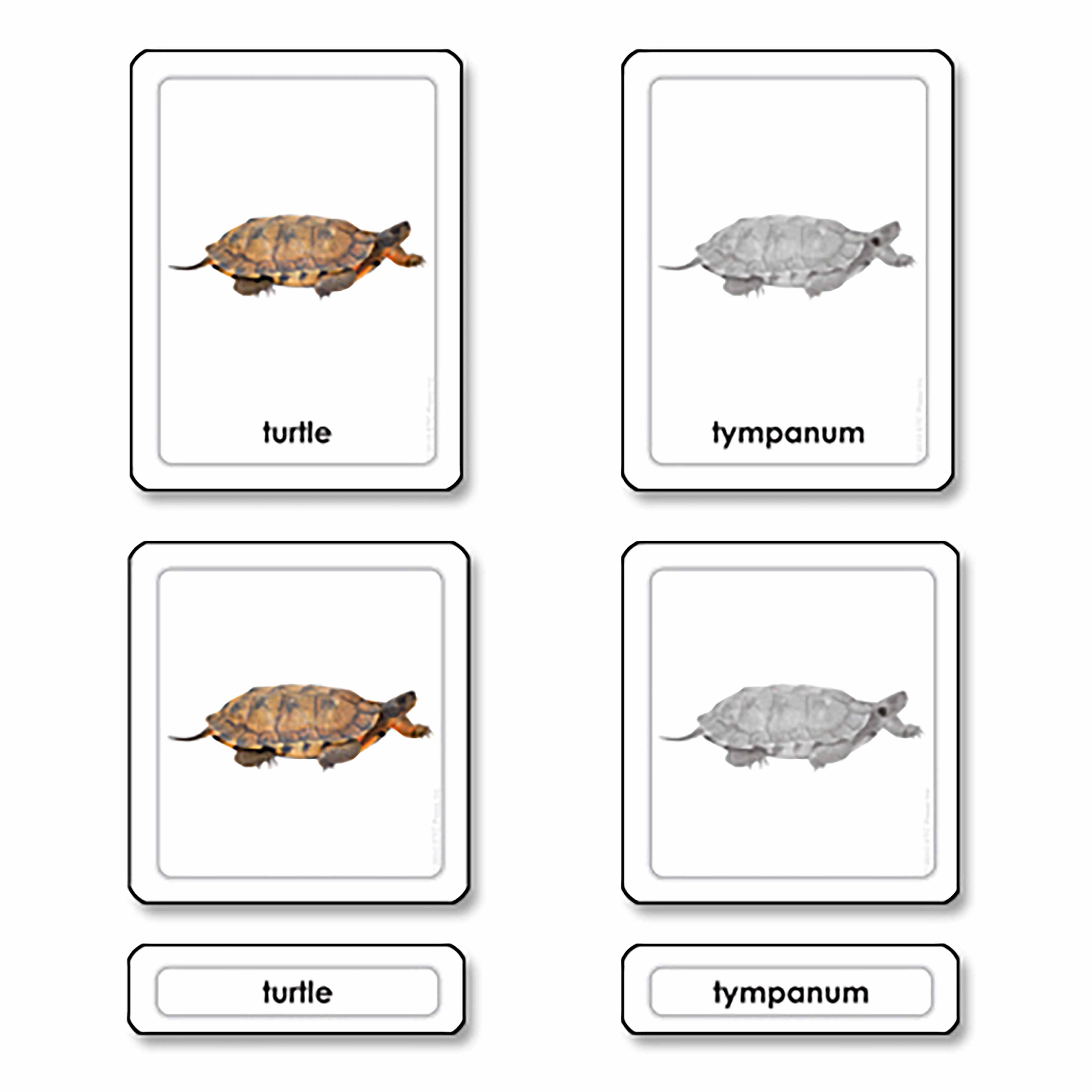
The Parts Of A Turtle (Reptile) is a category.biology Montessori material designed for children aged 3-6, crafted by Nienhuis Montessori to AMI standards.
This Parts of a Turtle nomenclature card set introduces children to reptile anatomy through precise three-part cards featuring detailed illustrations. The material supports the Montessori zoology curriculum by helping children learn specific anatomical terms including the tympanum (ear), while developing vocabulary and classification skills through hands-on matching work.
“Education is a natural process spontaneously carried out by the human individual, and is acquired not by listening to words but by experiences upon the environment.”— Maria MontessoriEducation for a New World
“The child is both a hope and a promise for mankind.”
— Maria Montessori, Education and Peace
The Parts of a Turtle nomenclature cards fulfill the young child's intense need to know the names of everything in their world. Between ages 3-6, children experience what Montessori called the 'sensitive period for language,' when acquiring new vocabulary happens effortlessly. These turtle anatomy cards harness this readiness by presenting scientific terms like 'tympanum' and 'carapace' at the exact moment when children crave such precise language. The three-part card format—picture card, label card, and control card—allows children to work independently, matching images to words at their own pace. This reptile material bridges the child's love of animals with their emerging interest in how living things work. By learning that a turtle has a tympanum rather than simply 'ears,' children develop the scientific precision that characterizes Montessori zoology work. The cards transform abstract anatomical concepts into concrete, manipulable objects that children can arrange, sort, and master through repeated handling.
Each order includes everything needed for proper presentation and long-term use.
Follow the Montessori method of presentation for optimal child development.
Show the child how to select one picture card and name the turtle part shown
Demonstrate finding the matching label card and placing it below the picture
Continue matching all pictures to labels, working left to right
Use the control cards to verify each match independently
Every material is carefully selected for durability, safety, and authentic Montessori experience.
Sourced from sustainably managed European forests. Beechwood is chosen for its exceptional durability, smooth grain, and natural warmth that invites touch.
Natural, unbleached cotton in child-friendly colors. The fabric provides the right amount of friction for developing fingers while being gentle on sensitive skin.
Water-based, child-safe finish that meets the strictest European safety standards. Designed to withstand years of daily use without chipping or peeling.
Each material supports multiple areas of child development simultaneously.
Children learn precise anatomical terms like tympanum, plastron, and carapace, building a foundation for scientific study.
Matching pictures to labels refines visual perception and attention to detail essential for reading readiness.
Understanding turtle anatomy supports the child's ability to classify and categorize living things systematically.
Three-part card format allows self-directed learning and built-in error control through the control cards.
Designed for child-sized hands
Professional tips from AMI-trained guides to maximize the educational value of this material.
“Present this material after children have worked with broader animal classification cards to establish reptile characteristics”
Use a real turtle shell or high-quality replica during the initial presentation to make connections tangible
Create a word wall with the turtle terminology, adding small illustrations next to each term
Connect this work to other reptile nomenclature sets to build comparative anatomy understanding
Everything you need to know about this material.
This set includes essential turtle anatomy terms such as the shell (carapace and plastron), head, legs, tail, tympanum (ear), eyes, and other key body parts. Each part is clearly illustrated and labeled to help children ages 3-6 understand reptile anatomy.
Three-part cards consist of a picture card, a label card, and a control card combining both. Children match the picture to its corresponding label, then use the control card to check their work independently. This self-correcting feature promotes autonomous learning and builds confidence.
The cards feature clear, realistic illustrations with simple vocabulary appropriate for early readers. The material aligns with the sensitive period for language development and the child's natural interest in animals, while the hands-on matching work develops fine motor skills and concentration.
Begin with a three-period lesson introducing 3-4 parts at a time. First, name each part while pointing ('This is the carapace'). Then ask the child to identify parts ('Show me the tympanum'). Finally, have them name parts independently ('What is this?'). Gradually introduce more complex terminology as the child masters basic parts.
Extensions include comparing turtle anatomy to other reptiles, creating a turtle diagram booklet, researching different turtle species, incorporating the cards into continent studies (where turtles live), or using them alongside live turtle observation. Children can also sort parts by function or create their own turtle drawings with labeled parts.
Can't find what you're looking for?
Contact Our Experts
Share your experience with this material and help other educators and parents.


