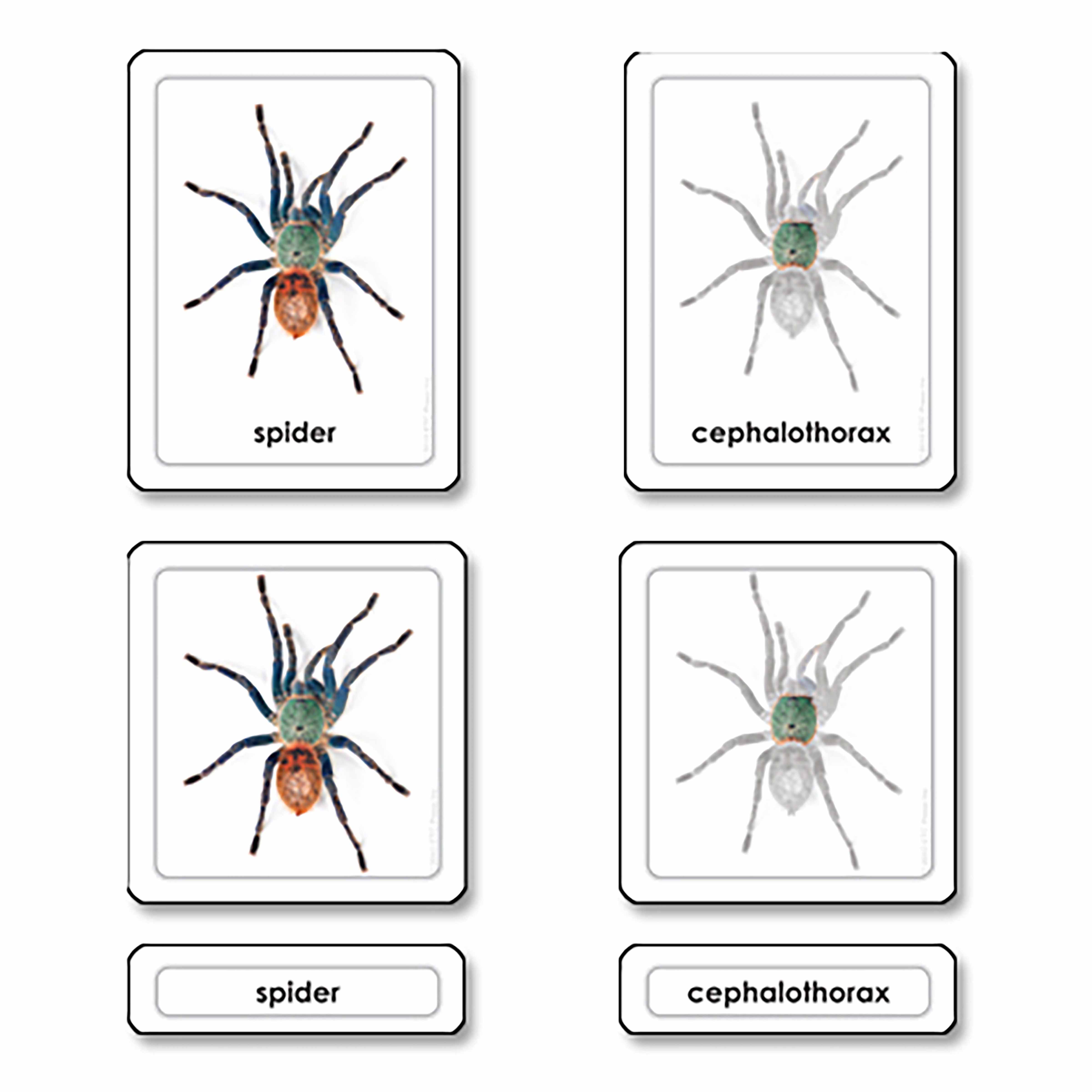
The Parts Of A Spider (Arachnid) is a Educational Materials Montessori material designed for children aged 3-6, crafted by Nienhuis Montessori to AMI standards.
These professionally designed 3-part nomenclature cards introduce young learners to spider anatomy through the Montessori method. The set features detailed color-coded illustrations with corresponding grayscale control cards and separate text labels, enabling children to master arachnid body parts through matching, reading, and self-correction activities.
“The child is both a hope and a promise for mankind.”— Maria MontessoriEducation and Peace
“The hands are the instruments of man's intelligence.”
— Maria Montessori, The Absorbent Mind
The Parts of a Spider nomenclature cards address children's fascination with small creatures by offering precise scientific vocabulary at the moment of greatest interest. These color-coded illustrations with matching grayscale controls allow children to isolate and identify each anatomical feature—from cephalothorax to spinnerets—through repeated matching work. The three-part card format respects the child's need for order by presenting spider anatomy in graduated complexity: first matching identical pictures, then associating pictures with labels, finally reading labels independently. Unlike simplified nature books, these nomenclature cards present accurate arachnid terminology that children readily absorb during their sensitive period for language. The grayscale control cards enable independent error correction, allowing children to verify their own understanding of where eight legs attach or how pedipalps differ from regular legs. This systematic approach to spider anatomy satisfies children's desire to name and classify their observations from outdoor exploration.
Each order includes everything needed for proper presentation and long-term use.
Follow the Montessori method of presentation for optimal child development.
Invite the child to match each colored spider part card with its grayscale counterpart, creating rows across the mat
Once all pictures are matched, introduce one label at a time, reading it aloud before placing it below the corresponding pictures
Remove all grayscale cards and labels, leaving only colored pictures. Invite the child to read and place labels independently
For reading practice, use only labels and grayscale cards, matching text to pictures without color cues
Every material is carefully selected for durability, safety, and authentic Montessori experience.
Sourced from sustainably managed European forests. Beechwood is chosen for its exceptional durability, smooth grain, and natural warmth that invites touch.
Natural, unbleached cotton in child-friendly colors. The fabric provides the right amount of friction for developing fingers while being gentle on sensitive skin.
Water-based, child-safe finish that meets the strictest European safety standards. Designed to withstand years of daily use without chipping or peeling.
Each material supports multiple areas of child development simultaneously.
Builds precise anatomical terminology through visual association and repetitive matching work.
Develops sight word recognition and connects written labels to visual representations.
Enhances ability to identify and categorize parts of living creatures systematically.
Control cards enable self-correction, fostering autonomy and confidence in knowledge acquisition.
Designed for child-sized hands
Professional tips from AMI-trained guides to maximize the educational value of this material.
“Present this material after children show interest in spiders during outdoor time or bring spider questions to circle”
Use a magnifying glass with a real preserved spider specimen alongside the cards for comparison
Create a classroom spider chart where children can add new spider facts using the anatomical vocabulary
Pair with books about different spider species to apply the learned body part names
Everything you need to know about this material.
The set includes essential arachnid anatomy parts such as cephalothorax, abdomen, eight legs, spinnerets, chelicerae (fangs), pedipalps, and eyes. Each part is clearly illustrated with color-coded diagrams on durable cards suitable for repeated handling by young children.
Children match the picture cards with corresponding labels, use grayscale control cards for self-correction, and practice reading vocabulary. Activities progress from simple matching to reading labels independently, building both visual discrimination and early literacy skills.
Yes, the educational illustrations present spiders in a scientific, non-threatening way that helps children understand arachnids objectively. Learning accurate information about spider anatomy often reduces fears by replacing misconceptions with factual knowledge.
Picture cards feature full-color illustrations with labels, while control cards show the same images in grayscale without text. Children use control cards to check their work independently after matching pictures with separate label cards, following the Montessori principle of self-correction.
Absolutely! These cards complement nature study perfectly. Children can observe real spiders (safely) outdoors or in containers, then use the cards to identify and name the parts they've seen, reinforcing concrete learning with abstract representation.
Can't find what you're looking for?
Contact Our Experts
Share your experience with this material and help other educators and parents.


