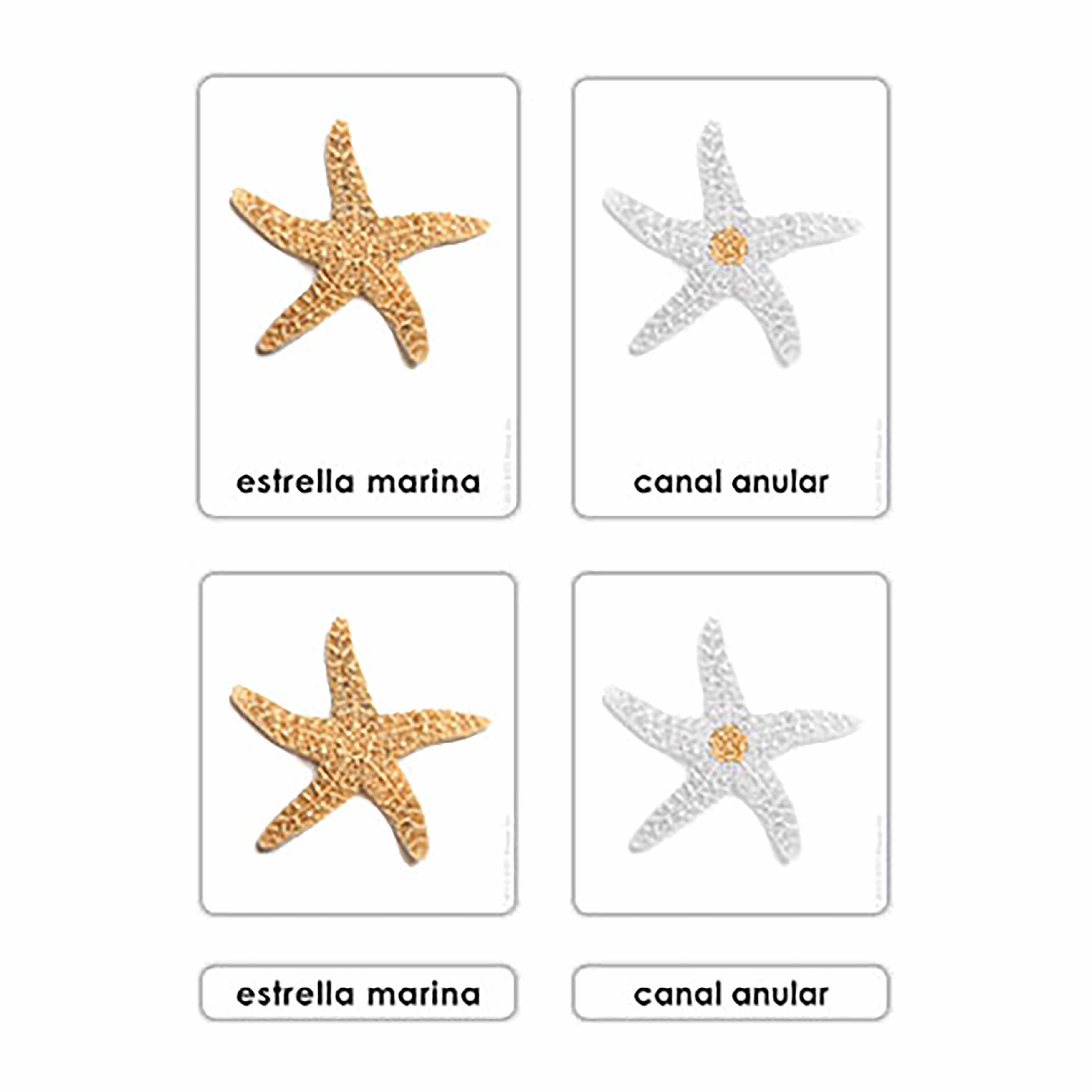
The Partes De Un Equinodermo is a Educational Materials Montessori material designed for children aged 3-6, crafted by Nienhuis Montessori to AMI standards.
This Spanish-language nomenclature card set introduces children to the anatomical parts of an echinoderm (starfish) through beautifully illustrated, laminated cards. Part of the Montessori zoology curriculum, these cards feature detailed illustrations with labeled parts, supporting vocabulary development and scientific classification skills. The durable laminated construction ensures repeated use in both individual and small group lessons.
“The child is both a hope and a promise for mankind.”— Maria MontessoriEducation and Peace
“The hands are the instruments of man's intelligence.”
— Maria Montessori, The Absorbent Mind
The Partes De Un Equinodermo nomenclature cards fulfill the young child's need to name and classify the natural world through precise Spanish vocabulary. These laminated zoology cards present the starfish's anatomy with scientific accuracy, allowing children to match labeled illustrations to their growing understanding of living creatures. The nomenclature format of these echinoderm cards follows the Montessori principle of isolation of difficulty—each anatomical part receives focused attention through clear visual representation. The durable laminated construction of Partes De Un Equinodermo enables repeated handling as children build their Spanish scientific vocabulary. By presenting real anatomical terms rather than simplified language, these cards respect the child's capacity for complex learning. The visual clarity of each echinoderm part—from rays to madreporite—satisfies the absorbent mind's hunger for detailed information about nature's design.
Each order includes everything needed for proper presentation and long-term use.
Follow the Montessori method of presentation for optimal child development.
Present the complete starfish card, inviting the child to observe its form
Select one part card (e.g., 'brazos'), place it below the main card, and give the Spanish name clearly
Continue with 2-3 more parts, allowing the child to repeat each Spanish term
Invite the child to match remaining part cards independently
Introduce the Spanish labels, matching them to the illustrated cards
Every material is carefully selected for durability, safety, and authentic Montessori experience.
Sourced from sustainably managed European forests. Beechwood is chosen for its exceptional durability, smooth grain, and natural warmth that invites touch.
Natural, unbleached cotton in child-friendly colors. The fabric provides the right amount of friction for developing fingers while being gentle on sensitive skin.
Water-based, child-safe finish that meets the strictest European safety standards. Designed to withstand years of daily use without chipping or peeling.
Each material supports multiple areas of child development simultaneously.
Introduces zoological vocabulary and understanding of invertebrate anatomy through detailed visual study.
Builds Spanish vocabulary for scientific terms while supporting reading readiness through word-picture matching.
Enhances observation skills as children identify and match specific anatomical features of the echinoderm.
Connects children to marine biology concepts while supporting Spanish language learners or bilingual education.
Designed for child-sized hands
Professional tips from AMI-trained guides to maximize the educational value of this material.
“Pre-teach basic Spanish pronunciation for anatomical terms during circle time”
Create a classroom display showing echinoderms from different ocean habitats
Connect to broader invertebrate studies by comparing with mollusk nomenclature cards
Use alongside preserved specimens or detailed models for three-dimensional understanding
Everything you need to know about this material.
The card set typically includes key anatomical features of a starfish such as the central disc, arms (rays), tube feet, madreporite, mouth, and other essential structures. Each part is clearly labeled in Spanish with detailed illustrations to help children identify and learn the scientific terminology.
These cards align with Montessori's systematic approach to teaching biological classification and anatomy. They introduce children to scientific vocabulary through visual learning, support the development of classification skills, and provide a foundation for understanding invertebrate anatomy within the broader zoology studies.
While the labels are in Spanish, the detailed illustrations make these cards valuable for visual learning regardless of language. They're excellent for bilingual education, Spanish immersion programs, or introducing scientific Spanish vocabulary. The visual nature of the material supports comprehension even without full Spanish fluency.
Children can engage in three-part card lessons, matching activities, vocabulary building exercises, and comparative anatomy studies. They can trace or draw the parts, create their own labeled diagrams, or use the cards alongside real specimens or models for hands-on exploration.
The laminated construction makes these cards highly durable for repeated classroom use. They resist tears, spills, and frequent handling by young children. The lamination also allows for easy cleaning and sanitizing, making them suitable for shared use in group lessons or learning centers.
Can't find what you're looking for?
Contact Our Experts
Share your experience with this material and help other educators and parents.


