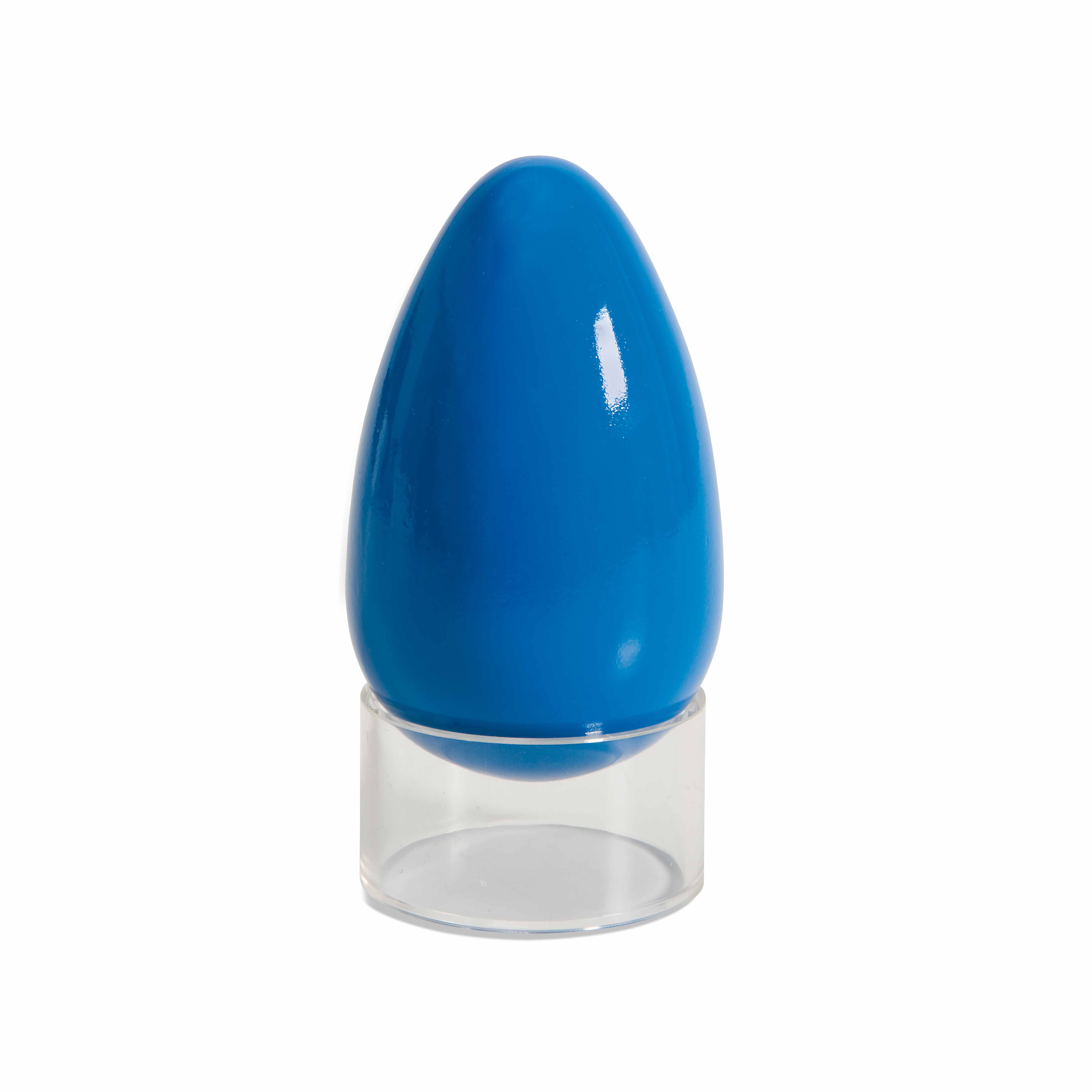
The Ovoid is a Educational Materials Montessori material designed for children aged 6-12, crafted by Nienhuis Montessori to AMI standards.
This precision-crafted ovoid introduces elementary students to three-dimensional geometry through hands-on exploration. The glossy blue egg-shaped form sits securely on a transparent cylindrical base, allowing children to examine its continuously curved surface from all angles while developing spatial reasoning and geometric vocabulary.
“The child is both a hope and a promise for mankind.”— Maria MontessoriEducation and Peace
“The hands are the instruments of man's intelligence.”
— Maria Montessori, The Absorbent Mind
The Ovoid serves as a bridge between the child's sensorial experiences and abstract mathematical concepts in the elementary classroom. This glossy blue egg-shaped form represents nature's geometry - found in seeds, stones, and celestial bodies - connecting mathematical study to the real world. The transparent cylindrical base elevates the ovoid for examination, allowing children to trace its continuously curved surface with their fingers while building mental images of three-dimensional forms. Unlike spheres or cubes with predictable dimensions, the ovoid's varying curvature challenges children to observe more carefully, developing the precision of thought required for advanced geometry. The ovoid's smooth, uninterrupted surface demonstrates how nature creates forms without edges or vertices, preparing children for concepts like ellipses, parabolas, and orbital mechanics. By manipulating this tangible geometric solid, children internalize spatial relationships that pure abstraction cannot provide, laying foundations for trigonometry, calculus, and physics.
Each order includes everything needed for proper presentation and long-term use.
Follow the Montessori method of presentation for optimal child development.
Invite the child to remove the ovoid from its base and explore its surface with both hands, noting where it curves most and least
Place the ovoid back on its base and rotate it slowly, observing how its silhouette changes from different viewing angles
Compare the ovoid to a sphere by attempting to roll both - note how the ovoid follows an curved path while a sphere rolls straight
Trace around the ovoid's widest point and narrowest point on paper, creating cross-sectional drawings
Each material supports multiple areas of child development simultaneously.
Introduces the ovoid as a three-dimensional form distinct from spheres and ellipsoids, building advanced shape recognition.
Develops precise geometric vocabulary and descriptive language for curved surfaces and egg-shaped forms.
Enhances ability to visualize and understand three-dimensional shapes through tactile exploration and observation.
Links geometric forms to natural shapes found in biology, preparing for interdisciplinary learning.
Designed for child-sized hands
Professional tips from AMI-trained guides to maximize the educational value of this material.
“Present the ovoid alongside other curved solids (sphere, ellipsoid) to highlight unique characteristics”
Connect ovoid study to biology lessons about eggs and seeds, reinforcing cross-curricular learning
Use the transparent base as a teaching tool - it demonstrates how we display and study three-dimensional objects
apex, axis, symmetry, cross-section, revolution
Everything you need to know about this material.
The ovoid introduces curved surfaces, rotational symmetry, cross-sections, and the relationship between 2D circles and 3D forms. Children explore how an ellipse rotated around its axis creates an egg-shaped solid, building understanding of three-dimensional geometry.
Unlike a sphere with uniform curvature, the ovoid has varying curvature - more pointed at one end and rounded at the other. This egg shape helps children understand that not all curved 3D objects are spheres and develops their ability to distinguish between geometric forms.
Children can trace cross-sections, compare it with other geometric solids, explore how it rolls differently than a sphere, study light reflections on its surface, and use it as a model for drawing and understanding natural forms like eggs.
The transparent cylindrical base serves multiple purposes: it keeps the ovoid stable for observation, allows children to see the contact point, demonstrates how 3D objects rest on surfaces, and enables viewing from below to understand the complete form.
The ovoid extends work with geometric solids, complementing spheres, cones, and cylinders. It bridges to advanced concepts like conic sections and prepares for later study of calculus concepts involving curves and rates of change in upper elementary.
Can't find what you're looking for?
Contact Our Experts
Share your experience with this material and help other educators and parents.

