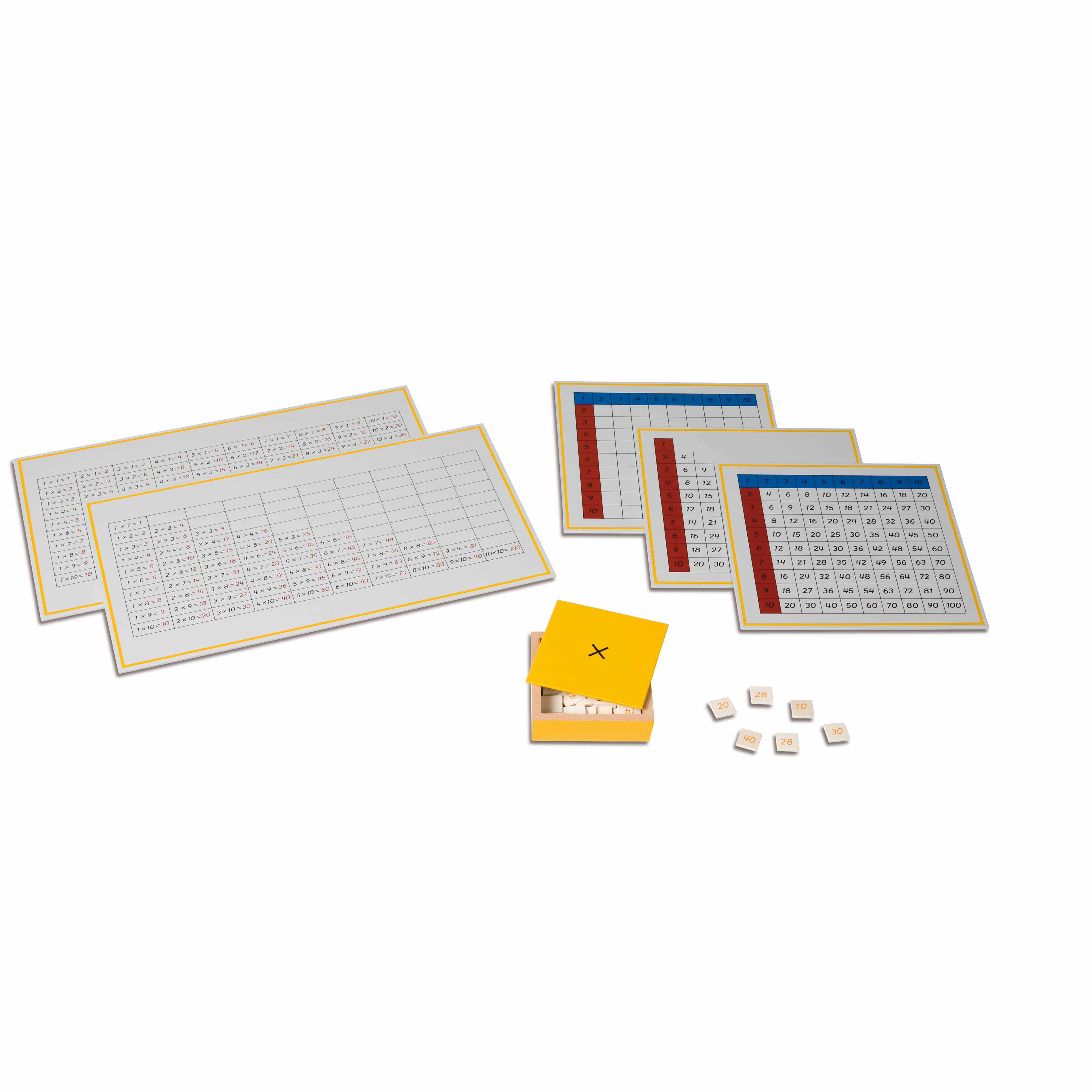
The Multiplication Working Charts is a Mathematics Montessori material designed for children aged 3-6, crafted by Nienhuis Montessori to AMI standards.
The Multiplication Working Charts provide systematic practice for memorizing multiplication facts through hands-on manipulation of numbered tiles. Children work through progressive charts, placing wooden tiles to complete multiplication equations, building fluency and understanding of multiplication relationships. This comprehensive material supports the transition from concrete manipulation to abstract mathematical thinking.
“Children display a universal love of mathematics, which is par excellence the science of precision, order, and intelligence.”— Maria MontessoriThe Discovery of the Child
“The greatest sign of success for a teacher is to be able to say, 'The children are now working as if I did not exist.'”
— Maria Montessori, The Absorbent Mind
The Multiplication Working Charts exist in the Montessori mathematics curriculum to address the child's developmental need for systematic fact memorization through physical manipulation. Each numbered tile in the Multiplication Working Charts represents a concrete quantity that the child can touch, move, and place, transforming abstract multiplication relationships into tangible experiences. The progressive nature of these charts allows children to discover patterns within multiplication tables through their own repeated work with the tiles. Unlike traditional rote memorization, the Multiplication Working Charts enable children to physically construct each multiplication fact by placing tiles in specific positions on the charts. This hands-on approach with the multiplication tiles satisfies the young child's need to learn through movement and touch while building the foundation for advanced mathematical thinking. The charts themselves serve as a bridge between the earlier concrete multiplication materials and the abstraction required for mental calculation.
Each order includes everything needed for proper presentation and long-term use.
Follow the Montessori method of presentation for optimal child development.
Begin with the 1x1 equation at the top left of Chart 1
Search through the tile box to find the correct answer tile
Place the answer tile in the empty square next to its equation
When Chart 1 is complete, remove all tiles and progress to Chart 2
Every material is carefully selected for durability, safety, and authentic Montessori experience.
Each tile is crafted from solid wood, providing satisfying tactile feedback as children place answers. The natural warmth of wood engages the senses while building mathematical understanding.
Each material supports multiple areas of child development simultaneously.
Systematic practice leads to memorization of multiplication facts through repeated concrete manipulation.
Color-coded grids help children discover multiplication patterns and relationships between numbers.
Control charts allow independent work and immediate feedback, building confidence and autonomy.
Bridges the gap between concrete materials and abstract mathematical concepts through progressive exercises.
Designed for child-sized hands
Professional tips from AMI-trained guides to maximize the educational value of this material.
“Present this material only after children have worked extensively with golden bead multiplication and understand the concept”
Store completed control charts separately so children can self-check their work independently
Observe which facts children consistently struggle with and offer targeted support with concrete materials
Create a classroom recording system where children track their progress through all charts
Everything you need to know about this material.
While labeled for ages 3-6, these charts are typically introduced around age 5-6, after children have mastered addition and subtraction concepts and have worked with multiplication using concrete materials like the bead chains and multiplication bead board.
The set includes multiple working charts with grids for multiplication practice, wooden numbered tiles for placing answers, control charts for self-correction, and a wooden storage box. The charts progress from simple to complex multiplication facts.
Children physically place numbered tiles in the correct spaces on the charts, engaging tactile and visual learning. The repetitive practice combined with self-correction using control charts helps children internalize multiplication facts through hands-on manipulation rather than rote memorization.
The Multiplication Bead Board introduces the concept of multiplication using concrete beads to show groups and quantities. The Working Charts are used after this initial understanding, focusing on practicing and memorizing multiplication facts through number tiles and systematic chart work.
Progress varies by child, but with regular practice (15-20 minutes daily), most children can master basic multiplication facts (1-10) within 3-6 months. The material allows children to work at their own pace, building confidence and fluency gradually.
Can't find what you're looking for?
Contact Our Experts
Share your experience with this material and help other educators and parents.


