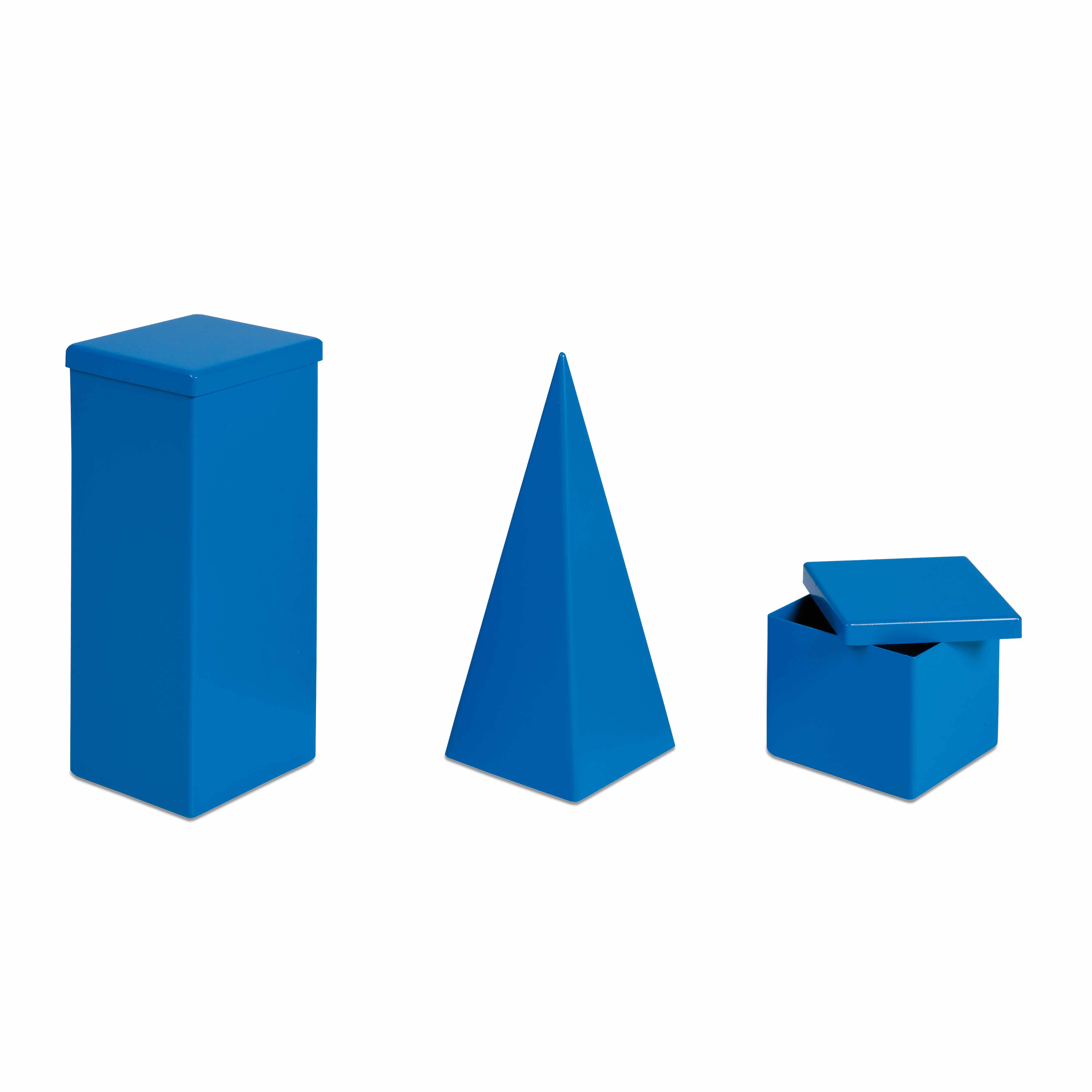
The Metal Volume Containers is a Educational Materials Montessori material designed for children aged 6-12, crafted by Nienhuis Montessori to AMI standards.
These precision-crafted metal volume containers introduce children to three-dimensional geometry through hands-on exploration. Each container features a removable lid, allowing students to investigate volume relationships by filling, comparing, and measuring different geometric solids. The durable metal construction ensures years of classroom use while providing clear visual and tactile feedback for understanding spatial concepts.
“The child is both a hope and a promise for mankind.”— Maria MontessoriEducation and Peace
“The hands are the instruments of man's intelligence.”
— Maria Montessori, The Absorbent Mind
The Metal Volume Containers emerge from Maria Montessori's observation that children aged 6-12 enter a phase of intellectual hunger for understanding abstract relationships. These precision-crafted containers transform the abstract concept of volume into tangible reality through their removable lids and fillable interiors. Each metal container's specific geometric form - whether cube, cylinder, or pyramid - allows children to physically manipulate and compare three-dimensional space. The metal construction provides weight and substance that engages the muscular memory while the mind grasps mathematical relationships. Unlike two-dimensional representations, these volume containers permit direct exploration of how different shapes can contain equal amounts despite varied appearances. The removable lids invite investigation through filling with water, sand, or small objects, making volume measurement a concrete experience. This hands-on approach to geometry satisfies the elementary child's need to understand the 'how' and 'why' of mathematical principles through direct manipulation rather than abstract explanation.
Each order includes everything needed for proper presentation and long-term use.
Follow the Montessori method of presentation for optimal child development.
Invite child to explore containers by removing lids and examining interior space
Fill one container with rice or water, then pour contents into another to compare volumes
Measure dimensions of each container and record findings
Calculate volume using discovered measurements, then verify by filling
Create volume equivalency chains showing which containers hold the same amount
Every material is carefully selected for durability, safety, and authentic Montessori experience.
The metal construction provides durability and precise edges that clearly demonstrate geometric principles. The weight and rigidity help children understand the permanence and structure of three-dimensional forms.
Each material supports multiple areas of child development simultaneously.
Children develop spatial reasoning by exploring three-dimensional shapes and their properties through direct manipulation.
Hands-on filling activities build concrete understanding of volume relationships between different geometric solids.
Comparing and measuring activities develop logical thinking and prepare for advanced geometric concepts.
Encourages systematic exploration through measuring, comparing, and recording volume relationships.
Designed for child-sized hands
Professional tips from AMI-trained guides to maximize the educational value of this material.
“Introduce containers gradually - start with cube and rectangular prism before adding cylinders and complex forms”
Keep filling materials (rice, lentils, water) in labeled containers for independent access
Create measurement recording sheets that match your specific container set
Connect volume work to practical life by relating to cooking measurements and real containers
Everything you need to know about this material.
The set typically includes fundamental 3D shapes such as cubes, rectangular prisms, cylinders, cones, pyramids, and spheres. Each container has precise measurements and removable lids for hands-on exploration of volume relationships.
Students fill the containers with materials like sand, water, or rice to compare volumes between different shapes. They can discover that shapes with the same base and height have related volumes, and explore concepts like displacement and capacity through practical experimentation.
These containers are designed for ages 6-12, aligning with when children develop spatial reasoning and can understand abstract mathematical concepts. The materials support progression from concrete manipulation to abstract understanding of volume formulas.
The durable metal construction ensures longevity in classroom environments, provides precise edges for accurate measurements, and offers satisfying sensory feedback. The material is rust-resistant, easy to clean, and maintains its shape integrity over years of use.
These containers embody Montessori's concrete-to-abstract approach, allowing children to physically manipulate and compare volumes before introducing formulas. They support self-directed discovery, provide control of error through visual comparison, and integrate with other Montessori geometry materials.
Can't find what you're looking for?
Contact Our Experts
Share your experience with this material and help other educators and parents.


