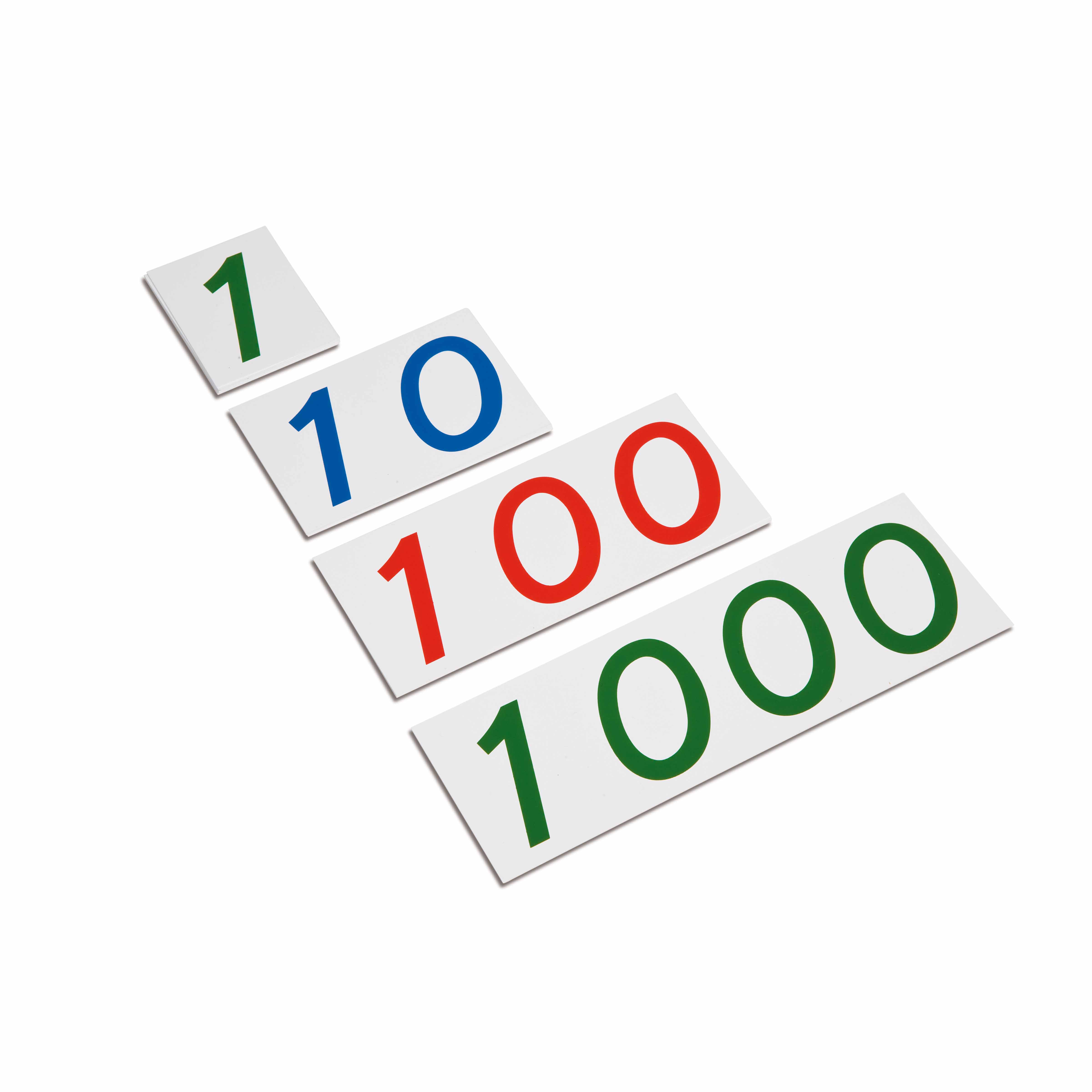
The Large Number Cards 1-1000: Plastic is a Mathematics Montessori material designed for children aged 3-6, crafted by Nienhuis Montessori to AMI standards.
These durable plastic number cards introduce children to place value and the decimal system through Montessori's color-coded approach. The cards feature units in green, tens in blue, and hundreds in red, allowing children to build and explore numbers from 1 to 1000 through hands-on manipulation and visual discrimination.
“Children display a universal love of mathematics, which is par excellence the science of precision, order, and intelligence.”— Maria MontessoriThe Discovery of the Child
“The greatest sign of success for a teacher is to be able to say, 'The children are now working as if I did not exist.'”
— Maria Montessori, The Absorbent Mind
The Large Number Cards 1-1000 serve as the concrete bridge between a child's understanding of quantities and the abstract symbols that represent them. These plastic cards with their distinctive color-coding—green units, blue tens, and red hundreds—make the decimal system visible and tangible for young learners. Each card's physical manipulation allows children to literally build numbers, experiencing how 3 hundreds, 4 tens, and 5 units combine to create 345. The overlapping design of these cards reveals the mathematical magic of place value, showing how digits occupy specific positions to create meaning. Through arranging and rearranging these colored number cards, children discover patterns within our number system that would remain hidden in traditional teaching methods. The Large Number Cards transform the abstraction of multi-digit numbers into a sensorial experience where children can see, touch, and physically construct their mathematical understanding.
Each order includes everything needed for proper presentation and long-term use.
Follow the Montessori method of presentation for optimal child development.
Introduce each color category separately, showing how units count by ones, tens by tens, and hundreds by hundreds
Demonstrate building a three-digit number by selecting one card from each stack and overlapping them precisely
Invite the child to build specific numbers you name, starting with round numbers like 300, then progressing to 345
Have the child read numbers you build, pointing to each place value as they identify it
Each material supports multiple areas of child development simultaneously.
Children physically layer cards to build numbers, making abstract concepts concrete through manipulation.
Color-coding helps children recognize patterns in our base-ten number system and understand hierarchies.
Building and reading four-digit numbers develops logical thinking and prepares for advanced operations.
Recognizing and organizing numbers by color and size refines visual perception skills.
Designed for child-sized hands
Professional tips from AMI-trained guides to maximize the educational value of this material.
“Store cards in separate color-coded containers to reinforce the hierarchical organization”
Practice the precise overlapping technique yourself before presenting to ensure smooth demonstration
Use a felt mat to prevent cards from sliding during manipulation
Create a number-building station where children can practice independently after the initial lesson
Everything you need to know about this material.
The set includes all numbers from 1-1000, with separate cards for units (1-9), tens (10-90), hundreds (100-900), and 1000. Children can layer these cards to create any number within this range.
Each place value has a distinct color following Montessori's decimal system: green for units (ones), blue for tens, and red for hundreds. This visual coding helps children recognize and understand the different values at a glance.
Yes, though 3-year-olds typically start with numbers 1-10. The full set grows with the child - most 4-5 year olds work with numbers to 100, while 5-6 year olds explore the complete range to 1000.
These plastic cards are highly durable, waterproof, and resistant to tearing or bending. They're ideal for frequent classroom use and easy to clean, though some prefer wooden cards for their natural texture and weight.
The cards follow Montessori proportions where each place value is progressively larger - units are smallest, tens are wider, and hundreds are widest. This allows them to overlap properly when building multi-digit numbers.
Can't find what you're looking for?
Contact Our Experts
Share your experience with this material and help other educators and parents.

