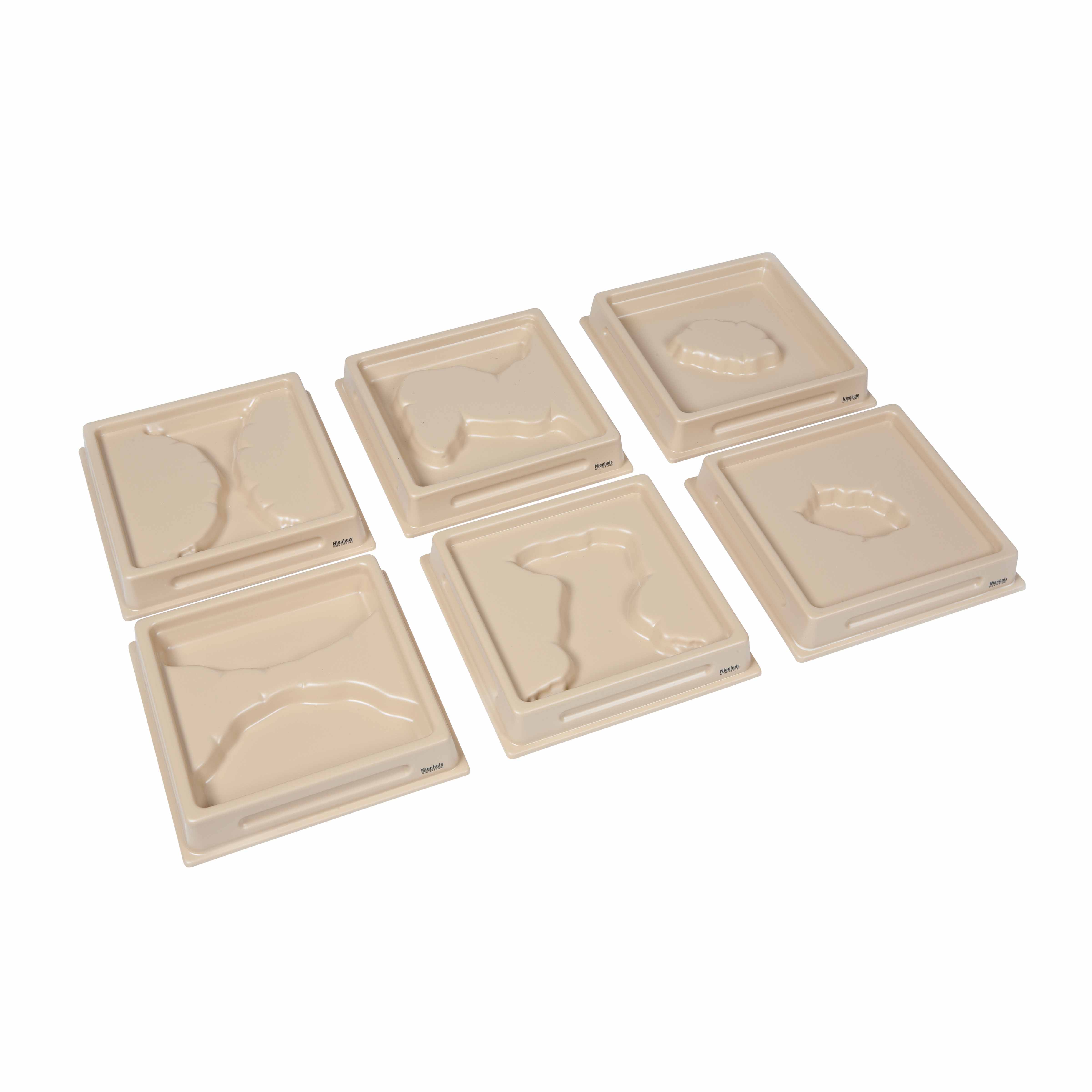
The Land And Water Form Trays: Set 1 is a category.geography Montessori material designed for children aged 3-6, crafted by Nienhuis Montessori to AMI standards.
These geography form trays introduce children to fundamental land and water formations through tactile exploration. Each durable tray features a recessed geographic form that children can trace with their fingers or fill with water, providing concrete sensory experiences that build understanding of Earth's physical features.
“Education is a natural process spontaneously carried out by the human individual, and is acquired not by listening to words but by experiences upon the environment.”— Maria MontessoriEducation for a New World
“The child is both a hope and a promise for mankind.”
— Maria Montessori, Education and Peace
Land and Water Form Trays transform abstract geographic concepts into concrete sensory experiences by allowing children to trace recessed formations with their fingers. These trays address the young child's need to understand their physical world through touch and movement, connecting tactile exploration to intellectual discovery. By filling the recessed areas with water, children witness how liquids naturally collect in Earth's depressions, making geography a living experience rather than memorized facts. The trays' design respects the child's developmental stage where hands must explore before the mind can abstract. Each geographic form—whether island, lake, peninsula, or gulf—becomes knowable through repeated tactile encounters in the trays. This sensorial approach to geography honors how children naturally learn about their environment: through direct manipulation and observation of physical forms.
Each order includes everything needed for proper presentation and long-term use.
Follow the Montessori method of presentation for optimal child development.
Invite the child to trace the raised land portion with their index finger, moving slowly around the edges
Pour water carefully into the recessed water area until it reaches the rim
Trace the water's edge where it meets the land, emphasizing the boundary
Name the formation: 'This is an island—land surrounded by water'
Empty the tray using the sponge, demonstrating careful squeezing into the pitcher
Each material supports multiple areas of child development simultaneously.
Concrete representation of abstract geographic concepts through tactile exploration and water experiments.
Tracing forms develops tactile discrimination and prepares the hand for later map work.
Introduces specific geographic terminology through hands-on experience with landforms.
Exploring how water interacts with different land formations builds early earth science concepts.
Designed for child-sized hands
Professional tips from AMI-trained guides to maximize the educational value of this material.
“Present contrasting forms together (island/lake) to highlight the inverse relationship between land and water”
Allow ample time for repetition—children often want to fill and empty trays many times before moving to naming
Create a dedicated geography shelf with trays at child height, ensuring easy access to water supplies
Observe which formations captivate individual children and provide real-world examples from your local geography
Everything you need to know about this material.
Set 1 typically includes fundamental formations such as island/lake, peninsula/gulf, cape/bay, and isthmus/strait. Each tray shows the land form on one side and its corresponding water form on the reverse, helping children understand complementary geographic features.
Children can pour water into the recessed areas representing water forms, creating a visual and tactile experience. The water clearly shows the difference between land (dry, raised areas) and water (wet, recessed areas), making abstract geographic concepts concrete and memorable.
The trays are constructed from durable, water-resistant materials designed to withstand frequent use and water exposure. They feature smooth surfaces for easy cleaning and raised edges to contain water during activities.
Children can trace the forms with their fingers, create corresponding shapes with clay, match the trays to picture cards or globes, and use them as templates for drawing maps. They also pair well with sandpaper land and water form cards and geography nomenclature materials.
These trays provide the concrete, sensory foundation essential for understanding abstract geographic concepts. By physically experiencing land and water forms through touch and sight, children develop a deep understanding that supports later work with maps, globes, and more complex geography studies.
Can't find what you're looking for?
Contact Our Experts
Share your experience with this material and help other educators and parents.

