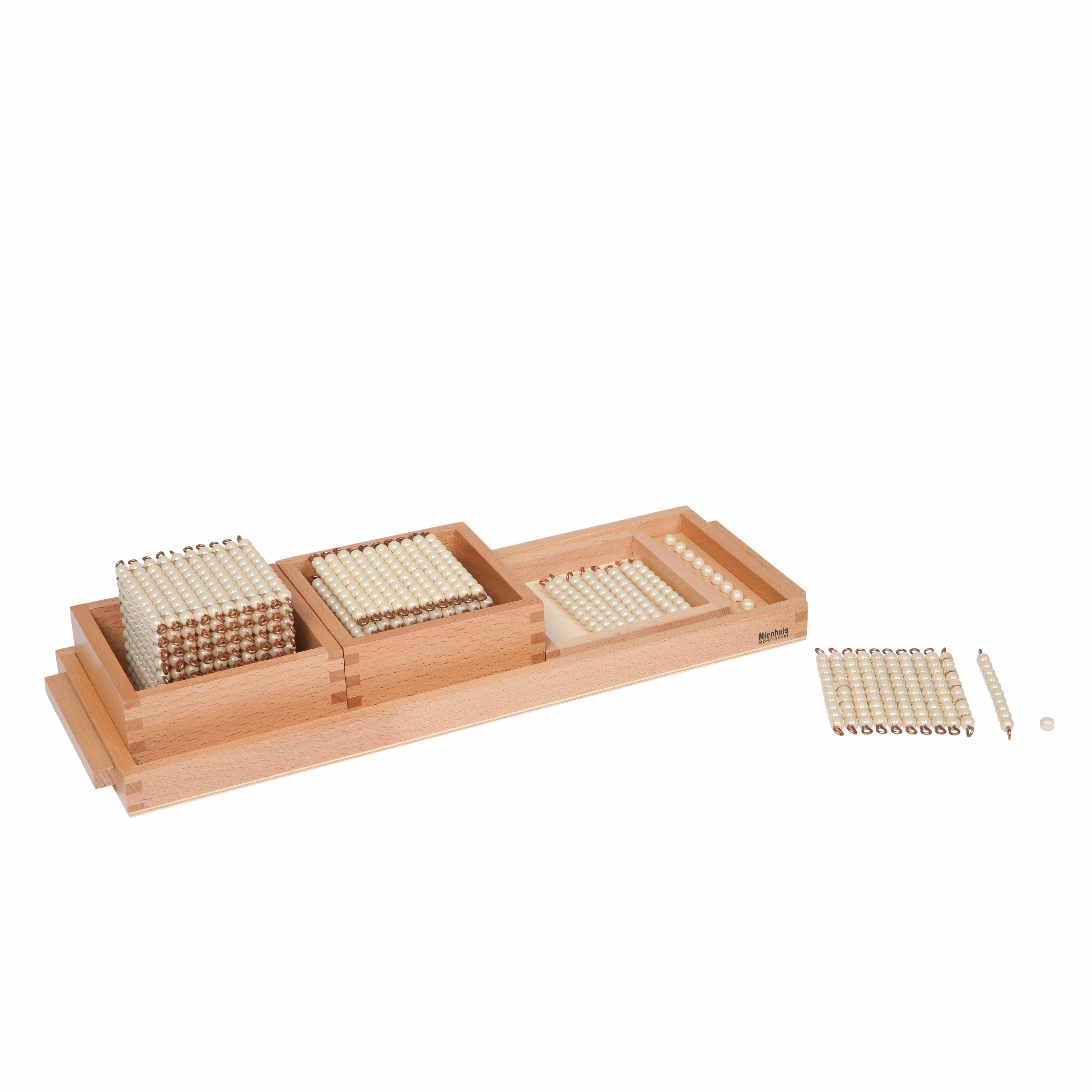
The Introduction To The Decimal System: Individual Beads Glass is a Mathematics Montessori material designed for children aged 3-6, crafted by Nienhuis Montessori to AMI standards.
This premium Introduction to Decimal System material features lustrous golden glass beads meticulously arranged in a multi-compartment wooden tray, providing concrete representations of units, tens (bars), hundreds (squares), and thousands (cubes). The glass beads on metal wire offer exceptional durability and a satisfying weight that helps children internalize the hierarchical nature of our decimal system through sensorial exploration.
“Children display a universal love of mathematics, which is par excellence the science of precision, order, and intelligence.”— Maria MontessoriThe Discovery of the Child
“The greatest sign of success for a teacher is to be able to say, 'The children are now working as if I did not exist.'”
— Maria Montessori, The Absorbent Mind
The Introduction to Decimal System with its lustrous golden glass beads creates a physical bridge between the child's concrete mind and abstract mathematical concepts. Each glass bead, bar, square, and cube in the wooden tray represents a specific quantity that children can touch, hold, and manipulate, making the base-ten system tangible. The weight of the glass beads provides crucial sensorial feedback as children discover that ten individual beads equal one ten-bar, ten bars form a hundred-square, and ten squares create a thousand-cube. This hierarchical arrangement in compartmented wood allows young learners to physically experience how our number system builds upon itself. The golden glass material captures light and attention, drawing children to explore mathematical relationships through their hands before their minds fully grasp the abstraction. By handling these precise glass representations, children construct their understanding of place value from direct sensorial experience rather than memorization.
Each order includes everything needed for proper presentation and long-term use.
Follow the Montessori method of presentation for optimal child development.
Introduce the unit bead, letting the child hold one golden glass bead
Present the ten-bar, counting each bead while running fingers along it
Show the hundred-square, demonstrating it contains ten ten-bars
Present the thousand-cube, showing how ten hundred-squares stack to form it
Practice exchanging: ten units for one ten-bar, ten bars for one hundred-square
Every material is carefully selected for durability, safety, and authentic Montessori experience.
The lustrous golden glass provides weight and beauty, making abstract mathematical concepts tangible and memorable for young learners.
The wooden compartmentalized tray reflects Montessori's emphasis on natural materials and organized presentation.
Each material supports multiple areas of child development simultaneously.
Physical manipulation of beads builds foundational understanding of place value and the base-ten system.
Hierarchical bead arrangements support pattern recognition and systematic thinking essential for advanced mathematics.
The weight and visual differences between units, tens, hundreds, and thousands enhance mathematical comprehension through multiple senses.
Designed for child-sized hands
Professional tips from AMI-trained guides to maximize the educational value of this material.
“Allow ample time for sensorial exploration - the weight and feel of glass beads provides essential feedback”
Model careful handling of glass materials while trusting children's capability with proper introduction
'unit,' 'ten,' 'hundred,' 'thousand' rather than informal terms
Store beads in their designated compartments to reinforce the hierarchical organization
Everything you need to know about this material.
Glass beads provide superior sensorial feedback through their weight and cool temperature, helping children better internalize mathematical concepts. The lustrous golden finish and satisfying heft of glass beads create a more impressive and memorable learning experience, while their durability ensures they maintain their beauty through years of classroom use.
Children begin by handling and counting individual unit beads, then explore ten-bars, hundred-squares, and thousand-cubes. This concrete manipulation builds a strong sensorial foundation for place value. As they work with the material, they naturally discover patterns and relationships, eventually transitioning to written numbers and abstract operations while maintaining their concrete understanding.
This material introduces place value, the hierarchical nature of the decimal system, and the relationship between units, tens, hundreds, and thousands. Children learn counting, skip counting, building large numbers, decomposing numbers, and the foundation for all four mathematical operations through hands-on exploration and manipulation.
Montessori recognizes that young children have remarkable mathematical minds when concepts are presented concretely. The glass beads allow 3-6 year olds to physically handle and see quantities, making abstract concepts tangible. This age represents a sensitive period for order and precision, making it ideal for introducing the systematic nature of our number system.
Begin with a three-period lesson introducing unit, ten-bar, hundred-square, and thousand-cube. Allow extensive exploration time for children to feel the weight differences and count beads. Progress to building numbers, exchanging activities, and simple operations. The key is following the child's interest while ensuring they experience the material's sensorial qualities fully.
Can't find what you're looking for?
Contact Our Experts
Share your experience with this material and help other educators and parents.


