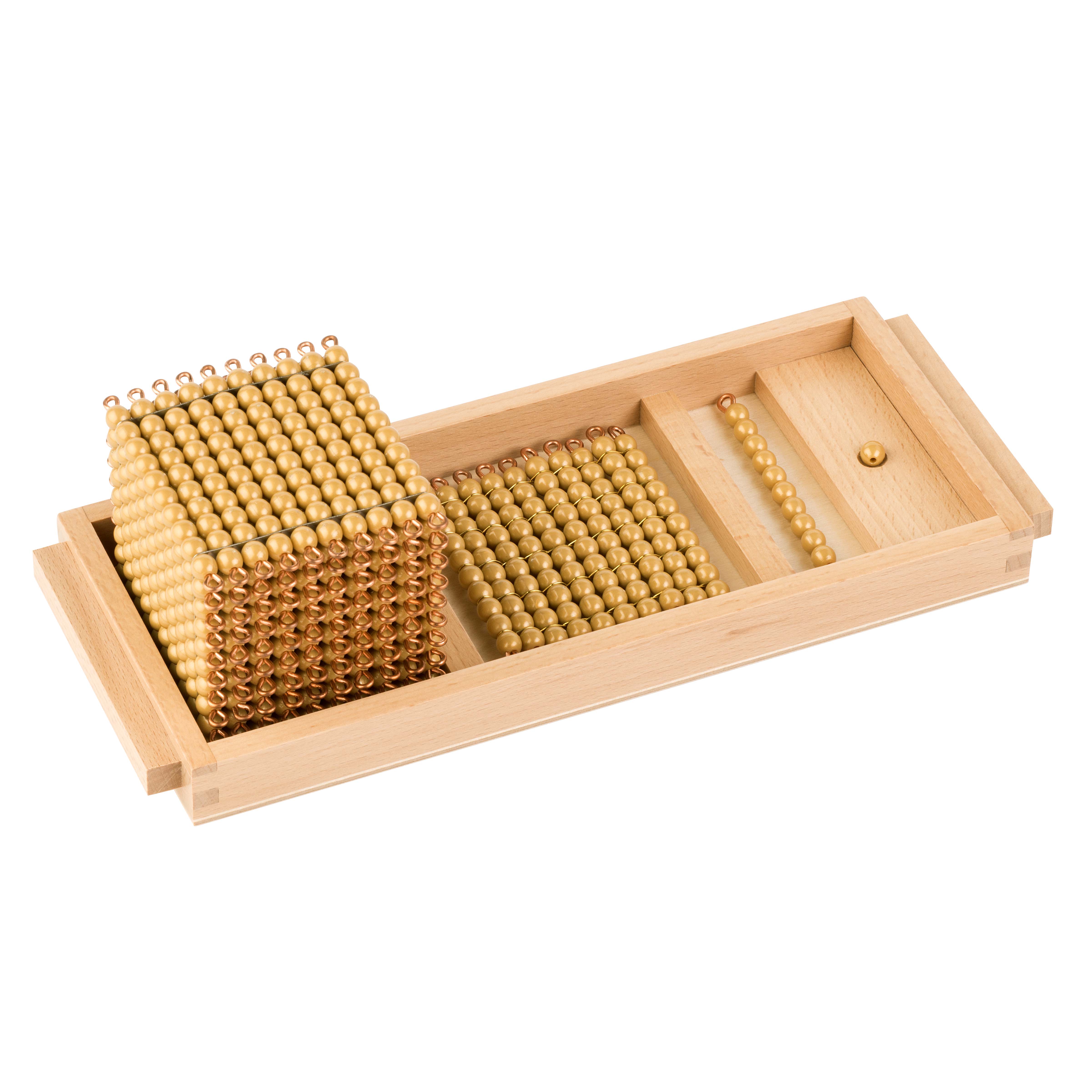
The Introduction To Decimal Quantity: Individual Beads Nylon is a Mathematics Montessori material designed for children aged 3-6, crafted by Nienhuis Montessori to AMI standards.
This essential decimal quantity material features golden-colored nylon beads mounted on wire frames, housed in a wooden storage tray with sliding lid. The individual beads and bead bars provide concrete representations of units through thousands, allowing children to physically manipulate decimal quantities while building foundational understanding of the base-ten system.
“Children display a universal love of mathematics, which is par excellence the science of precision, order, and intelligence.”— Maria MontessoriThe Discovery of the Child
“The greatest sign of success for a teacher is to be able to say, 'The children are now working as if I did not exist.'”
— Maria Montessori, The Absorbent Mind
The Introduction to Decimal Quantity material with its golden-colored nylon beads creates a bridge between concrete counting and abstract numerical understanding. Each bead and bead bar in this set represents a specific quantity that children can touch, move, and arrange, transforming the abstract concept of place value into tangible experience. The golden beads' consistent size and weight provide sensorial feedback that reinforces quantity relationships - ten unit beads equal one ten-bar, ten ten-bars equal one hundred-square. This decimal quantity material addresses the child's developmental need to understand how our number system is organized, offering physical manipulation of units, tens, hundreds, and thousands. The nylon beads' durability ensures countless repetitions as children explore exchanging, combining, and comparing quantities. Through handling these golden beads, children discover patterns in our base-ten system before encountering written numerals, building a concrete foundation for all future mathematical operations.
Each order includes everything needed for proper presentation and long-term use.
Follow the Montessori method of presentation for optimal child development.
Introduce unit beads by counting them one by one into the child's hand
Count out ten unit beads, then show the ten-bar, demonstrating they represent the same quantity
Build quantities using different combinations (e.g., 23 using two ten-bars and three units)
Practice exchanging: when accumulating ten units, exchange for one ten-bar
Every material is carefully selected for durability, safety, and authentic Montessori experience.
The solid wood construction provides a durable home for the decimal materials, with smooth sliding action that children can operate independently.
Each material supports multiple areas of child development simultaneously.
Concrete manipulation of decimal quantities builds deep understanding of place value and the base-ten number system.
Progresses from concrete bead handling to abstract number concepts through repeated sensorial experience.
Precise handling of individual beads and bead bars refines pincer grip and hand-eye coordination.
Systematic work with decimal quantities develops sustained focus and attention to mathematical relationships.
Designed for child-sized hands
Professional tips from AMI-trained guides to maximize the educational value of this material.
“Store extra unit beads separately for easy access during exchange activities”
Check that wire frames are intact before presentations to ensure beads don't slide off
always say 'unit' not 'one', 'ten-bar' not 'ten'
Allow ample time for free exploration after initial presentations
Everything you need to know about this material.
This set includes individual golden nylon beads representing units (1), tens (10-bead bars), hundreds (100-bead squares), and thousands (1000-bead cubes), all mounted on wire frames and stored in a wooden tray with sliding lid for organized storage.
Children physically handle and count the beads to understand place value concepts. They can exchange 10 units for a ten-bar, 10 ten-bars for a hundred-square, and 10 hundred-squares for a thousand-cube, experiencing the base-ten system through concrete manipulation.
Nylon beads are more durable, lightweight, and safer for young children aged 3-6. They maintain the golden color and tactile experience of traditional Montessori materials while being less prone to breakage and easier for small hands to manipulate.
This material introduces place value, decimal system hierarchy, counting to 1000, skip counting, basic addition and subtraction with regrouping, and the foundation for understanding large numbers through hands-on exploration of quantities.
By providing concrete representations of abstract numbers, children develop a deep understanding of quantity and place value. This sensorial experience creates a strong foundation for later work with the golden bead material, stamp game, and eventual abstract mathematical operations.
Can't find what you're looking for?
Contact Our Experts
Share your experience with this material and help other educators and parents.


