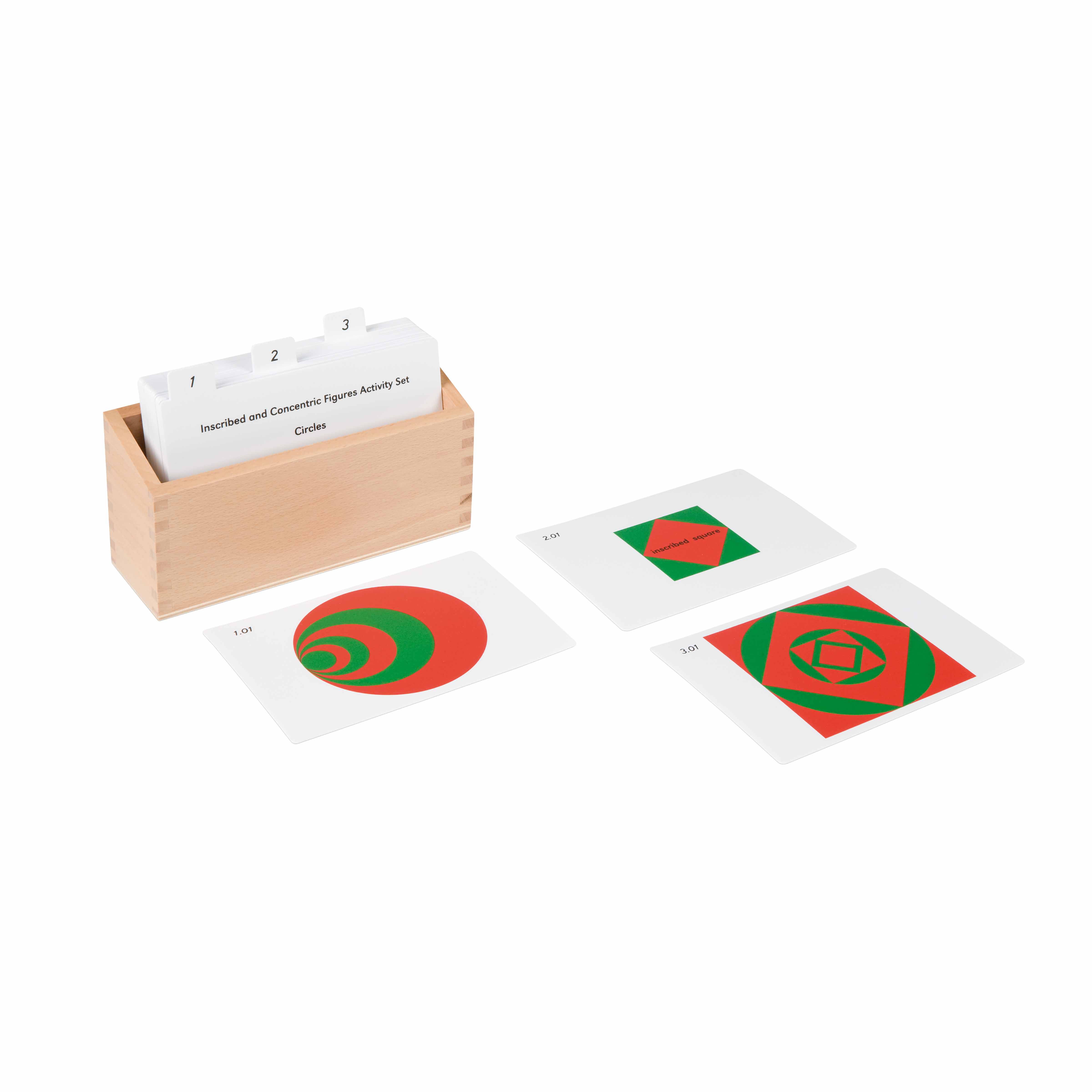
The Inscribed And Concentric Figures Activity Set is a Educational Materials Montessori material designed for children aged 3-6, crafted by Nienhuis Montessori to AMI standards.
This inscribed and concentric figures activity set introduces children to complex geometric relationships through carefully sequenced task cards. The numbered cards progress from simple to complex patterns, helping children discover how circles and squares can be inscribed within or arranged concentrically around each other. Stored in a compartmentalized wooden box, this material supports the development of geometric reasoning and visual discrimination essential for later mathematical understanding.
“The child is both a hope and a promise for mankind.”— Maria MontessoriEducation and Peace
“The hands are the instruments of man's intelligence.”
— Maria Montessori, The Absorbent Mind
The Inscribed And Concentric Figures Activity Set serves a precise mathematical purpose in the Montessori classroom, addressing the child's developmental need to understand spatial relationships between geometric forms. Each numbered task card in this set presents circles and squares in specific arrangements—either inscribed within one another or arranged concentrically—allowing children to discover these relationships through direct manipulation and observation. The compartmentalized wooden box provides ordered storage that mirrors the sequential nature of geometric discovery, from simple single-figure relationships to complex multi-layered patterns. This material bridges the gap between the concrete geometric cabinet work and abstract geometric theorems, appearing when children demonstrate readiness to explore how shapes interact spatially. The progression from basic inscribed circles within squares to complex concentric arrangements satisfies the mathematical mind's need for pattern recognition and logical sequence.
Each order includes everything needed for proper presentation and long-term use.
Follow the Montessori method of presentation for optimal child development.
Present card #1 showing a simple inscribed figure. Trace the outer shape with your finger, then the inner shape
Invite the child to trace both figures, noting how one fits perfectly inside the other
Progress to cards showing concentric figures. Trace from the center outward
Allow independent exploration with subsequent cards, increasing in complexity
Every material is carefully selected for durability, safety, and authentic Montessori experience.
The wooden storage box teaches children to care for materials while providing a sensorial experience through the warmth and texture of natural wood.
Each material supports multiple areas of child development simultaneously.
Children discover relationships between shapes as they explore how circles and squares can be inscribed within or arranged concentrically around each other.
Comparing inscribed and concentric figures develops the ability to perceive subtle differences in spatial relationships.
Understanding these geometric concepts lays groundwork for later studies in geometry, including radius, diameter, and proportional relationships.
The numbered progression from simple to complex patterns supports logical thinking and the ability to follow increasingly challenging sequences.
Designed for child-sized hands
Professional tips from AMI-trained guides to maximize the educational value of this material.
“Present this material after solid work with the geometric cabinet and constructive triangles”
inscribed, concentric, circumscribed—avoid simplifying terms
Connect to cultural studies by showing inscribed figures in architecture and art
Keep a set of tracing paper nearby for children who want to copy and overlay figures
Everything you need to know about this material.
This set teaches children about inscribed shapes (shapes drawn inside other shapes) and concentric figures (shapes sharing the same center point). Through hands-on exploration with task cards, children learn how circles fit inside squares, squares inside circles, and how multiple shapes can share a common center, building foundational geometry understanding.
The numbered task cards follow a carefully planned sequence from simple to complex. Beginning cards might show a single circle inside a square, progressing to multiple concentric circles, then advancing to combinations of inscribed and concentric figures. This gradual progression ensures children master basic concepts before moving to more challenging geometric relationships.
Children develop visual discrimination, spatial reasoning, pattern recognition, and geometric vocabulary. They also strengthen fine motor control through tracing activities, enhance concentration through focused work, and build logical thinking by observing relationships between shapes. These skills directly support later mathematical learning in geometry and spatial concepts.
The wooden box features separate compartments that keep task cards organized by difficulty level, making it easy for children to select appropriate work independently. This organization supports the Montessori principle of self-directed learning, allows children to return materials properly, and helps teachers quickly assess which concepts students have explored.
Extensions include tracing the figures onto paper, creating their own inscribed and concentric designs, using compass and ruler to construct geometric patterns, exploring these concepts in art projects, finding examples in architecture or nature, and combining with other geometry materials to discover more complex relationships between shapes.
Can't find what you're looking for?
Contact Our Experts
Share your experience with this material and help other educators and parents.


