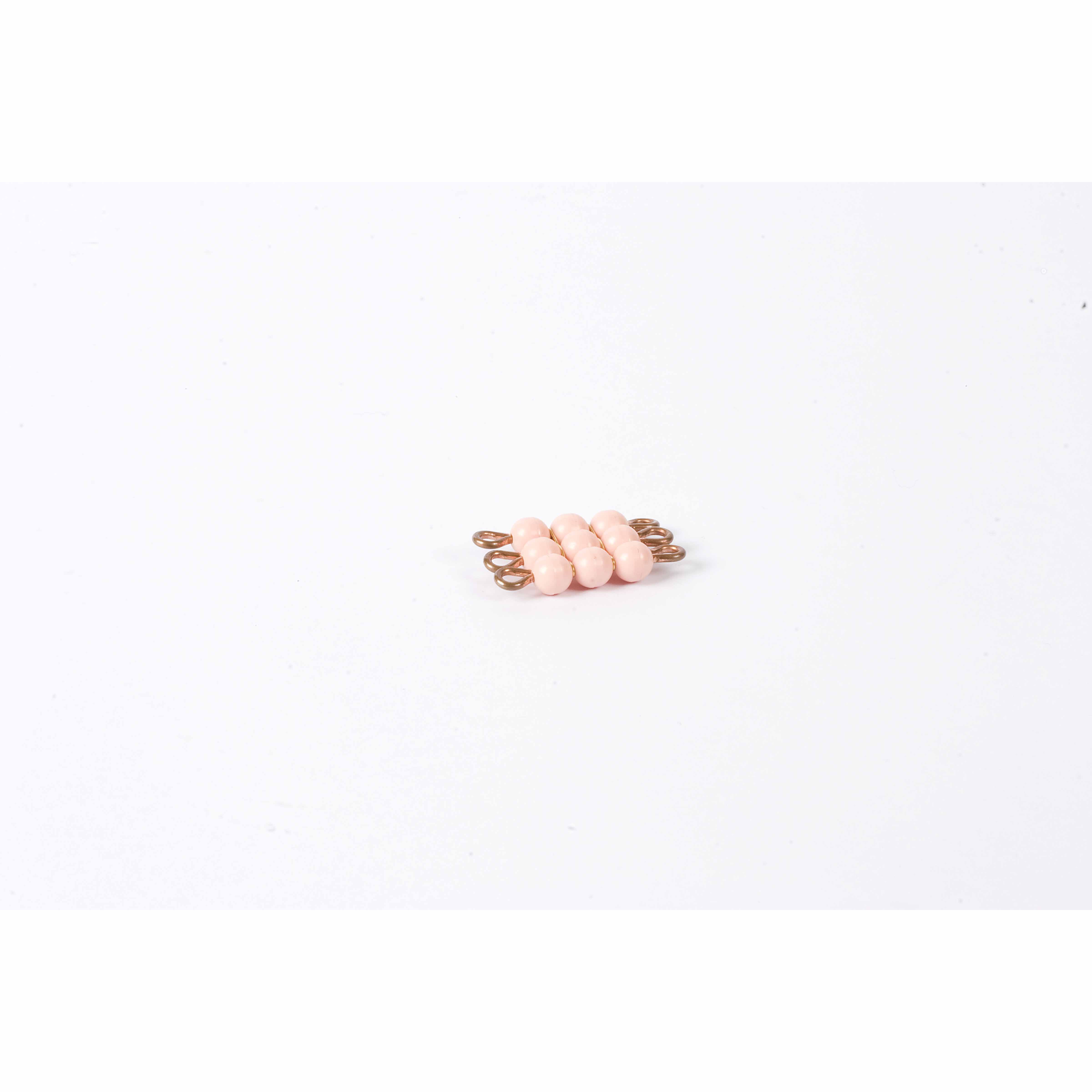
The Individual Nylon Bead Square Of 3: Pink is a Mathematics Montessori material designed for children aged 3-6, crafted by Nienhuis Montessori to AMI standards.
This individual nylon bead square represents the mathematical concept of 3², featuring nine pink beads arranged in a precise 3x3 formation on metal wires. Essential for the Montessori bead cabinet work, this manipulative allows children to physically explore squared numbers, supporting the transition from concrete to abstract mathematical understanding through tactile exploration and visual representation.
“Children display a universal love of mathematics, which is par excellence the science of precision, order, and intelligence.”— Maria MontessoriThe Discovery of the Child
“The greatest sign of success for a teacher is to be able to say, 'The children are now working as if I did not exist.'”
— Maria Montessori, The Absorbent Mind
The Individual Nylon Bead Square of 3 embodies Maria Montessori's principle that mathematical concepts become accessible through sensorial experience. This pink bead square transforms the abstract notion of 3² into a tangible reality—nine beads arranged in perfect symmetry that children can touch, count, and manipulate. Within the bead cabinet sequence, this specific square serves as a bridge between counting individual beads and comprehending multiplication as repeated addition. The pink coloring of these nine beads creates a distinct visual memory, helping children internalize that squaring means creating equal rows and columns. By handling this bead square repeatedly, children discover that 3² equals 3+3+3 and 3×3 simultaneously. The metal wire construction allows children to feel the rigid structure of squared numbers while the nylon beads provide smooth tactile feedback. This mathematical manipulative addresses the developmental need for concrete representations before symbolic understanding, allowing the child's mathematical mind to construct knowledge through direct manipulation rather than abstract explanation.
Each order includes everything needed for proper presentation and long-term use.
Follow the Montessori method of presentation for optimal child development.
Invite the child to feel the bead square, running fingers along each row
Count the beads in the first row together: 'One, two, three'
Ask: 'How many beads in the second row?' Count together again
Count all nine beads, touching each one systematically
Introduce language: 'This is the square of three. Three rows of three makes nine'
Every material is carefully selected for durability, safety, and authentic Montessori experience.
Sourced from sustainably managed European forests. Beechwood is chosen for its exceptional durability, smooth grain, and natural warmth that invites touch.
Natural, unbleached cotton in child-friendly colors. The fabric provides the right amount of friction for developing fingers while being gentle on sensitive skin.
Water-based, child-safe finish that meets the strictest European safety standards. Designed to withstand years of daily use without chipping or peeling.
Each material supports multiple areas of child development simultaneously.
Physically represents 3² = 9, allowing children to see and touch the square number relationship.
Develops ability to recognize square formations and relate them to numerical values.
Introduces squaring as repeated addition (3+3+3) through concrete manipulation.
Bridges concrete bead work to abstract understanding of exponential notation.
Designed for child-sized hands
Professional tips from AMI-trained guides to maximize the educational value of this material.
“Store bead squares in sequence within the bead cabinet—visual progression supports mathematical understanding”
Combine with bead bars of 3 to show how three threes create the square formation
'square of three' not 'three squared' to match material naming
Allow extensive repetition—children often need 20+ presentations before abstraction occurs
Everything you need to know about this material.
The pink bead square of 3 visually and tactilely demonstrates the concept of 3² (3 squared = 9), helping children understand that squaring means multiplying a number by itself. It provides a concrete representation of abstract mathematical concepts, essential for building a strong foundation in algebra and geometry.
Children use the bead square to explore squared numbers through hands-on manipulation. They can count the beads, trace the square formation with their fingers, compare it with other bead squares and cubes, and use it alongside the bead chains to understand the relationship between linear counting and squared numbers.
Yes, the nylon beads are specifically chosen for their durability and resistance to wear. The beads are securely strung on metal wires in a rigid square formation, making them suitable for repeated handling by young children in both classroom and home environments.
This bead square is part of the complete Montessori bead cabinet system. It works alongside the pink bead chain of 9, the cube of 3 (27 beads), other colored bead squares (1-10), and number labels. Together, these materials create a comprehensive system for exploring powers of numbers.
Children typically begin working with bead squares around age 4-5, after they have mastered linear counting with bead chains and have a solid understanding of numbers 1-10. The material remains useful through age 6 and beyond as children explore more complex mathematical relationships and prepare for abstract multiplication.
Can't find what you're looking for?
Contact Our Experts
Share your experience with this material and help other educators and parents.


