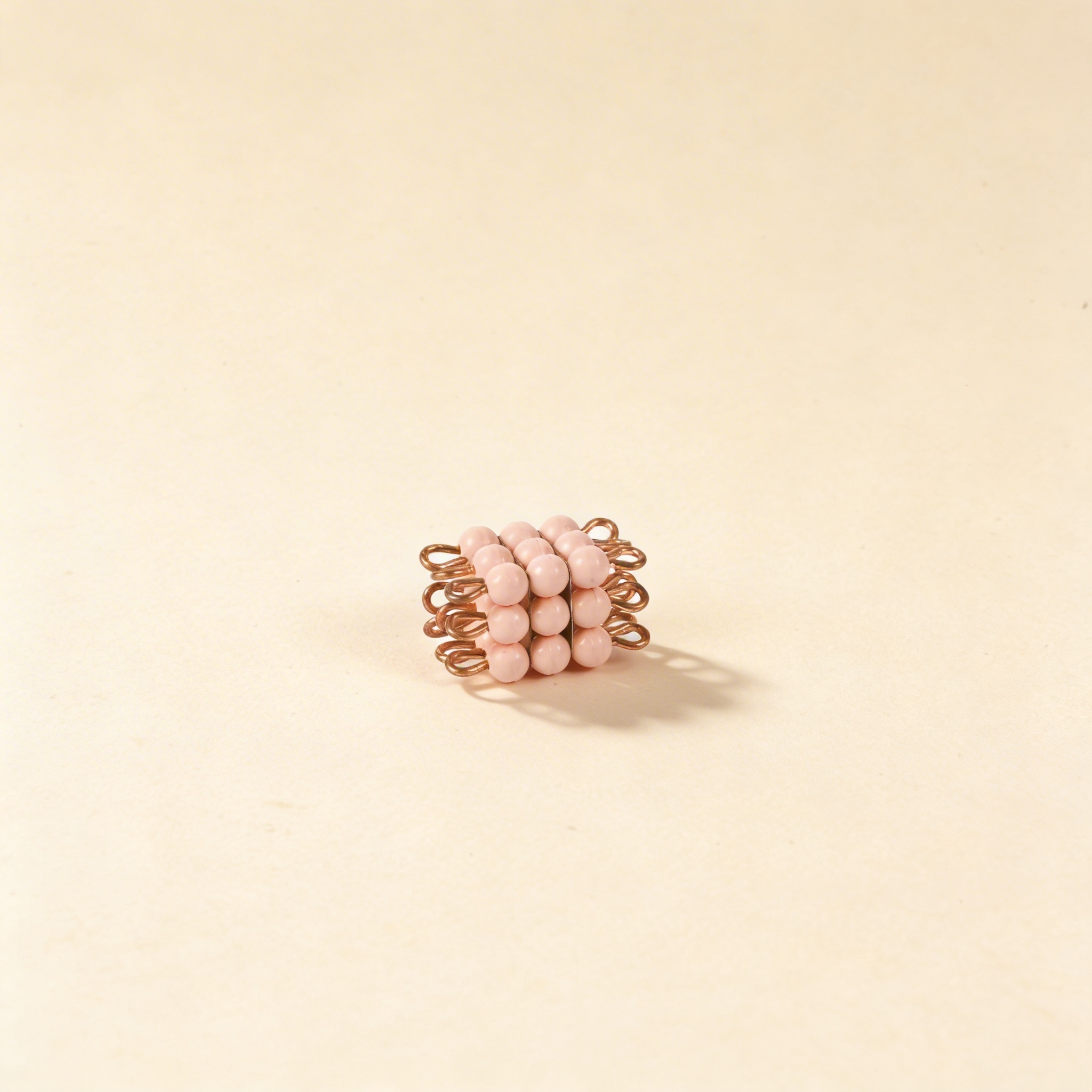
The Bead Cube of 3 — Pink Individual Nylon Cube for Mathematics is a Sensorial Montessori material designed for children aged 3-6, crafted by Nienhuis Montessori to AMI standards.
This individual pink bead cube represents the concrete visualization of 3³ (27 units), an essential component of the Montessori bead materials for teaching mathematical concepts. The cube features 27 uniform pink beads arranged in a 3×3×3 formation, held together by metal wires with loop ends for easy handling and connection to other bead materials.
“Education is a natural process spontaneously carried out by the human individual, and is acquired not by listening to words but by experiences upon the environment.”— Maria MontessoriEducation for a New World
“The child is both a hope and a promise for mankind.”
— Maria Montessori, Education and Peace
The Pink Bead Cube of 3 embodies Maria Montessori's principle of making abstract mathematical concepts concrete through manipulative materials. This sensorial material allows children to physically experience the concept of cubing through visual and tactile exploration. By holding and examining the cube, children internalize the relationship between linear, square, and cubic dimensions before formal mathematical instruction begins. The material's precise construction—27 individual beads arranged in perfect cubic form—satisfies the child's need for order while developing mathematical intuition. The pink color designation follows the Montessori color-coding system, creating visual consistency across materials. This concrete representation of 3³ serves as a bridge between sensorial exploration and mathematical abstraction, preparing the mathematical mind through hands-on experience.
Each order includes everything needed for proper presentation and long-term use.
Follow the Montessori method of presentation for optimal child development.
Invite the child to carry the cube with both hands to the mat
Place the cube gently on the mat and invite exploration through touch
Count the beads along one edge together: 'One, two, three'
Show how 3 beads on each edge creates layers of 9 beads
Connect to previous work by comparing with the third cube of the pink tower
Every material is carefully selected for durability, safety, and authentic Montessori experience.
Each bead is uniformly sized to ensure accurate mathematical representation and consistent sensorial experience.
Each material supports multiple areas of child development simultaneously.
Concrete representation of cubing and powers of three supports understanding of volume and multiplication.
Tactile experience of counting and feeling the cubic structure develops spatial awareness.
Bridges concrete manipulation to abstract mathematical concepts through hands-on exploration.
Designed for child-sized hands
Professional tips from AMI-trained guides to maximize the educational value of this material.
“Present this material only after the child has mastered linear counting and bead squares”
Store the cube at child's eye level to encourage visual familiarity before handling
'cube,' 'edge,' 'face' rather than informal terms
Connect this work to the geometric solids, particularly when exploring the cube form
Everything you need to know about this material.
The pink bead cube of 3 provides a concrete, visual representation of 3³ (3x3x3=27), helping children understand cubing concepts through sensorial exploration. It's used to introduce powers of numbers and prepare children for more advanced mathematical concepts like volume and algebraic thinking.
This is a single replacement or supplementary cube containing 27 pink beads in a 3×3×3 formation. It can be purchased individually for replacing lost pieces, creating extensions, or for focused work on the concept of cubing without needing the entire bead cabinet.
This material is designed for children ages 3-6, aligning with the sensitive period for order and mathematical concepts. Children at this age benefit from concrete manipulatives that allow them to physically explore abstract mathematical ideas through their senses.
The metal wires with loop ends provide durability and allow children to handle the cube easily without beads falling apart. The loops enable connection to other bead materials for extended activities and help children maintain the cube's structural integrity during manipulation.
Children can count the beads to verify 27 units, compare it with linear and square representations, build the cube of 3 using unit beads, explore patterns in cube construction, and use it alongside other bead materials to understand the relationship between linear counting, squaring, and cubing.
Can't find what you're looking for?
Contact Our Experts
Share your experience with this material and help other educators and parents.
Bundle related materials and save. Free curriculum guide included with every set.


