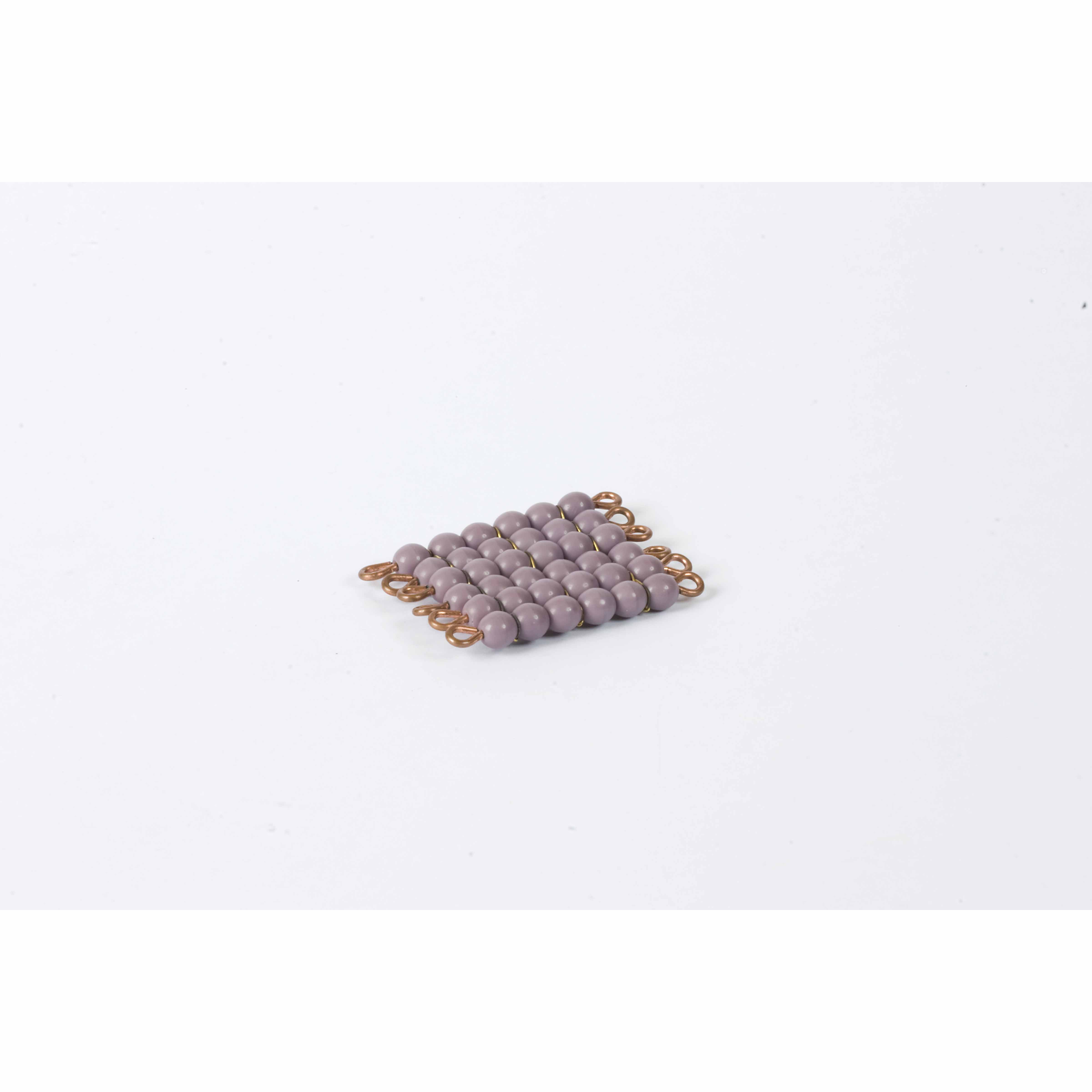
The Individual Glass Bead Square Of 6: Purple is a Mathematics Montessori material designed for children aged 3-6, crafted by Nienhuis Montessori to AMI standards.
This Individual Glass Bead Square of 6 presents the mathematical concept of six squared through a precise arrangement of 36 purple glass beads. The beads are interconnected with gold-colored metal rings to form a stable 6×6 grid, providing a tactile representation of multiplication and square numbers that children can manipulate and explore.
“Children display a universal love of mathematics, which is par excellence the science of precision, order, and intelligence.”— Maria MontessoriThe Discovery of the Child
“The greatest sign of success for a teacher is to be able to say, 'The children are now working as if I did not exist.'”
— Maria Montessori, The Absorbent Mind
The Individual Glass Bead Square of 6 embodies the Montessori principle of making abstract mathematical concepts concrete through sensorial experience. Each of the 36 purple glass beads in this square provides tactile feedback as children count, allowing them to physically experience six squared rather than merely memorizing it. The gold-colored metal rings connecting these beads create a flexible yet stable structure that children can bend and manipulate, helping them understand that 6×6 remains 36 whether the beads form a perfect square or are gently curved. This purple bead square serves as a bridge between the concrete manipulation of individual beads and the abstract understanding of square numbers. The glass material of each bead offers weight and texture that engages the child's sense of touch while they explore multiplication. By holding and counting these 36 interconnected beads, children discover mathematical relationships through their own exploration rather than through adult explanation.
Each order includes everything needed for proper presentation and long-term use.
Follow the Montessori method of presentation for optimal child development.
Invite the child to count all beads in the square, touching each one
Count one row of 6 beads, then show how there are 6 rows total
Demonstrate skip counting by 6s while pointing to each row: 6, 12, 18, 24, 30, 36
Gently curve the bead square to show it still contains 36 beads
Have the child draw the square pattern on paper and label it '6 squared = 36'
Every material is carefully selected for durability, safety, and authentic Montessori experience.
The smooth glass beads provide weight and substance to mathematical concepts, making abstract numbers tangible for young learners.
The gold-colored metal rings create flexible yet stable connections, allowing the square to maintain its shape while being handled.
Each material supports multiple areas of child development simultaneously.
Visualizes square numbers and multiplication concepts through concrete manipulation.
Supports learning to count by 6s through the organized bead arrangement.
Develops understanding of mathematical patterns and relationships in square formations.
Enhances dexterity through careful handling and counting of individual beads.
Designed for child-sized hands
Professional tips from AMI-trained guides to maximize the educational value of this material.
“Store bead squares flat in individual compartments to prevent tangling of the metal rings”
Introduce this material after children are comfortable with the bead chains of 6
Create a 'square number book' where children can record their discoveries with each bead square
'six squared' or 'six times six' to reinforce the concept
Everything you need to know about this material.
This material introduces squared numbers (6²=36), skip counting by 6s, multiplication facts of 6, area concepts, and the relationship between linear and square measurements. It provides a concrete representation of abstract mathematical ideas.
Children use the bead square to count individual beads, skip count rows or columns by 6s, explore the concept of 6×6=36, compare it with other bead squares, and transition from concrete to abstract understanding of square numbers.
In Montessori mathematics, purple represents the number 6 in the color-coded bead system. The gold-colored metal rings create a stable, interconnected grid that maintains the square shape while allowing flexibility for manipulation and exploration.
Children can count all 36 beads, trace the square's perimeter, compare linear counting (6) to area counting (36), use it with number cards for matching exercises, and combine it with other bead materials for advanced multiplication work.
This material is typically introduced after children have worked with the bead chains and understand linear counting. It bridges the gap between concrete counting and abstract multiplication, usually around ages 4-6 when children are ready for squared number concepts.
Can't find what you're looking for?
Contact Our Experts
Share your experience with this material and help other educators and parents.


