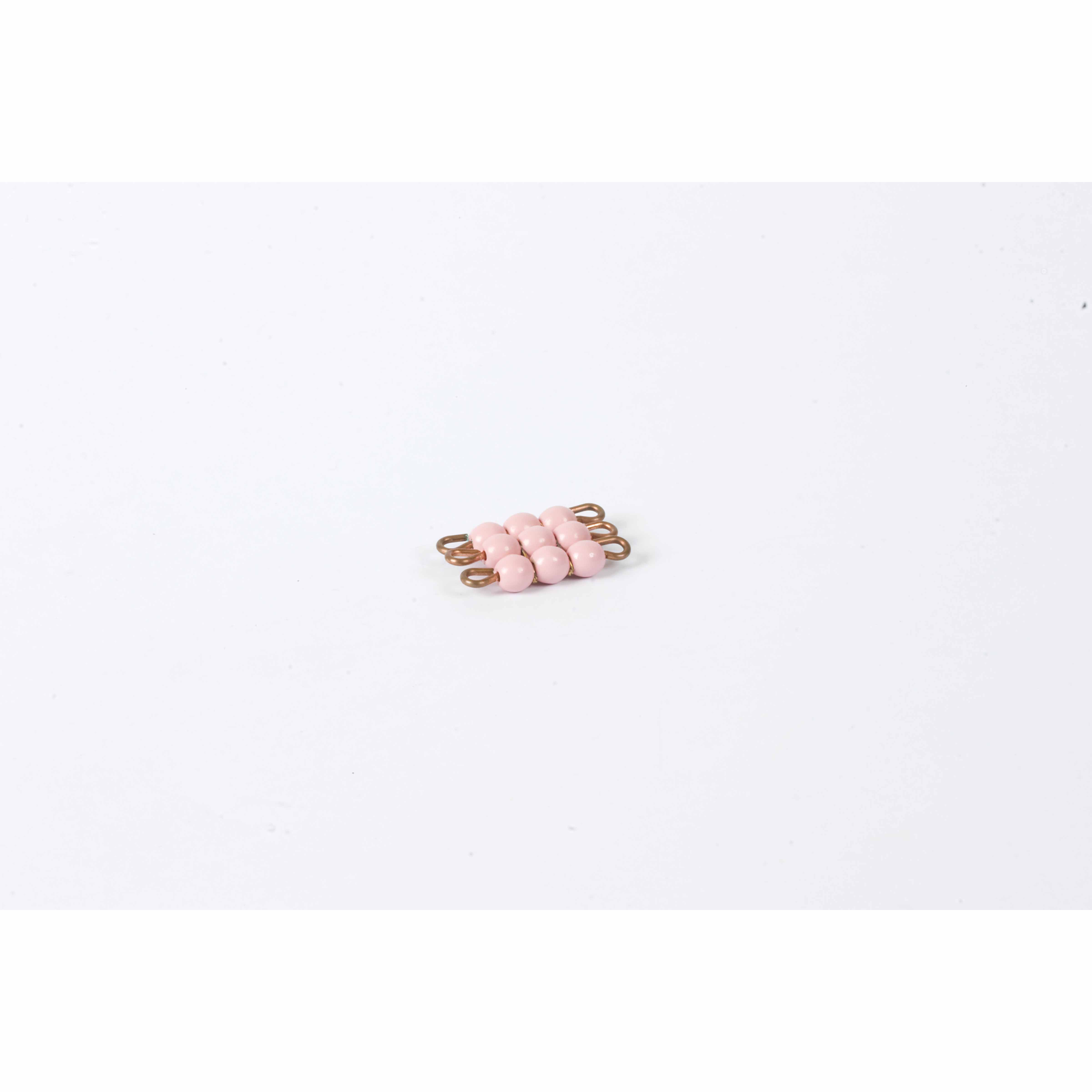
The Individual Glass Bead Square Of 3: Pink is a Mathematics Montessori material designed for children aged 3-6, crafted by Nienhuis Montessori to AMI standards.
This pink glass bead square represents the mathematical concept of 3², visually demonstrating that three squared equals nine through a concrete 3x3 arrangement. Part of the Montessori bead materials, this individual square supports children's understanding of squaring numbers and serves as a building block for more complex mathematical operations involving powers and algebraic concepts.
“Children display a universal love of mathematics, which is par excellence the science of precision, order, and intelligence.”— Maria MontessoriThe Discovery of the Child
“The greatest sign of success for a teacher is to be able to say, 'The children are now working as if I did not exist.'”
— Maria Montessori, The Absorbent Mind
The Individual Glass Bead Square of 3 embodies Montessori's principle of making abstract mathematical concepts tangible through sensorial experience. This pink bead square transforms the abstract notation 3² into a concrete reality that children can touch, count, and manipulate. The glass beads' weight and texture provide sensory feedback that reinforces the mathematical concept of squaring, while the pink color creates a distinct visual memory for the square of three. By physically handling these nine beads arranged in a perfect square formation, children internalize that multiplication represents repeated addition in a spatial dimension. The Individual Glass Bead Square of 3 serves as a crucial bridge between concrete counting and abstract algebraic thinking, allowing young mathematicians to discover that 3² means three groups of three through their own exploration. This pink square becomes a reference point for understanding powers, preparing children for more complex operations while respecting their need for concrete manipulation before abstraction.
Each order includes everything needed for proper presentation and long-term use.
Follow the Montessori method of presentation for optimal child development.
Invite the child to count the beads along one edge of the square
Count the beads along the perpendicular edge, noting both edges have three
Count all nine beads systematically, row by row
Introduce the language: 'This is three squared, or three times three'
Have the child recreate the square using loose beads
Every material is carefully selected for durability, safety, and authentic Montessori experience.
The smooth glass beads provide sensorial feedback while maintaining the traditional Montessori aesthetic. Their uniform size ensures mathematical accuracy in representing the square of three.
Each material supports multiple areas of child development simultaneously.
Provides concrete representation of squaring, helping children visualize that 3² means 3 groups of 3.
The square formation helps children recognize geometric patterns and understand area concepts.
Introduces the concept of powers through manipulative materials before abstract notation.
The tactile nature of counting and handling beads reinforces numerical concepts through touch.
Designed for child-sized hands
Professional tips from AMI-trained guides to maximize the educational value of this material.
“Store the glass bead square in a designated place to maintain its special significance in the mathematics area”
Introduce this material after children are comfortable with linear counting and basic multiplication concepts
'three squared' rather than 'three to the power of two' initially
Allow children to discover that rearranging nine beads always makes a 3x3 square through experimentation
Everything you need to know about this material.
The pink bead square visually represents 3² (three squared), showing that 3 x 3 = 9 through a concrete arrangement of 9 beads in a 3x3 formation. This helps children understand the concept of squaring numbers through hands-on manipulation.
Children use this square to explore squaring concepts concretely before moving to abstraction. It's typically introduced after children understand linear counting and is used alongside other bead squares to discover patterns in squared numbers and prepare for work with the bead chains and cubing materials.
While suitable for ages 3-6, this material is typically introduced around age 4-5, after children have mastered counting to 10 and have experience with the golden bead material. The exact timing depends on each child's individual development and readiness.
This square works with the complete set of bead squares (1-10), bead chains, bead cubes, and the bead cabinet. It also connects to the colored bead bars, hundred board, and later to the squaring and cubing chains for advanced mathematical exploration.
In Montessori mathematics, each number 1-10 has a specific color coding. Pink represents the number 3 throughout all bead materials, creating consistency that helps children recognize and work with the number 3 across different mathematical concepts and materials.
Can't find what you're looking for?
Contact Our Experts
Share your experience with this material and help other educators and parents.


