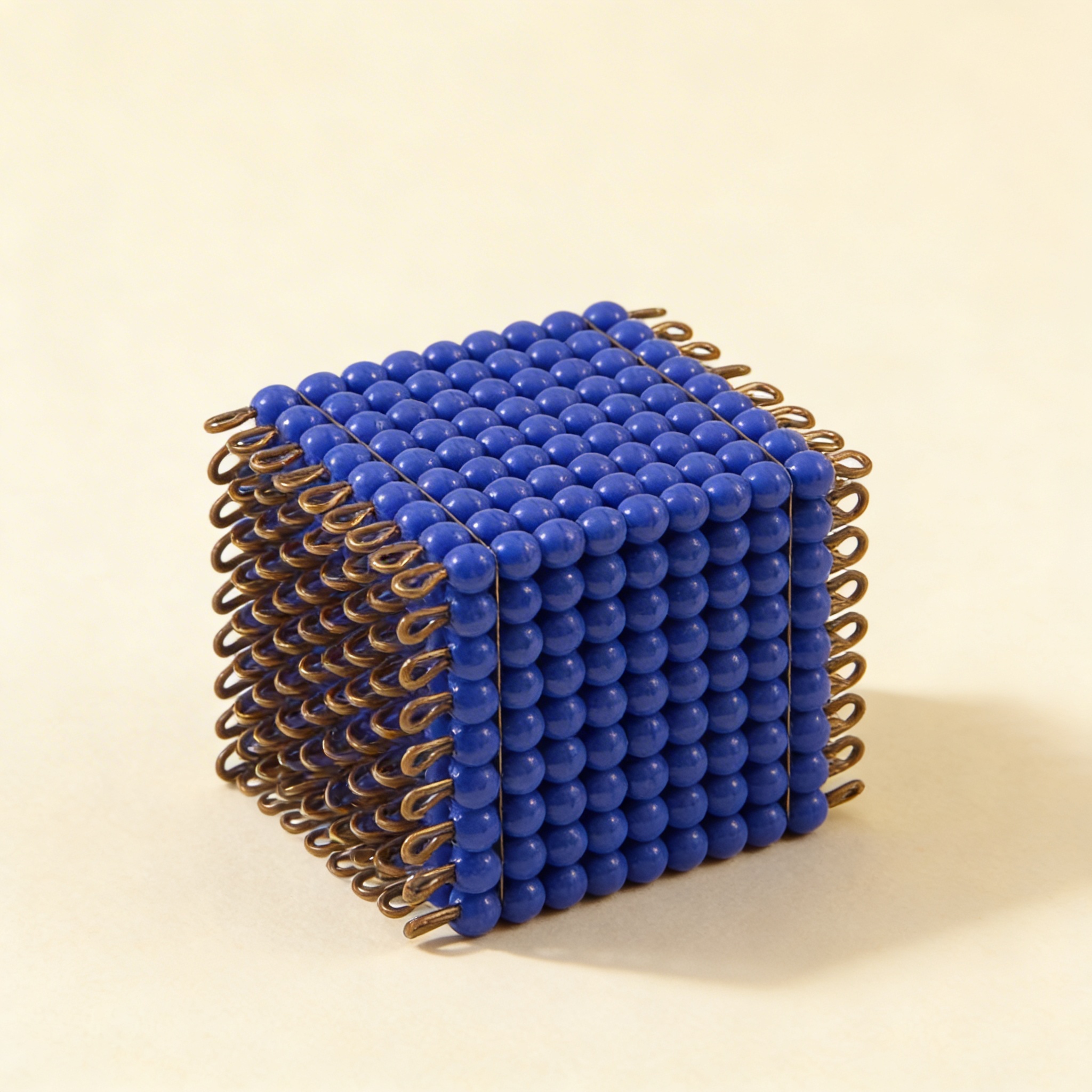
The Glass Bead Cube of 9 — Dark Blue Wire Frame Representing 729 Units is a Sensorial Montessori material designed for children aged 3-6, crafted by Nienhuis Montessori to AMI standards.
This Individual Glass Bead Cube of 9 represents 9³ (729) through precisely arranged dark blue glass beads on a metal wire framework. Part of the Montessori bead material sequence, this cube provides a concrete, visual representation of the mathematical concept of cubing, allowing children to physically explore volume and the power of nine through sensorial manipulation.
“The senses, being explorers of the world, open the way to knowledge.”— Maria MontessoriThe Discovery of the Child
“Children display a universal love of mathematics, which is par excellence the science of precision, order, and intelligence.”
— Maria Montessori, The Discovery of the Child
The Glass Bead Cube of 9 embodies Montessori's principle of materialized abstraction, where complex mathematical concepts become tangible through precise sensorial experience. This material bridges the concrete and abstract by allowing children to physically hold and examine 729 individual beads arranged as 9³. Through this sensorial exploration, children absorb the mathematical relationship between linear, square, and cubic dimensions before formally understanding these concepts. The material's beauty and precision appeal to the child's mathematical mind, fostering what Montessori called 'materialized abstractions.' The cube serves as a concrete representation that will later support the child's understanding of cubing in mathematics, demonstrating how sensorial experiences in early childhood lay the foundation for abstract thinking.
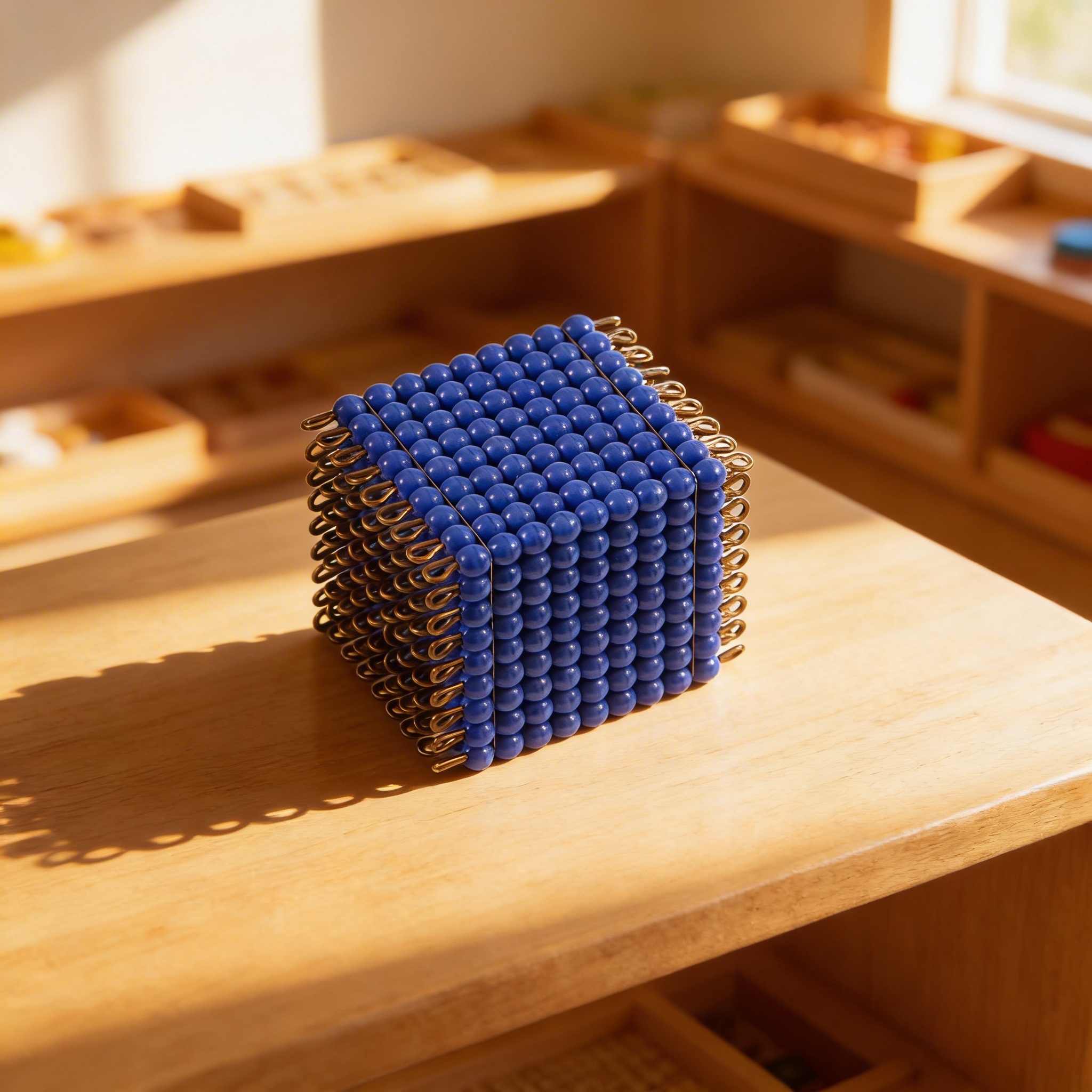
Each order includes everything needed for proper presentation and long-term use.
Follow the Montessori method of presentation for optimal child development.
Invite the child, saying 'I'd like to show you something special.' Carefully carry the cube with both hands to the mat.
Place the cube gently on the mat. Sit to the child's right. Pause and observe the cube together in silence.
Slowly trace the edges of the cube with your index finger, following each dimension.
Invite the child to feel the weight of the cube by carefully lifting it with both hands.
If appropriate, count one edge: '1, 2, 3, 4, 5, 6, 7, 8, 9.' Show how each edge has 9 beads.
Return the cube to its designated place on the shelf with the same care.
Every material is carefully selected for durability, safety, and authentic Montessori experience.
The smooth glass beads provide consistent weight and texture, allowing children to feel the substantial nature of 729 units while the translucent quality adds visual depth to the mathematical concept.
Each material supports multiple areas of child development simultaneously.
Bridges concrete manipulation to abstract understanding of cubing and volume through visual and tactile exploration.
Develops three-dimensional thinking as children examine the cube from different angles and understand its construction.
The precise arrangement of 729 beads captivates attention and promotes sustained focus on mathematical relationships.
Designed for child-sized hands
Professional tips from AMI-trained guides to maximize the educational value of this material.
“Present this material only after the child has worked extensively with the bead chains and squares”
Observe the child's handling carefully - readiness includes gentle, purposeful movements with other materials
Connect this work to the geometric solids, particularly comparing to the geometric cube
Document the child's observations and any spontaneous mathematical discoveries
Everything you need to know about this material.
This dark blue glass bead cube represents 9³ or 9 cubed, which equals 729. It provides a concrete, three-dimensional visualization of the mathematical concept of cubing, allowing children to physically see and touch what 9×9×9 looks like in bead form.
This cube of 9 is part of the comprehensive bead material sequence that includes cubes from 1³ to 10³. It works alongside bead chains, squares, and other cubes to help children understand the relationships between linear counting, squaring, and cubing, building a foundation for advanced mathematical concepts.
In Montessori mathematics, dark blue consistently represents the number 9 across all materials. This color coding helps children recognize patterns and make connections between different mathematical materials, reinforcing the concept of 9 whether working with bead bars, chains, squares, or cubes.
Children explore the cube sensorially by holding and examining it from different angles, counting the beads along edges (9 beads per edge), and comparing it to the bead square of 9 and bead chain of 9. They may also use it for skip counting exercises, understanding volume concepts, and discovering the relationship between 9² and 9³.
The price reflects the precision craftsmanship required to create exactly 729 individual glass beads perfectly arranged on a durable metal wire framework. Each bead must be uniform in size and securely positioned to maintain the cube's mathematical accuracy and withstand years of classroom handling while preserving its educational value.
Can't find what you're looking for?
Contact Our Experts
Share your experience with this material and help other educators and parents.
Bundle related materials and save. Free curriculum guide included with every set.


