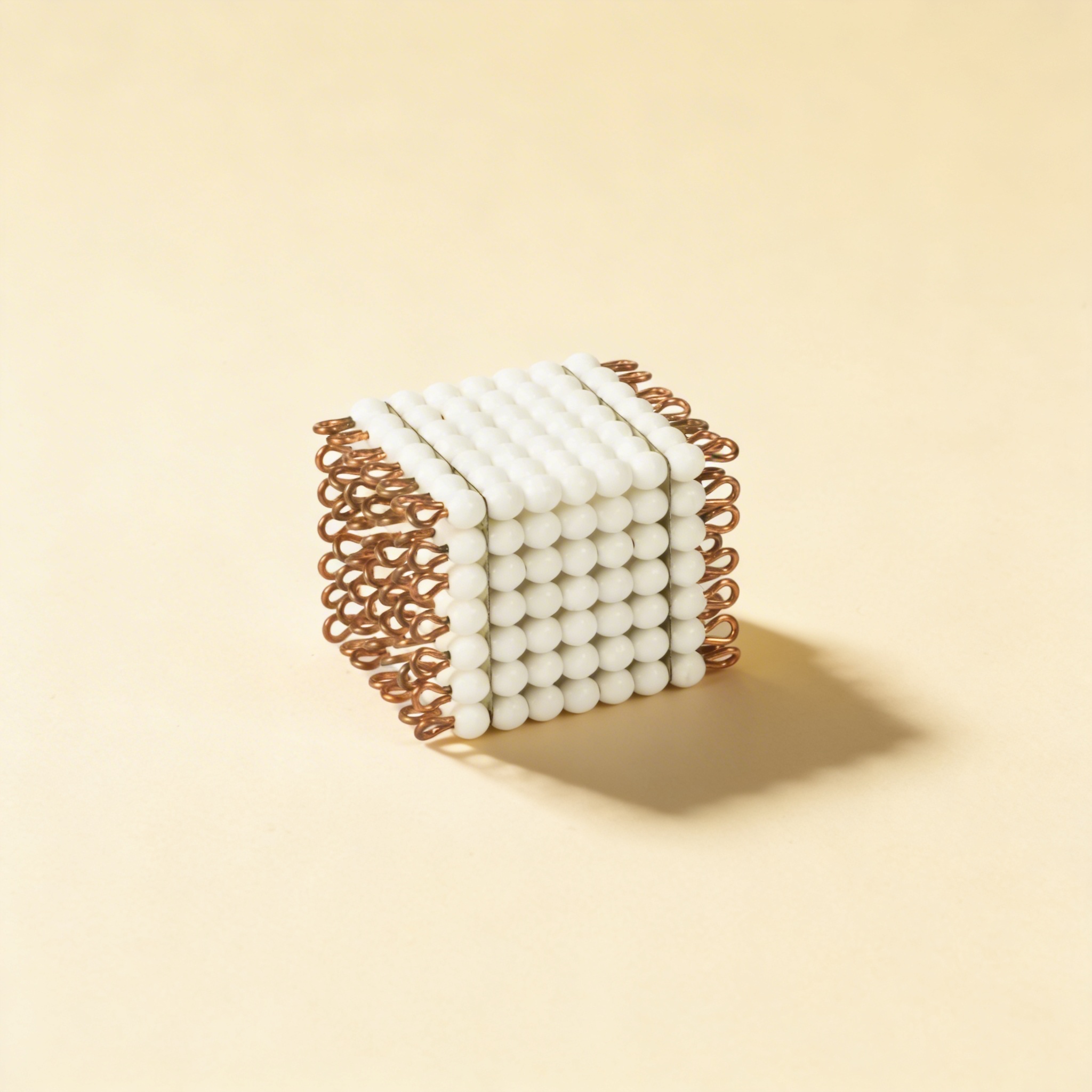
The Glass Bead Cube of 7 — White Individual Beads for 7³ Concept is a Sensorial Montessori material designed for children aged 3-6, crafted by Nienhuis Montessori to AMI standards.
This Individual Glass Bead Cube of 7 represents the concrete manifestation of seven cubed (7³ = 343), essential for the child's mathematical abstraction journey in the Casa dei Bambini. The white glass beads strung on copper wire create a tangible representation of cubic numbers, bridging the gap between concrete sensorial experience and abstract mathematical concepts through the child's manipulation and exploration.
“Free the child's potential, and you will transform him into the world.”— Maria MontessoriTo Educate the Human Potential
“Education is a natural process spontaneously carried out by the human individual, and is acquired not by listening to words but by experiences upon the environment.”
— Maria Montessori, Education for a New World
The Individual Glass Bead Cube of 7 embodies Montessori's principle of materialized abstraction, where mathematical concepts become tangible through precisely crafted materials. This cube represents 343 individual beads, allowing the child to physically experience the weight, dimension, and reality of seven cubed. Through sensorial exploration, children internalize mathematical relationships before formal operations are introduced. The material's beauty and precision appeal to the child's mathematical mind, fostering concentration and repetition. By handling this concrete representation, children build neural pathways that later support abstract thinking. The cube serves as a bridge between the sensorial and mathematical areas, demonstrating Montessori's integrated curriculum where materials in one area prepare the child for work in another.
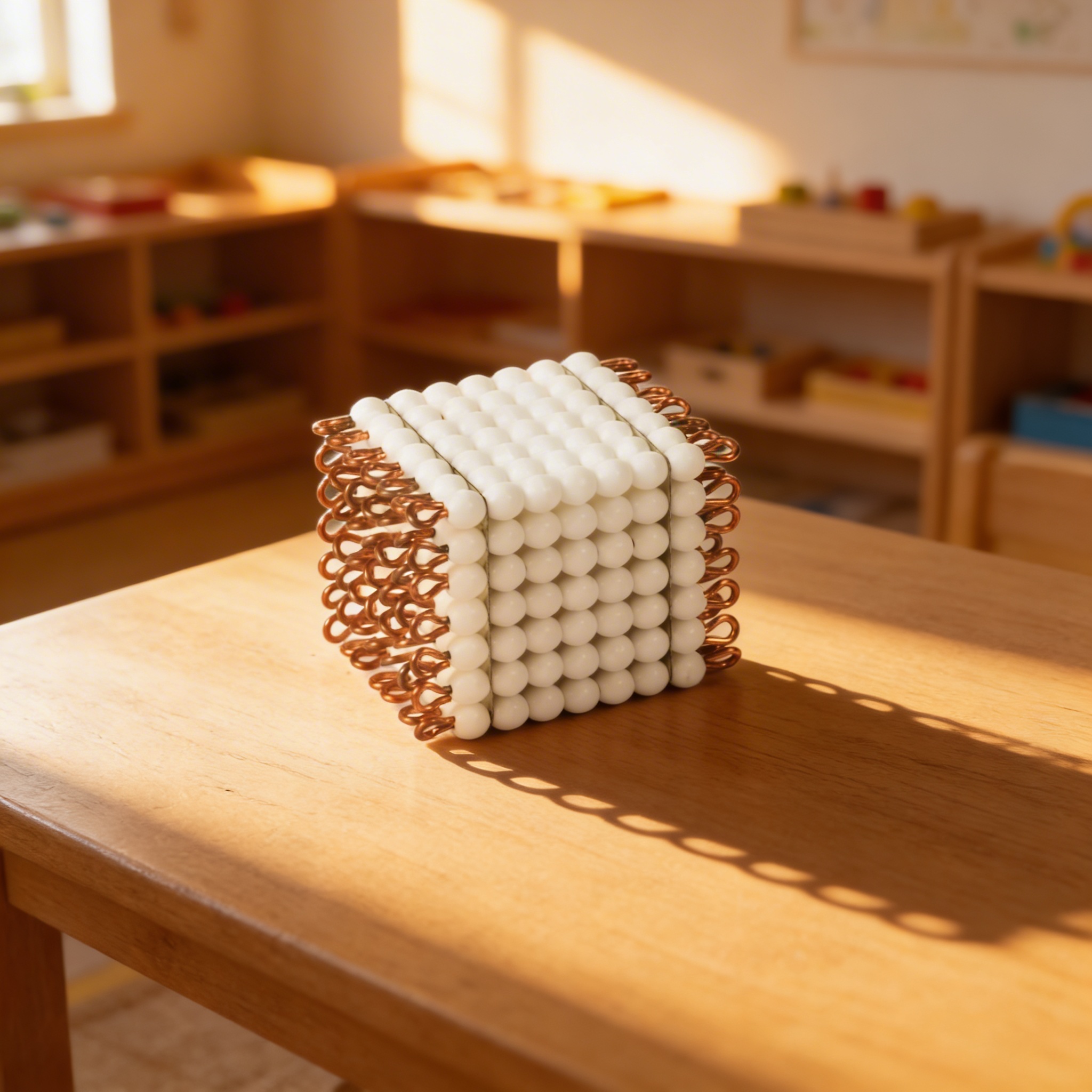
Each order includes everything needed for proper presentation and long-term use.
Follow the Montessori method of presentation for optimal child development.
Invite the child to carry the cube with both hands, feeling its weight
Explore the cube's dimensions by running fingers along each edge
Compare with the seventh cube of the pink tower if available
Count the beads on one face: 7 x 7 = 49
Introduce the concept that the whole cube contains 7 x 7 x 7 beads
Every material is carefully selected for durability, safety, and authentic Montessori experience.
The smooth, uniform glass beads provide consistent weight and tactile feedback, essential for the child's sensorial exploration of quantity and mathematical relationships.
Each material supports multiple areas of child development simultaneously.
Concrete representation of cubing helps children understand powers of numbers through sensorial experience before abstract notation.
The three-dimensional cube structure develops spatial awareness and understanding of geometric relationships.
Physical manipulation of cubic numbers prepares the mathematical mind for later algebraic concepts and binomial/trinomial work.
Designed for child-sized hands
Professional tips from AMI-trained guides to maximize the educational value of this material.
“Present this material only after the child has worked extensively with the sensorial cubes and has shown readiness for mathematical abstraction”
Connect this work to the child's previous experiences with the number 7 in other materials like the colored bead stairs
Observe whether the child is ready for the abstraction - some may benefit from first working with smaller cubes (3³ or 4³)
'cube', 'cubed', 'seven cubed', avoiding casual terms
Everything you need to know about this material.
This cube represents 7³ (seven cubed), which equals 343 individual beads. It provides a concrete, tangible way for children to understand cubic numbers and the concept of volume through hands-on exploration.
By physically handling and counting the 343 beads arranged in a 7x7x7 cube, children internalize the concept of cubic numbers through sensorial experience. This concrete manipulation creates a strong foundation for later abstract mathematical understanding.
White glass beads provide visual clarity and uniformity, allowing children to focus on the mathematical concept without distraction. The beads' weight and texture offer important sensorial feedback, while the copper wire maintains the cube's structural integrity during handling.
Children can count the beads, explore the cube's dimensions, compare it with other bead materials, use it for skip counting by 7s, and incorporate it into mathematical operations. It's particularly valuable for understanding powers, multiples, and geometric concepts.
This material is typically introduced after children have worked with the bead chains and squares, usually around age 4-5. They should have a solid understanding of linear and square concepts before exploring cubic representations.
Can't find what you're looking for?
Contact Our Experts
Share your experience with this material and help other educators and parents.
Bundle related materials and save. Free curriculum guide included with every set.


