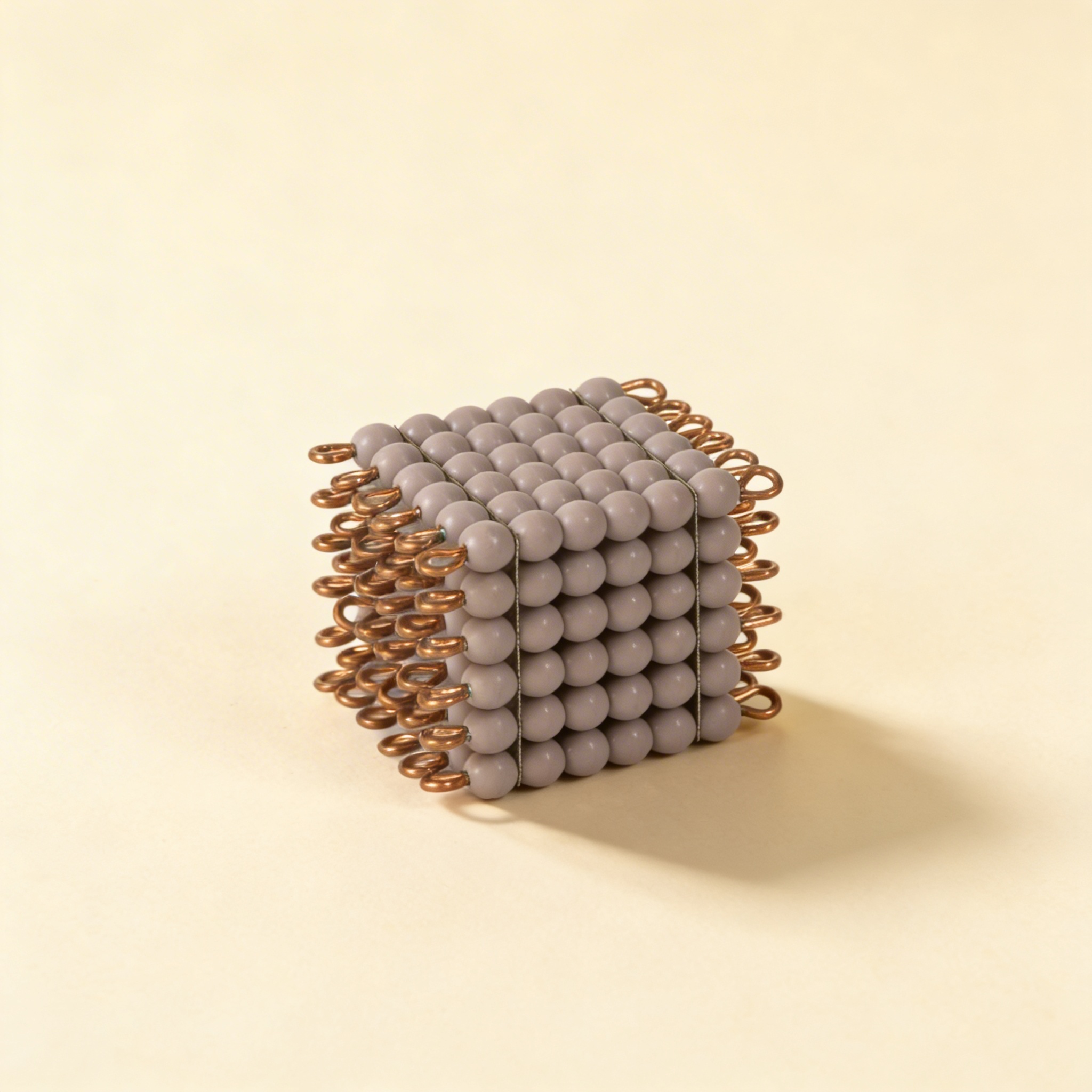
The Glass Bead Cube of 6 — Purple Cube for Mathematical Visualisation is a Sensorial Montessori material designed for children aged 3-6, crafted by Nienhuis Montessori to AMI standards.
This exquisite purple glass bead cube represents the concrete manifestation of 6³ (216), serving as a tactile and visual bridge between abstract mathematical concepts and physical reality. Part of the bead material progression, this cube allows children to explore the relationship between linear, square, and cubic dimensions through sensorial experience, preparing them for advanced mathematical work in the elementary years.
“Education is a natural process spontaneously carried out by the human individual, and is acquired not by listening to words but by experiences upon the environment.”— Maria MontessoriEducation for a New World
“The child is both a hope and a promise for mankind.”
— Maria Montessori, Education and Peace
The Individual Glass Bead Cube of 6 embodies Maria Montessori's principle of materialized abstraction, where complex mathematical concepts are made tangible through sensorial experience. This purple cube represents 6³ (216 beads), allowing the child to physically hold and examine what would otherwise remain an abstract number. Through this material, the child's mathematical mind is nourished as they transition from concrete to abstract thinking. The weight, texture, and visual beauty of the glass beads engage multiple senses simultaneously, creating neural pathways that support deep mathematical understanding. This material bridges the gap between the sensorial explorations of the Children's House and the more abstract mathematical work of the elementary years, respecting the child's need for concrete manipulation while preparing for intellectual abstraction.
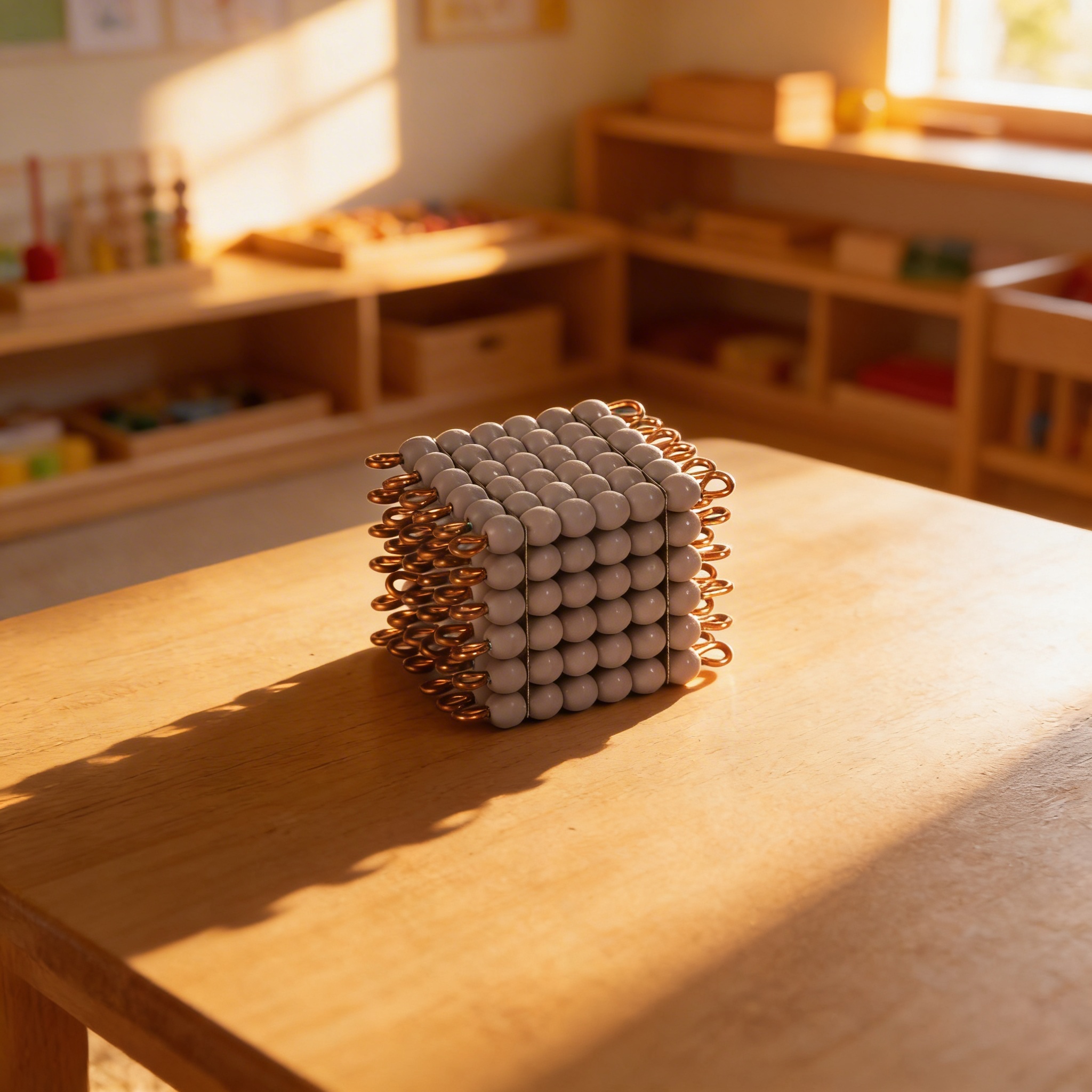
Each order includes everything needed for proper presentation and long-term use.
Follow the Montessori method of presentation for optimal child development.
Invite the child to carefully carry the cube with both hands, feeling its weight
Place the cube on the mat and observe all faces, noting each shows 36 beads
Compare with the bead bar of 6 (linear) and bead square of 6 (two-dimensional)
Count the edge: 1, 2, 3, 4, 5, 6 beads along each dimension
Introduce the language: 'This is 6 cubed, or 6 to the power of 3'
Every material is carefully selected for durability, safety, and authentic Montessori experience.
The distinctive purple color and glass material provide visual and tactile feedback essential for sensorial learning, while the weight helps children appreciate the concept of cubic volume.
Each material supports multiple areas of child development simultaneously.
Provides concrete representation of cubic numbers, preparing for abstract mathematical concepts and algebraic thinking.
The weight and visual presence of 216 beads offers tangible understanding of exponential growth from linear to cubic dimensions.
Examining and counting the structured arrangement develops focus and appreciation for mathematical patterns.
Designed for child-sized hands
Professional tips from AMI-trained guides to maximize the educational value of this material.
“Present this material only after thorough work with bead chains and squares - the child must understand squaring before cubing”
Store the cube at eye level to invite visual appreciation; its beauty draws mathematical interest naturally
Connect to geometric solids work by comparing this mathematical cube to the geometric wooden cube
Document children's discoveries about cubic relationships in their mathematics journals for later reference
Everything you need to know about this material.
The glass bead cube of 6 represents 6³ (216 beads) and helps children physically understand cubic dimensions. Children can count the beads, explore the relationship between 6 linear beads, 6² (36) as a square, and 6³ as a cube, building concrete understanding of exponential growth and volume.
While primarily mathematical, this cube engages multiple senses - children feel its weight (216 beads), see the three-dimensional structure, and experience the smooth glass texture. This sensorial exploration helps children internalize abstract mathematical concepts through concrete, tangible experience.
Children should first work with the golden bead material, understanding units, tens, hundreds, and thousands. They should also be familiar with linear counting and have experience with bead chains and squares. This progression ensures they can appreciate the cubic relationship.
This material bridges primary and elementary work by introducing cubing concepts concretely. It prepares children for understanding powers, volume calculations, and algebraic thinking. The physical manipulation of 216 beads as 6³ creates a sensorial memory for later abstract work.
Yes, this cube is part of a complete bead material system. It can be used alongside bead chains, squares, and other cubes to explore mathematical relationships. Children might compare it with other cubes or use it in skip counting exercises and multiplication work.
Can't find what you're looking for?
Contact Our Experts
Share your experience with this material and help other educators and parents.
Bundle related materials and save. Free curriculum guide included with every set.


